Oana Ruxandra, CEO of PopHatch. Former Chief Digital Officer at Warner Music Group.

If you write songs, there is money being collected in your name right now that you cannot receive until you join a performing rights organization. The choice between the two big ones, ASCAP and BMI, is a near-day-one decision, and most artists make it on a coin flip when a few facts would settle it.
ASCAP and BMI both collect public performance royalties for songwriters and publishers: the money your songs earn when they play on radio, on streaming, on TV, and in venues. ASCAP is a not-for-profit, governed by its members, and free to join as a writer. BMI is a for-profit company, sold to investment firm New Mountain Capital in 2024, and also free to join as a songwriter. Both collect from the same licensees, so the royalty difference across a career is small. ASCAP wins on transparency and a member-owned structure with a one-year term, while BMI pays a bit faster and locks a two-year writer term. You can belong to only one at a time, so pick on structure, term, and transparency rather than on payout. Either is a sound home. The cost of choosing neither is leaving money uncollected.
I spent fifteen years inside the major label system. From where I sat at Warner Music Group, performance royalties were the quiet money artists left on the table more than any other, because the checks arrive from an invisible system most musicians never set up. Joining a PRO is how you turn that system on for yourself.
Here is what these organizations do, how the two differ, and how to choose.
What Is a PRO, and What Does It Collect?
A performing rights organization, or PRO, collects public performance royalties on behalf of songwriters and publishers. A public performance is any time your song is played in public: spun on the radio, streamed on Spotify, used on television, played in a bar, a gym, a store, or performed at a venue. The businesses that use music pay the PRO for a license, and the PRO distributes that money to the writers and publishers whose songs were played.
This is a different pocket from the money you already know. Your streaming recording royalty, the one your distributor collects, pays the owner of the recording. The performance royalty a PRO collects pays the owner of the song, the composition underneath the recording. The same Spotify play generates both, and they reach you through two separate systems, which is why an artist can collect their streaming money and still be missing the performance side.
A PRO covers the songwriter and the publisher shares of performance income. If you have not set up a publishing entity, you can still join as a writer and collect the writer share, which is the bigger and simpler half to start with. The performance royalty is one of the four kinds of music royalties your music earns, and it is the one a PRO exists to capture.
What a PRO Does Not Collect?
A PRO collects only public performance royalties on the songwriting side, so several other income streams need their own setups. Knowing the gaps is how you avoid assuming one membership has you fully covered.
A PRO does not collect your recording royalties from streaming. Those are the master side of a stream, and your distributor collects them. A PRO also does not collect mechanical royalties, the separate songwriting royalty owed when your song is reproduced or streamed, which in the United States flow through the Mechanical Licensing Collective or a publishing administrator. Learning to collect your mechanical royalties is a separate task from joining a PRO.
It also does not handle sync fees, the money from placing your music in film, television, or ads, which you or a sync agent negotiate directly. And it does not collect neighboring rights, the performance royalties owed to the recording owner and the performers, which in the United States run through SoundExchange rather than a PRO.
The takeaway is that a PRO is one piece of a larger collection map. Joining one captures your public performance songwriting money, and a complete setup also covers the master royalties, the mechanicals, the sync income, and the neighboring rights, each through its own door. The piece on the four kinds of music royalties lays out how they fit together.
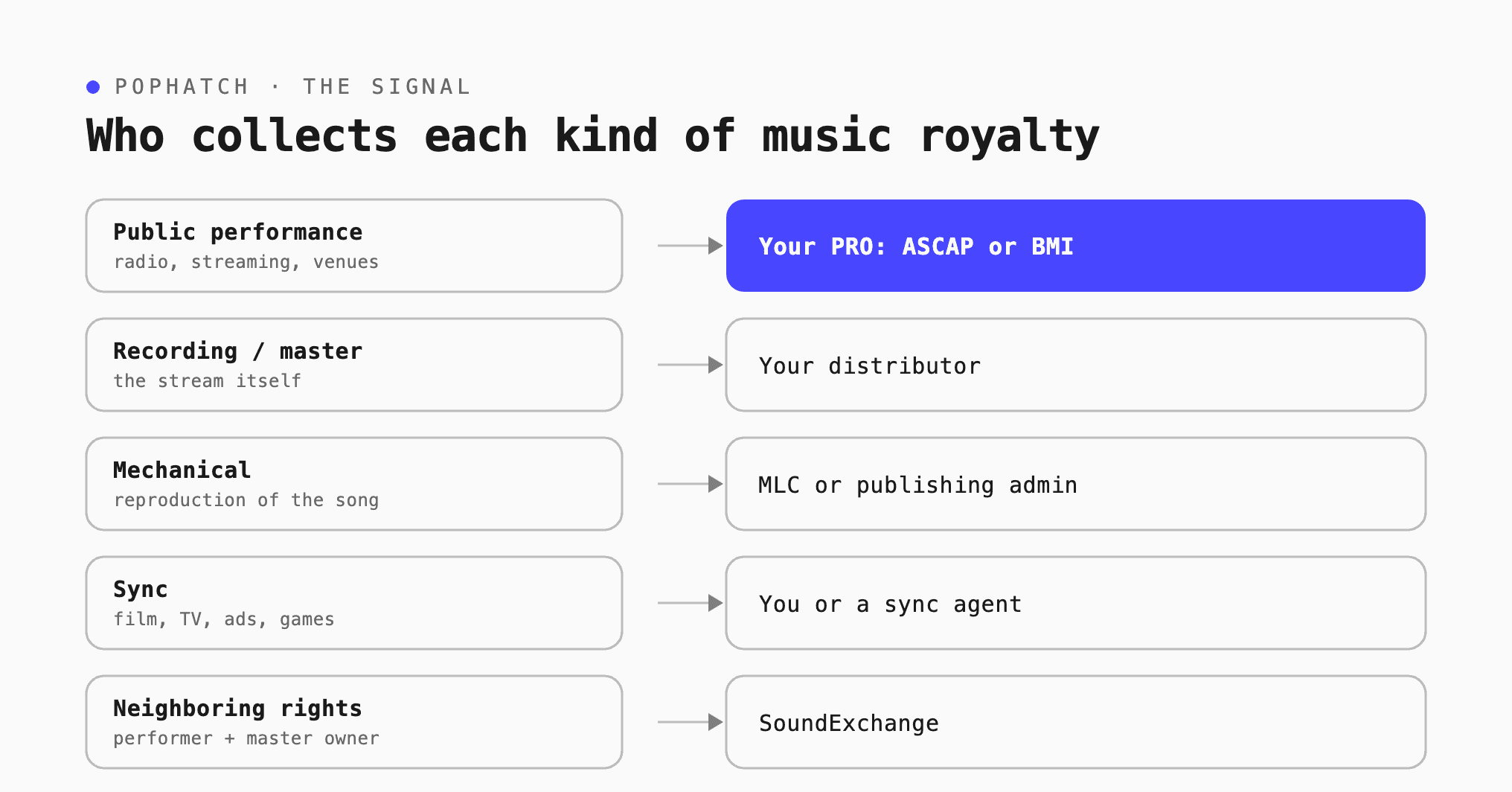
Map of who collects each kind of music royalty: public performance from radio, streaming, and venues goes to your PRO, ASCAP or BMI; recording or master royalties from the stream itself go to your distributor; mechanical royalties go to the MLC or a publishing admin; sync fees from film, TV, and ads go to you or a sync agent; and neighboring rights go to SoundExchange.
What Is ASCAP?
ASCAP is a not-for-profit performing rights organization owned and governed by its songwriter and publisher members. ASCAP describes itself as the only American PRO founded and run by its members, and the only not-for-profit among them, which it frames as the reason it can pay members first. It collects public performance royalties and distributes them after covering its operating costs, with no shareholders taking a profit.
Joining ASCAP as a writer is free. The organization suspended writer application fees in 2023, so a new songwriter can affiliate at no cost. If you later set up a publishing company, publisher membership carries a 50 dollar fee, and joining as both a writer and a publisher at the same time waives it. The writer agreement runs one year and renews automatically, which makes it the more flexible of the two big PROs if you ever want to move.
The structural argument for ASCAP is transparency and control. As a not-for-profit, it publishes its distribution rules and financials, so members can see how the money is split. As a member-governed body, its board answers to writers and publishers rather than to outside owners. For an artist who wants to see how the sausage is made and keep an easy exit, that combination is the draw.
What Is BMI?
BMI is the largest performing rights organization in the United States, and since 2024 it is a for-profit company owned by an investor group led by New Mountain Capital. BMI's sale to New Mountain Capital closed in early 2024, following BMI's earlier move to a for-profit model, and the company distributed 100 million dollars from the deal to its songwriter, composer, and publisher affiliates. It collects public performance royalties on the same terms of trade as ASCAP, from the same kinds of licensees.
Joining BMI as a songwriter is also free. Setting up a publishing company with BMI carries a fee, in the range of 175 dollars for an individual publisher and more for a corporation, LLC, or partnership. The BMI writer agreement runs two years rather than one, and publisher agreements run five, so BMI asks for a longer commitment in exchange for a longer-term home for your catalog.
Two practical differences favor BMI for some artists. It tends to pay roughly a quarter sooner than ASCAP, so the checks land a little faster. And it is the largest PRO by membership, with a vast catalog and licensing reach. The trade is transparency: under its for-profit ownership, BMI discloses less about its finances than ASCAP does, which is the cost of the faster, larger, privately owned model.
ASCAP vs BMI: The Side-by-Side
The two PROs are more alike than different, because they license the same businesses and collect from the same pools. The differences that matter are structure, cost beyond the free writer tier, term length, payout speed, and transparency. Here is the comparison.
Factor | ASCAP | BMI |
Structure | Not-for-profit, member-governed | For-profit, owned by New Mountain Capital group |
Writer cost | Free | Free |
Publisher cost | 50 dollars, waived if you join as writer and publisher together | Around 175 dollars for an individual, more for a company |
Writer term | One year, auto-renews | Two years |
Payout speed | Standard | Roughly a quarter sooner |
Transparency | Publishes distribution rules and financials | Discloses less under for-profit ownership |
PRO fees and terms change, especially after BMI's ownership change. The figures here were verified in June 2026; confirm current fees on ASCAP's and BMI's own sites before joining.
Read the table as a choice of temperament rather than a choice of income. The career royalty difference between the two is small, because they collect the same money from the same licensees. What you are really picking is whether you value a member-owned, transparent, flexible home, which points to ASCAP, or a larger, faster-paying, privately owned one, which points to BMI. Neither choice will make or lose you meaningful money on its own.
What About SESAC and GMR?
SESAC and GMR are the other two American PROs, and both are invite-only, so they are not options for most artists. SESAC and Global Music Rights are smaller, for-profit organizations that work with selected songwriters and publishers by invitation rather than open enrollment. You cannot simply sign up the way you can with ASCAP or BMI.
For the comparison of ASCAP vs BMI vs SESAC, the practical answer is that the decision for nearly every new artist is between the two open PROs. If SESAC or GMR ever extends an invitation, you can weigh it then, usually later in a career when your catalog has the kind of performance income that draws their attention.
One rule applies across all of them. You can belong to only one PRO for your writer share at a time, so this is a single choice rather than a collect-them-all. Choose one, register your songs, and you are set until you have a reason to switch.
How Do You Join a PRO?
You join a PRO by signing up online with the one you choose, registering as a writer, and then registering every song you have written so the organization can match performances to you. The writer side is free, and the process takes about the time of a careful form.
Walk the steps in order.
1. Choose one PRO and create a writer account. ASCAP and BMI both let you apply online, and both are free to join as a writer.
2. Complete your profile and banking details so royalties can reach you. You receive an identifier, an IPI or CAE number, which is your unique global ID as a songwriter, the way the system tracks performances back to you.
3. Register every work you have written, including co-writes, with the correct splits among writers. Unregistered songs cannot be matched, so this is the step that turns the system on.
4. Add your PRO affiliation and IPI number where your music lives, in your distributor settings and on any split sheets, so the recording and the composition are linked.
5. If you set up a publishing entity, register it too and assign your works to it, which lets you collect the publisher share alongside the writer share.
The order matters because registration is what makes the collection work. Joining without registering your songs is like opening a bank account and never making a deposit, since the money is being gathered in your name and has nowhere to land until the works are on file.
What to Have Ready Before You Register?
Before you register, gather a short list of items so the process runs in one sitting rather than several false starts. Registration stalls most often because a detail is missing rather than because the system is hard.
Have these ready:
A list of every song you have released or co-written, with the exact title as it appears on streaming.
The co-writers on each song and the agreed split percentages, totaling 100 percent per song.
Your bank or payment details, so royalties have somewhere to land.
Your distributor login, so you can add your PRO affiliation and IPI number once you have them.
A common case shows why the splits matter. Two writers make a song and never agree on paper who owns what. One registers it at 100 percent, the other assumes it is 50/50, and the PRO pays out on what was filed. Settle the split before you register, write it on a simple split sheet you both sign, and the money reaches the right people without a dispute later.
Which PRO Should You Join?
Join ASCAP if you value a not-for-profit, member-owned, transparent organization with a flexible one-year term, and join BMI if you want the largest PRO with slightly faster payouts and do not mind a two-year commitment and less financial disclosure. Both are free to join as a writer, both collect the same performance royalties, and both are sound long-term homes.
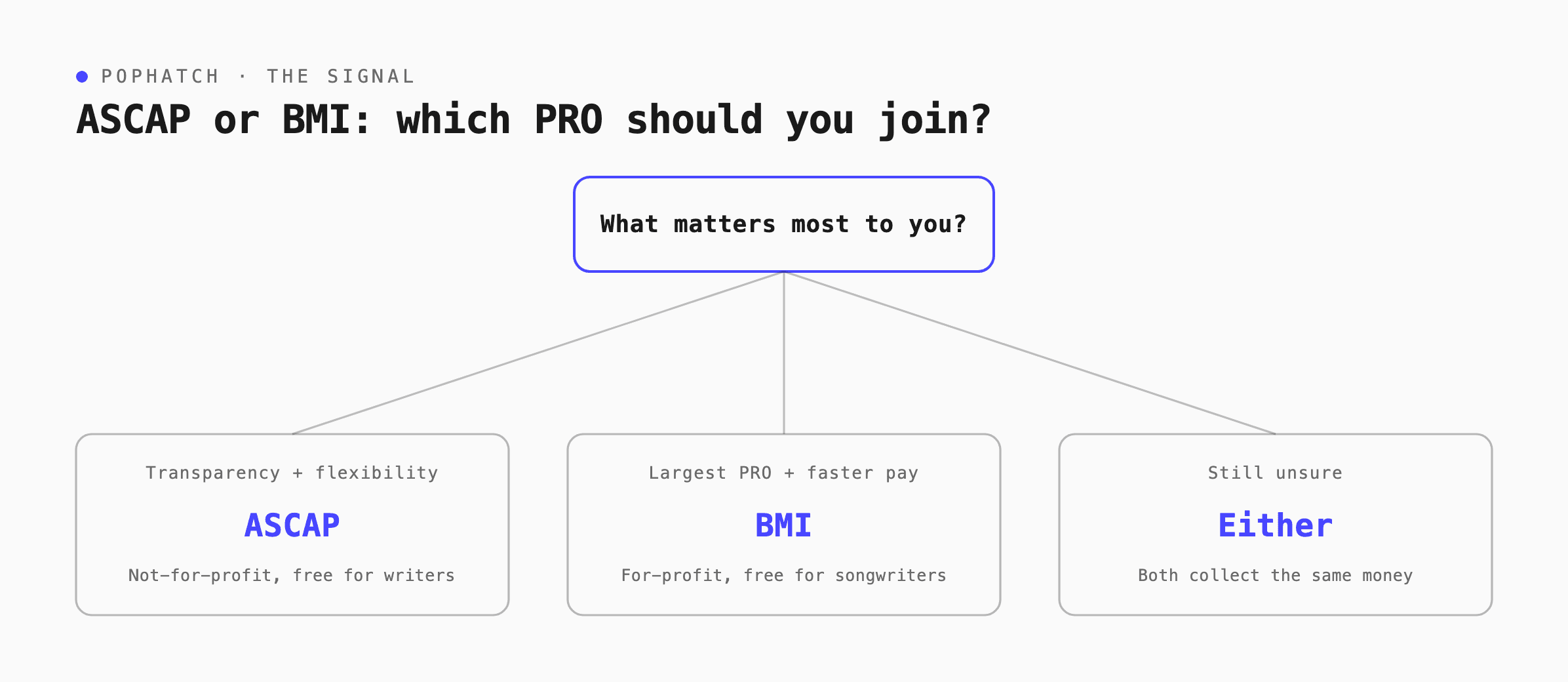
Decision tree for choosing between ASCAP and BMI: if you value transparency and a flexible one-year term, choose ASCAP, a not-for-profit that is free for writers; if you want the largest PRO with faster payouts, choose BMI, a for-profit that is free for songwriters; if you are still unsure, either works because both collect the same money.
A simple way to decide:
Choose ASCAP if transparency and an easy exit matter to you, or if you want to join as a writer and publisher together and have the publisher fee waived.
Choose BMI if faster payouts and the largest licensing reach matter to you, and a longer term is fine.
Pick either and move on if you cannot decide, because the income difference is small and registering your songs matters far more than which logo collects them.
The decision that moves your money is making the choice at all, then registering every song so the system can pay you. Joining a PRO sits alongside the other rights work that protects your catalog, from learning to copyright your songs to setting up to collect your mechanical royalties, the streams of income most artists discover years late.
This is the work PopHatch helps you stay on top of. Knowing which royalties exist, which you have set up, and which you are still missing is a moving checklist, and the artist business partner keeps it in view and tells you the next thing to claim. PopHatch reads where your money is and prepares the next step, so the quiet income stops slipping past you. You can go deeper any time and protect your rights one piece at a time.
___
Performance royalties are the quiet money most artists never switch on. PopHatch is the artist business partner that tracks which royalties you have claimed and which you are still missing, and tells you the next one to set up. Start your free trial at pophatch.com.
Frequently Asked Questions

Written by
Oana Ruxandra
Founder & CEO, PopHatch
Oana Ruxandra is the founder and CEO of PopHatch, the artist business partner. She spent fifteen years inside the music industry, ending as Chief Digital Officer at Warner Music Group, where she grew digital revenue by $2B and negotiated first-of-their-kind deals with Apple, Spotify, YouTube, Amazon, Meta, and TikTok. She writes about the business of music from the inside, for the artists building careers on their own terms.