Oana Ruxandra, CEO of PopHatch. Former Chief Digital Officer at Warner Music Group.

Choosing a distributor feels like choosing a record deal, and it is the opposite of one. For the price of a few coffees a year, any of these three puts your music on every platform and lets you keep your masters. The decision is not who lets you in. It is which pricing shape fits how often you release.
DistroKid, TuneCore, and CD Baby all distribute your music to Spotify, Apple Music, and every major platform while you keep ownership. DistroKid charges a flat annual subscription from 24.99 dollars a year for unlimited releases and keeps zero percent of your streaming royalties. TuneCore charges per release, 24.99 dollars for a single and 44.99 dollars for an album the first year, then an annual renewal to keep it live, and also keeps zero percent of streaming. CD Baby charges a one-time fee per release, 9.95 dollars for a single and 14.95 dollars for an album, with no renewal, so your music stays up forever, and keeps 9 percent of your streaming royalties.
High-volume releasers save with DistroKid or TuneCore; artists who release rarely and dislike recurring bills often prefer CD Baby. The right pick depends on your release pace rather than on which name you have heard most.
I spent fifteen years inside the major label system. From where I sat at Warner Music Group, global distribution was an expensive moat the majors owned, the reason a smaller act needed a deal at all. That moat is gone. Distribution now costs less than a streaming subscription, which is the quiet shift that made the independent path possible. The only question left is which structure fits your year.
Here is the three-way comparison, what each one does well, and how to match one to your career.
What Does a Music Distributor Do?
A music distributor delivers your finished tracks to streaming platforms and stores, collects the money those platforms pay, and passes it to you, while you keep ownership of the recording. It is the bridge between your file and the world's playback buttons, and it is the single piece of infrastructure every independent artist needs.
A distributor does not develop you, market you, or own your music. It moves files and money. That narrow job is exactly why it is cheap now, and why the choice between providers comes down to fee structure rather than gatekeeping. All three of these send your music to the same platforms, so a stream earns the same pool money regardless of who delivered it, a point I covered in how Spotify pays artists.
Because the service is close to identical, the differences that matter are three: how you pay, whether the provider takes a cut of your royalties, and what happens to your music if you stop paying. Those three lines decide the whole comparison.
What to Look for in a Distributor Beyond Price
Price is the headline, and a handful of features decide whether a distributor fits the way you work. All three deliver to the same platforms, so the differences live in the services wrapped around that delivery.
Speed to platforms: How fast a release goes live, and how far ahead you can schedule a date to pitch playlists, varies by provider. A dependable lead time matters when a release is timed to a campaign.
Collaborator splits: If you make music with others, look for built-in splits that pay each person their share directly, so you are not dividing every payment by hand. DistroKid offers this, and the others handle it differently.
Publishing administration: Distribution covers your recording royalties, and your songwriting earns separately. A distributor that also offers publishing admin, as TuneCore does, can collect money you would otherwise leave behind.
YouTube Content ID: This finds and monetizes uses of your music across YouTube, including videos other people post. If YouTube is part of your plan, confirm the distributor offers it and on what terms.
Pre-save and promotion tools: Smart links, pre-save campaigns, and pitch tools differ across providers and shape how a release lands.
Reliable payouts: The point of the service is that the money reaches you cleanly on a predictable schedule. A provider's payout frequency and support quality matter more the more you earn.
Match these against how you work. A solo artist releasing singles needs different things from a collective splitting income six ways, and the right distributor is the one whose features fit your workflow rather than the one with the lowest sticker price.
DistroKid vs TuneCore vs CD Baby: The Comparison
DistroKid and TuneCore both keep zero percent of your streaming royalties and charge a recurring fee, while CD Baby charges once and keeps 9 percent. Here is the full side-by-side, drawn from each company's current pricing and the long-running Ari's Take distribution comparison.
Feature | DistroKid | TuneCore | CD Baby |
Pricing model | Flat annual subscription | Per release, billed yearly | One-time fee per release |
Starting cost | 24.99 dollars per year, unlimited releases | 24.99 dollars per single, 44.99 dollars per album | 9.95 dollars single, 14.95 dollars album, one-time |
Streaming royalty kept | 0 percent | 0 percent | 9 percent |
Renewal | Yearly, ongoing | Yearly per release (singles about 9.99 dollars a year) | None, paid once |
If you stop paying | Music can be removed | Music can be removed | Music stays up forever |
Best for | Frequent releasers | Steady releasers who want add-on services | Occasional releasers who dislike renewals |
Read the table as a trade between time and money. DistroKid and TuneCore ask for a small payment every year and let you keep every cent of streaming income. CD Baby asks once and never again, then quietly takes 9 percent of your streams for as long as the music earns. Over a few years, a track that streams well costs you more under CD Baby's 9 percent than under a flat annual fee. A track that barely streams costs you less, because 9 percent of very little is very little, and you never renew.
Run the numbers over three years to see the shape. A prolific artist on DistroKid pays about 75 dollars across three years for unlimited releases and keeps every cent of streaming. The same artist releasing a dozen tracks on a per-release plan pays far more, since each release carries its own fee and renewal. A quiet artist with two lifetime releases on CD Baby pays once and never again, then gives up 9 percent of whatever those tracks earn. The cheapest option is the one whose math matches your output, and the math only becomes clear when you project it across a few years rather than a single release.
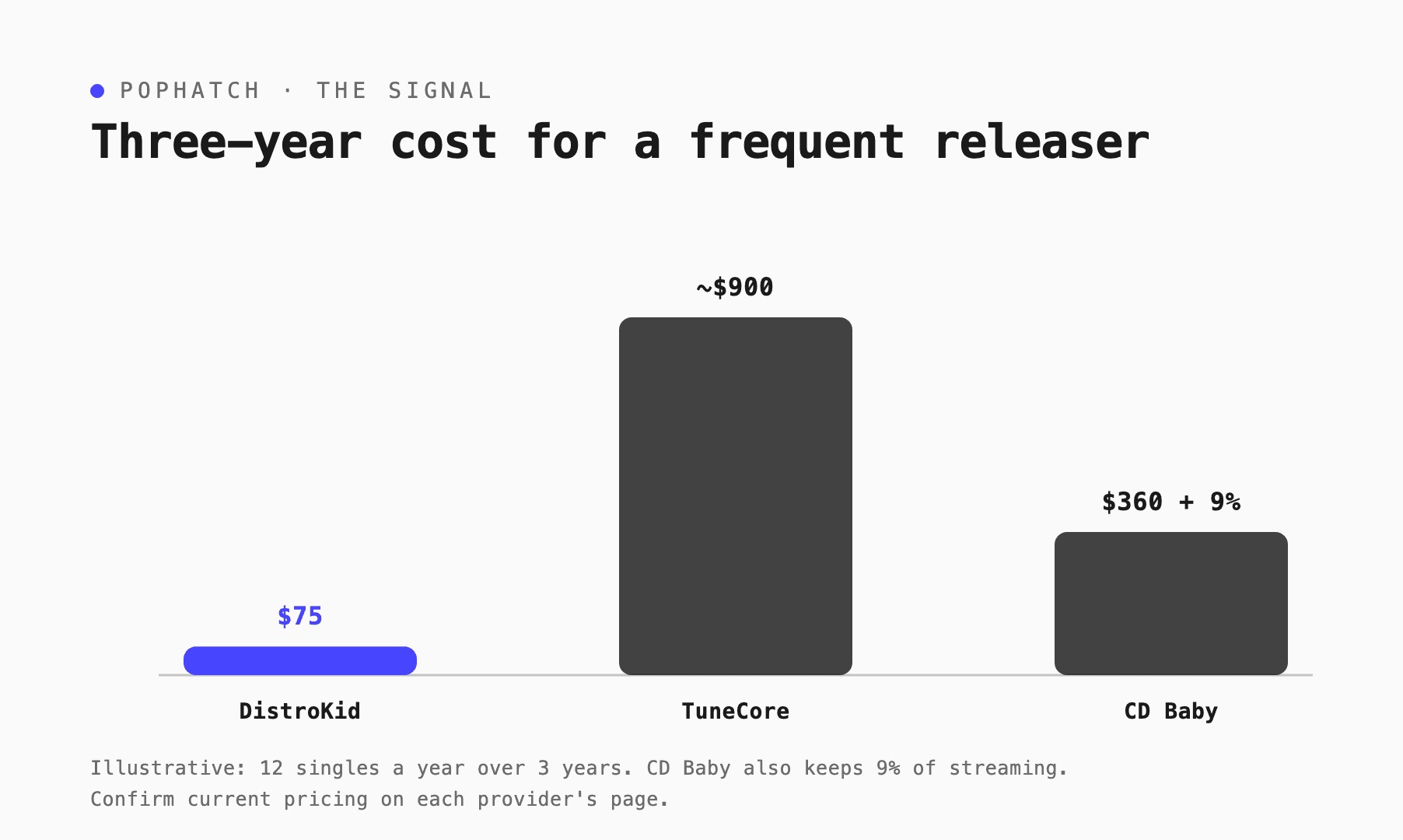
Bar chart of illustrative three-year cost for an artist releasing twelve singles a year: DistroKid about 75 dollars, TuneCore about 900 dollars, and CD Baby about 360 dollars one-time plus a 9 percent cut of streaming.
Distributor pricing changes often. The prices here were verified in June 2026; check each provider's own pricing page for current figures before you sign up.
DistroKid Review: Best for Frequent Releasers
DistroKid fits artists who release often, because its flat annual subscription covers unlimited uploads while it keeps none of your streaming money. DistroKid's pricing runs three tiers: Musician at 24.99 dollars a year for one artist name, Musician Plus at 44.99 dollars for two, and Ultimate at 89.99 dollars for up to one hundred. Every plan keeps 100 percent of your earnings.
The math rewards volume. If you put out a single every month, you upload twelve releases for one flat fee, where a per-release distributor would charge you twelve times. For a prolific artist, DistroKid is usually the cheapest path by a wide margin, which is why it became the default for high-output independent musicians.
The catch sits in the word subscription. Your music stays live only while you keep paying, so the fee is rent rather than a purchase. Stop the subscription and your catalog can come down, unless you keep renewing or pay to keep older work up. For an active artist that is a non-issue. For someone who releases once and walks away, it is a recurring bill against music that may have stopped earning.
TuneCore Review: Best for Add-On Services
TuneCore fits steady releasers who want distribution plus a deeper menu of publishing and monetization services, and it also keeps zero percent of your streaming royalties. TuneCore's pricing charges per release, 24.99 dollars for a single and 44.99 dollars for an album in the first year, then an annual renewal to keep the release live, with singles renewing around 9.99 dollars a year. Your streaming income comes back to you in full.
Where TuneCore earns its place is the surrounding services. It offers publishing administration to collect the songwriter royalties many artists leave uncollected, plus monetization for social platforms, and it takes a percentage only on that social and user-generated revenue rather than on your core streaming. For an artist who wants one provider to handle distribution and chase the publishing money too, that breadth is the draw.
The structure suits a measured release pace. Per-release pricing is friendly when you put out a few releases a year and want each one to carry its own services, and it grows expensive when you release constantly, which is the exact point where DistroKid's flat fee wins. Match the model to your output, and the cost difference between the two is small.
CD Baby Review: Best for Occasional Releasers
CD Baby fits artists who release rarely and want their music online permanently without a recurring bill, in exchange for a 9 percent cut of streaming royalties. You pay a one-time fee per release, 9.95 dollars for a single and 14.95 dollars for an album, and never renew, so a song you upload once stays live for years with no further payment. CD Baby keeps 9 percent of the streaming revenue that song earns, and you keep the other 91 percent.
The appeal is permanence. An artist with a small back catalog who does not want to think about subscriptions can pay once and forget it, knowing the music will not vanish because a card expired. For a legacy release, a one-off project, or a musician who releases every couple of years, that peace of mind can be worth the percentage.
The cost shows up only if a track takes off. Because the 9 percent never ends, a release that streams heavily pays CD Baby more over time than a flat annual fee would have. The honest way to read it is as insurance against renewals that you pay for with a slice of your upside. If your catalog stays modest, the trade favors you. If a song becomes a hit, you will wish you had kept the 9 percent.
Do All Three Pay You the Same Streaming Money?
All three deliver your music to the same platforms, so a stream earns the same pool money regardless of which distributor sent it. What differs is the cut each one takes and how reliably the money reaches you. A play on Spotify generates the same streamshare whether you are on DistroKid, TuneCore, or CD Baby, which is the pool math I covered in how Spotify pays artists.
The difference shows up in the slice you keep. DistroKid and TuneCore pass on 100 percent of your streaming royalties after their flat fees, so the platform pays them and they pay you the full amount. CD Baby keeps 9 percent before passing the rest, so the same stream lands slightly smaller in your account. Across a catalog that earns steadily, that 9 percent compounds into a number worth weighing against the convenience of never renewing.
Payout reliability is the quieter factor. The provider that pays on a predictable schedule, reports clearly, and answers when something breaks is worth more than a few dollars of price difference once your catalog earns enough to matter.
Common Mistakes When Choosing a Distributor
The costliest mistakes come from switching and lapsing rather than from picking the wrong provider on day one. A distributor is easy to choose and harder to leave cleanly, so a little foresight saves money.
Switching distributors carelessly. Moving a catalog between providers can reset your stream counts and risk losing playlist placements tied to the old release, so plan a migration rather than jumping on a whim.
Letting a subscription lapse. On DistroKid or TuneCore, stopping payment can pull your music down, which erases the stream history and placements a release has built. Keep the subscription active for anything still earning.
Ignoring publishing. Choosing a distributor and stopping there leaves your songwriting royalties uncollected. Pair distribution with a publishing admin or a performing rights organization so both halves of every stream reach you.
Choosing by brand recognition. The most advertised name is not automatically the right fit. Match the provider to your release pace and your need for collaborator splits or publishing, and the cheaper, quieter choice often wins.
Avoid those four and the distributor decision becomes what it should be: a small, durable choice you make once and rarely revisit.
Which Distributor Fits Your Career?
Match the distributor to your release pace and your tolerance for recurring bills, because that is what separates them. The services are close enough that the fee structure is the deciding factor.
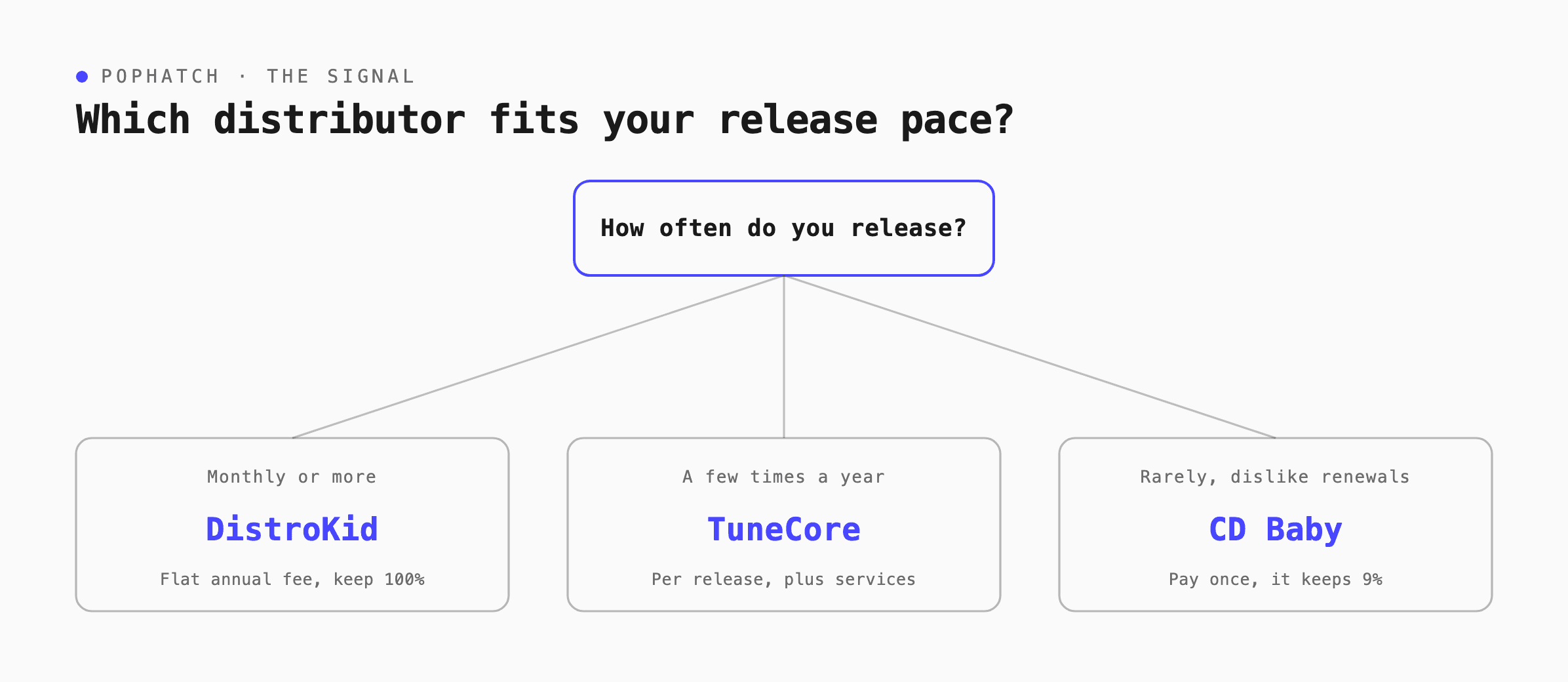
Decision tree for choosing a music distributor by release pace: release monthly or more, choose DistroKid for its flat annual fee and 100 percent royalties; release a few times a year, choose TuneCore for per-release pricing plus publishing and social services; release rarely and dislike renewals, choose CD Baby, which charges once and keeps 9 percent.
Release often, want the lowest cost: choose DistroKid. Unlimited uploads on a flat annual fee is the cheapest home for a prolific artist, and you keep all of your streaming money.
Release steadily, want publishing and social services in one place: choose TuneCore. Per-release pricing fits a measured pace, and the add-on services collect money you might otherwise leave behind.
Release rarely, hate renewals, accept a cut: choose CD Baby. Pay once, stay online forever, and trade 9 percent of streaming for never seeing another bill.
Whichever you pick, the win is the same: you keep your masters and the platforms pay you, which is the advantage the majors used to hold. The point of choosing well is keeping your masters and the largest share of the income they earn. The distributor is plumbing, and the decisions that grow the income flowing through it are the harder, more valuable work.
That is where PopHatch comes in. Picking a distributor is a one-time call, and the ongoing work is reading what your releases earn, deciding what to release next, and structuring the business around it, which is what the artist business partner does with you. PopHatch reads your numbers across platforms and prepares the decisions, so the plumbing stays simple and your attention goes to growth. When you are ready, the next step is to set up your music business so the money you keep is organized and protected.
How to Choose and Set Up a Distributor Today
You can pick a distributor and have music on the way to streaming in under an hour. The work is a few decisions made in order rather than a research project.
1. Estimate your release pace for the next year. Count how many singles and projects you expect to put out, since that number decides which pricing model is cheapest.
2. Pick from the decision above. Frequent releasers choose DistroKid, steady releasers who want publishing and social services choose TuneCore, and rare releasers who dislike renewals choose CD Baby.
3. Create the account and add your release. Upload your audio, artwork, and credits, and set the release date far enough ahead to pitch playlists, usually three to four weeks.
4. Set up collaborator splits if you co-wrote or co-produced, so each person is paid their share directly rather than waiting on you to divide it.
5. Set up publishing separately. Distribution covers your recording royalties, so register with a performing rights organization and a publishing administrator to collect the songwriting side.
6. Keep the subscription active for anything still earning, and add a calendar reminder for the renewal so a lapse never pulls your catalog down.
Here is how it looks in practice. A producer releasing two singles a month picks DistroKid for the flat fee, sets up splits with each vocalist, schedules every drop a month out, and registers the compositions with a PRO. Setup is an afternoon, and every dollar of streaming after that is theirs to keep.
___
A distributor is plumbing you choose once. Growing what flows through it is the ongoing work, and PopHatch is the artist business partner that reads your numbers and prepares the calls. Start your free trial at pophatch.com.
Frequently Asked Questions

Written by
Oana Ruxandra
Founder & CEO, PopHatch
Oana Ruxandra is the founder and CEO of PopHatch, the artist business partner. She spent fifteen years inside the music industry, ending as Chief Digital Officer at Warner Music Group, where she grew digital revenue by $2B and negotiated first-of-their-kind deals with Apple, Spotify, YouTube, Amazon, Meta, and TikTok. She writes about the business of music from the inside, for the artists building careers on their own terms.