Oana Ruxandra, CEO of PopHatch. Former Chief Digital Officer at Warner Music Group.
TL;DR: At 100 users, your retention curve will not pass a statistical test. It can still tell you what you need to know. Read it for shape, not for confidence intervals. The shape decides whether you have a product worth scaling or a leaky bucket dressed up as growth. Most founders skip this read because they were taught to wait for bigger numbers. The numbers are already speaking.
There is a version of this advice that says: wait until you have a thousand users before you read your retention curve. That version is wrong.
It is also old. The convention came from an era when SaaS was built by teams of fifteen and validated by enterprise sales cycles, when cohort sizes of a thousand were the floor, and when a quarterly board update was the unit of learning. That world held for about twenty-five years. It is ending.
The post-launch founder right now has 47 signups, or 112, or 240. The dashboards they pay for were built for the old arrangement. The advice they read on Twitter was written for it. Their confusion is the residue of that arrangement, not a failure of judgment.
Here is what most founders miss. A retention curve at 100 users carries a different kind of information than the curve at 10,000. The early curve is qualitative data in quantitative clothing. You are not measuring a population. You are reading a shape. And the shape is legible long before the math is.
I wrote about the same compression happening across founder economics in The Default State. The retention curve is one of the artifacts of that compression. The read used to take a year. It can now take three weeks.
Retention Curve Basics: How Do You Calculate It?
Retention is calculated cohort by cohort. A cohort is a group of users who started using the product in the same time window, usually a week or a month. For each cohort, you measure the share who return on day 1, day 7, day 30, or whatever window matches your product's natural use cycle.
The base formula is direct:
Retention on Day N = (Users active on Day N ÷ Users in starting cohort) × 100
Day 1 retention for a cohort of 50 signups with 22 returning on day 1 is 44%. Week 4 retention with 14 of 50 still active is 28%. Cohort retention is the same calculation repeated across multiple time windows, then stacked into a curve.
The choice that matters more than the formula is what counts as "active." A login does not count. Reaching the moment the product was built to produce does. Amplitude and Mixpanel both compute curves automatically once you define the starting event and the return event, and they both default to login if you do not override it. Override it. Reforge covers the difference between shallow and meaningful retention events in their retention engagement piece, and the distinction shapes every read you do after.
What Does a Retention Curve Show?
A retention curve shows the percentage of users from a starting cohort who return to your product over a defined window. The curve tells you whether your product holds people or loses them.
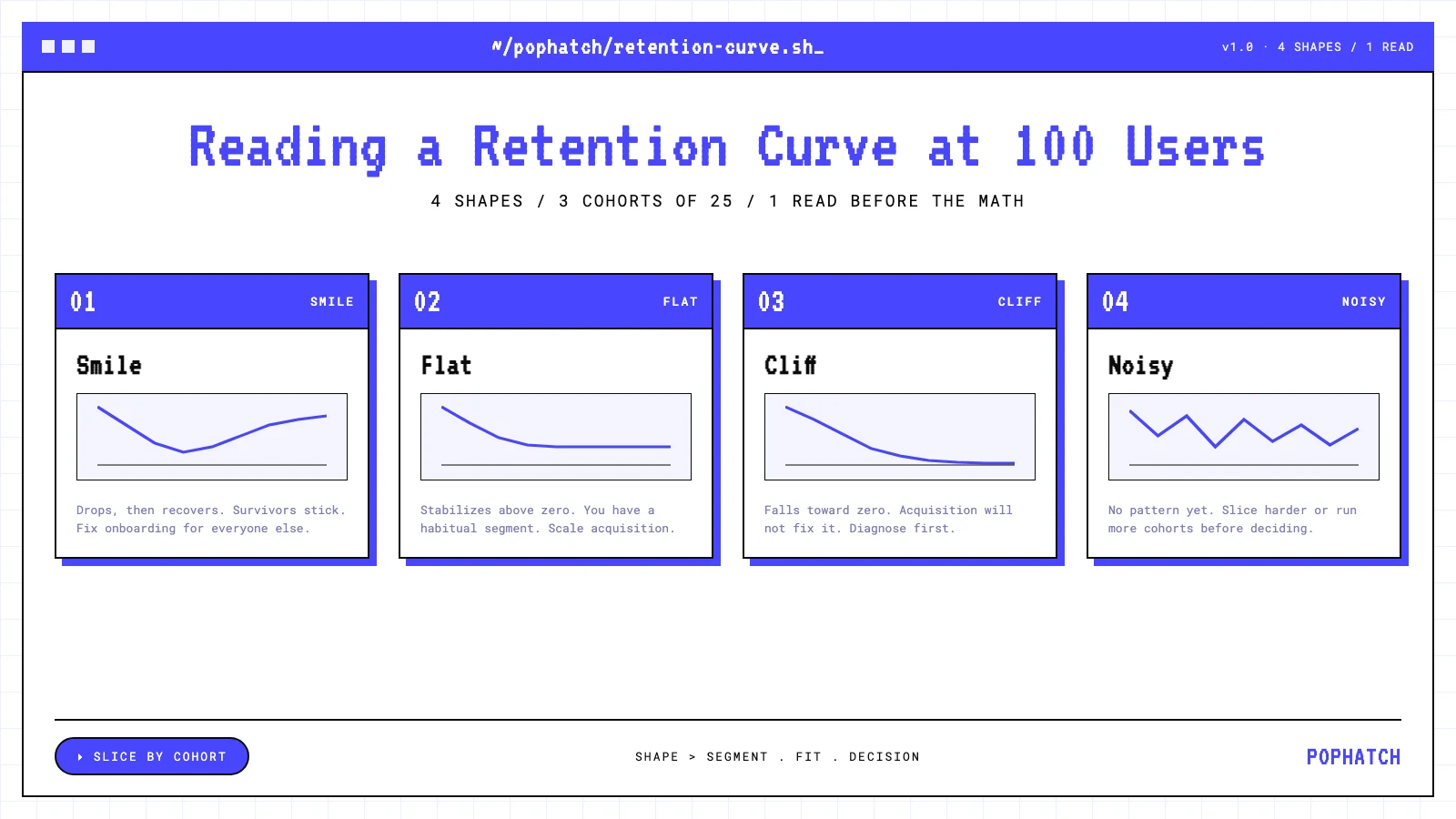
At scale, you read it for confidence intervals and statistical decay rates. At 100 users, you read it for shape. There are four shapes that matter, and three of them tell you what to do next.
Smile: █▆▃▁▂▄▆▇ (drops, then recovers)
Flat: █▆▄▃▃▃▃▃ (stabilizes above zero)
Cliff: █▅▃▂▁▁▁▁ (falls toward zero)
Noisy: █▃▆▂▇▁▄▃ (no pattern yet)
Smile curve. Retention falls, then climbs back. You have a product that finds its people after a beat of friction. The early drop is expected. The recovery is the read.
Flat curve. Retention falls, then stabilizes above zero. You have a product with a habitual user segment, even if it is small. This is the most valuable shape to find at 100 users. The flat line is the product.
Cliff curve. Retention falls and keeps falling toward zero. You have a leaky bucket that acquisition will not fix. Diagnose the drop before you spend another dollar on top-of-funnel.
Noisy curve. Retention fluctuates with no pattern. This is the most common shape at 100 users, and the one that produces the most paralysis. You need more cohorts, not more users.
How Many Users Do You Need to Read the Curve?
You need at least three cohorts of 25 to 50 users each to read shape with any reliability. That is the floor for early-stage reading, separate from the floor for statistical reading. Statistical reading needs more, often much more. Shape-reading needs consistency across cohorts more than population size.
This is the move most early-stage founders never make. They have 100 users, and they treat them as one cohort. They look at "the curve" instead of "the curves." One cohort tells you nothing. Three cohorts tell you whether a pattern is repeating.
When I was a quantitative portfolio manager at BlackRock, we ran into the same problem in a different vocabulary. You cannot estimate variance from a single time series. You estimate it from multiple time series that share a generating process. Three cohorts of 30 users is closer to that than 100 users treated as one.
Slice by week of signup. Or by acquisition channel. Or by feature first used. The slicing is the read. Andrew Chen made the same point years ago with the Power User Curve, and it remains the cleanest framing of why averages mislead at small scale.
What Does Each Curve Shape Mean for a Founder?
Each shape implies a different next move. Below is what each one is telling you to do.
Curve shape | What it tells you | What to do next |
Smile | Friction drops users early; survivors stick | Fix onboarding. The product works for the patient. |
Flat | You have a habitual user segment | Find more of that segment. Acquisition becomes the question. |
Cliff | The product does not hold | Stop spending on acquisition. Diagnose the drop. |
Noisy | Not enough cohorts to read | Run two more cohorts before deciding anything. |
The table is the discipline. The shape decides the next decision. Most founders try to make the decision before they read the shape, which is how three months disappear without learning.
Why Do Most Founders Misread Their Curve at This Stage?
Most founders misread their curve because they mix cohorts and read averages. The average curve at 100 users is almost always noisy. It will not tell you which shape you are sitting on. The slice will.
There is a counterpoint worth sitting with. Slicing by cohort at 100 users means each cohort holds 25 to 35 users. That is not a population. Statistical purists will say you cannot learn anything from a sample that small. They are right about statistics. They are wrong about the shape-reading.
Shape-reading is closer to qualitative pattern recognition than to quantitative inference. You are not trying to prove the population behaves this way. You are trying to detect whether a pattern is repeating across cohorts. A repeating pattern across three samples of 25 users is stronger evidence of product behavior than 75 users treated as a single number.
The discipline is to slice, look, and admit when you cannot tell.
What If Your Curve Is Noisy?
A noisy curve at 100 users means you do not have enough cohorts yet, or your cohorts are too mixed. The fix is structural. Slice harder. Add cohorts. Wait two more weeks of signups before re-running the read.
There is also a darker possibility. A persistently noisy curve, even after slicing, can mean you do not have a product yet. You have a collection of usage events that fail to converge on a habit. The curve is not telling you to keep going. The curve is telling you to listen to the users you have, in their own words, about what they came for. How to find product-market fit covers the conversation discipline that pairs with this read.
What Do These Curves Look Like in Practice?
Two composite cases from teardowns I have sat in on this year.
A founder running a small B2B scheduling tool was looking at a cliff. Every cohort fell to under 8% by week four. When she sliced by signup source, the cliff resolved into two different curves. Users from a Product Hunt launch behaved one way. Users from word-of-mouth referrals behaved another. The Product Hunt cohort was the cliff. The referral cohort was a smile that climbed back to 33% by day 30. The acquisition channel was the read. The product was working for the right list, and quietly broken for the wrong one.
A second founder, building a developer productivity tool, ran their first cohort read at 92 paying users. The curve was flat from week two onward at 41%. Most early-stage founders would have called that low. It was the indicator that the product had a habit-forming segment. They stopped building features and started building outbound to people who matched the 41% segment's profile. Six weeks later cohort retention held at 39% with three times the volume. The flat line was the product. They scaled it.
SaaS retention at this stage is rarely about the average. It is about which segment is inside the average, and what they have in common.
How Does Retention Connect to Onboarding and Activation?
Reading the curve is the first half of the work. Acting on it is the second. Most early-stage retention problems trace back to one of three places: onboarding length, activation event clarity, or habit loop frequency. Onboarding too long produces a smile curve where the drop is too deep to recover from. An activation event that is unclear produces a cliff curve, because users never reach the moment the product was built to produce. A weak habit loop produces a flat line below the rate at which the business model works.
Each problem has a different fix, and a different cost. The curve points to which one you are looking at before you spend two months on the wrong one.
When Does the Curve Become Statistical Instead of Qualitative?
The curve becomes statistically meaningful somewhere between 500 and 2,000 users, depending on retention shape and variance. Below that, you are reading. Above that, you are testing. The transition is the moment your cohorts stop fluctuating wildly week over week.
At the qualitative stage, you are looking for shape. At the statistical stage, you are looking for change. They are different reading modes. Founders who treat them as the same lose months in either direction. They wait for statistics when shape was already there. Or they declare statistical significance off ten people and chase a false floor.
You can run both reads in parallel inside PopHatch. PopHatch slices your cohorts, tracks variables you have changed against the cohort you changed them in, and tells you when the read is shifting from shape to statistic. It remembers the prior cohorts. It does not start over every Monday.
What If Your Cohort Is Smaller Than 25 Users?
A cohort below 25 is too small for even shape-reading. The fluctuation between weeks will dominate any pattern. The fix is patience or aggregation. Either wait two more weeks of signups, or pool cohorts deliberately while keeping a flag for which week each user joined.
Pooled cohorts cost you a read. They give you a baseline. Use them as scaffolding, not as the answer. Once a single cohort hits 30, return to weekly slicing and discard the pool. The PMF at 50 users post covers the parallel discipline for product-market fit reading at this scale.
What This Means for the Founder Holding 47 Signups
A founder with 47 signups is not behind. They are inside the part of the build where reading shape matters more than reading numbers. The arrangement that taught us to wait for statistical significance was built for a different kind of company. This kind of company learns earlier.
What is decompressing right now is the gap between launch and meaningful read. It used to take a year. It can take three weeks, with the right cuts. The infrastructure for those cuts has been missing for the founder building outside the institutions that used to host it. And every founder I talk to is sitting on a curve they could already read, if someone had handed them the slicing pattern in the first hour after launch.
That is the problem I am building PopHatch to solve.
___
If you have users and cannot tell what is working, PopHatch slices your retention curve, compares cohorts side by side, and tells you the shape you are sitting on before the math kicks in. Free 14-day trial. Founding Member pricing locked at $19/month for the first 12 months.