Oana Ruxandra, CEO of PopHatch. Former Chief Digital Officer at Warner Music Group.
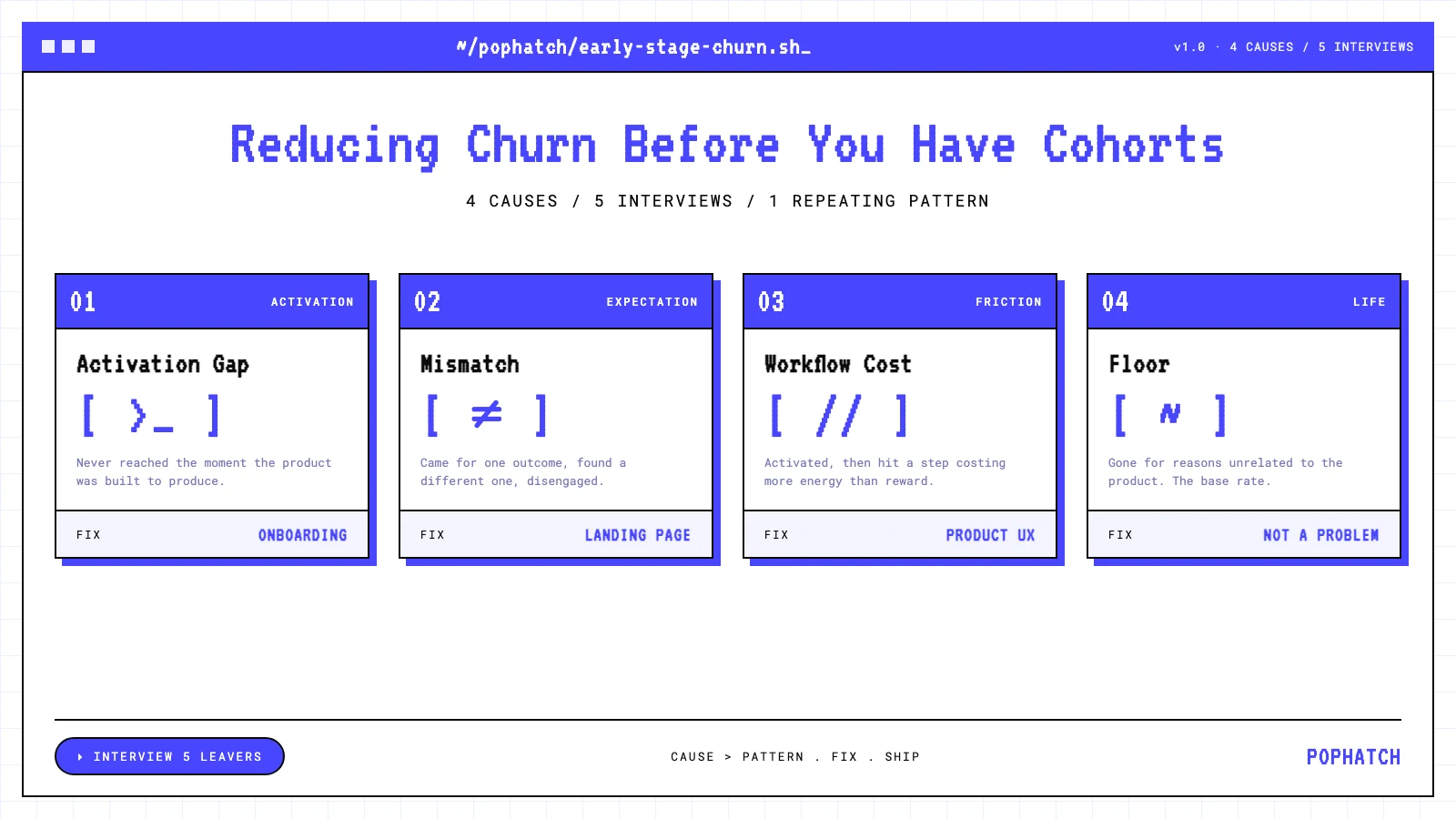
TL;DR: Reducing churn at early stage does not begin with a churn model. It begins with conversations. Before you have cohorts, every cancellation is a complete data point you can interview. Three to five exit conversations will tell you more about why people leave than any retention curve at 100 users. The lever you have at this stage is qualitative, and it works.
There is a version of this advice that says: gather six months of churn data, then attack it with a retention model. That version is wrong for any founder with fewer than 300 users.
It is also a residue of the arrangement that produced the modern SaaS playbook. The retention literature was written for companies with thousands of customers and a success team to interpret the numbers. The founder at 80 or 200 users does not need a model. They need to know why the last four people quit. The conversation is the data.
The cancellation rate at this stage is too small to model. The reasons inside each cancellation are not. Each leaver is a complete case file. You can call them. They will often answer. I covered the same compression across founder economics in The Default State. Early-stage churn is one of its sharpest artifacts.
What Reduces Early-Stage Churn?
Eight levers produce most of the movement at pre-cohort scale. Knowing them in advance makes your exit interviews sharper, because you have a menu to listen against. The interview tells you which one to pull first.
Onboarding compression. Shorten the path from signup to first outcome. Most early-stage cancellations happen before the user reaches the moment the product was built to produce. Cut setup steps. Default to skipping anything not required for the first usable result.
Faster activation. Activation is the user's first observable success inside the product. Track it, name it, move it earlier. Paddle's research on activation shows products with shorter time-to-activation hold users at meaningfully higher rates than products requiring extended setup.
Expectation alignment. Audit the landing page against the first-session experience every month. If they promise different outcomes, cancellations will spike between day 4 and day 7 as the gap reveals itself. Fix the landing page before fixing the product.
Proactive founder support. At pre-cohort scale, the founder can email every new signup personally inside 24 hours. Founders who do this consistently report higher activation and lower 30-day churn in Lenny Rachitsky's reader surveys.
Cancellation interception. A short cancellation flow asking one honest question can convert 10 to 20% of intent-to-leave back to active, per Paddle teardowns of self-serve SaaS cancellation flows. The flow works only if it surfaces a fixable objection, never if it begs.
Weekly customer check-ins. A fifteen-minute call with one paying user every week is the sharpest research tool available at this scale. It also builds enough of a relationship to lower cancellations on its own. Schedule one every Friday and never skip it.
Usage nudges. Email or in-app prompts triggered by inactivity, not by time elapsed. A nudge at day 14 of zero usage outperforms any weekly newsletter by an order of magnitude. Build it once and let it run.
Pricing clarity. If interviews surface confusion about what is included at which tier, the underlying issue is positioning. Pricing tables that require a re-read create silent cancellations. Rewrite the table before you change the prices.
The list above is the menu. The interview is the order.
What Counts as Early-Stage Churn?
Early-stage churn is any cancellation, refund, or quiet drop-off inside a base of fewer than 300 paying users. At that scale, churn does not behave like a rate. It behaves like a sequence of individual stories.
Each story has a trigger event. Sometimes the trigger is a missing feature. Sometimes it is a billing surprise. Sometimes it is a life change that has nothing to do with you. The aggregate of these stories is what the cohort would have told you if the cohort had been large enough to run.
You have the same information. It is disaggregated. If you launched and are sitting with zero or near-zero paying users, the discipline starts earlier, with the people who signed up and never converted. Same shape, different list.
How Do You Reduce Churn Without Cohort Data?
You reduce churn at this stage by interviewing the leavers and listening for repeats. The repeats are the pattern you would have read off a cohort analysis.
Three reads matter more than the rest.
Pattern repetition. When two leavers cite the same reason, take it seriously. When three cite it, prioritize it. Three out of fifteen exits naming the same friction is closer to certainty than most data points at this scale.
Trigger placement. Note where in the user lifecycle the leaver canceled. Day 4 cancellations and day 60 cancellations are different problems. Day 4 is onboarding. Day 60 is value drift.
Activation gap. Ask each leaver what they did inside the product. Most early-stage leavers never completed the first task that produces the core outcome. Closing that gap is the highest-leverage move you can make at this stage. How to read a retention curve at 100 users covers the parallel discipline on the retention side.
These three reads can be done by hand. They require fifteen minutes per leaver and a willingness to hear something uncomfortable.
What Should You Ask in an Early-Stage Exit Interview?
Ask four questions and stop. The discipline is in keeping the conversation short.
What were you hoping the product would do for you?
What did you try inside the product?
What stopped working, or what stopped mattering?
What did you switch to, or do instead?
Question one is the expectation. Question two is the experience. Question three is the failure. Question four is the alternative. Together they reconstruct the canceled relationship in under twelve minutes.
When I was running early-stage product programs at Warner Music Group, we used a tighter version of this script for artist drop-off interviews. The shape of the answers was repetitive. The same four or five reasons covered 80% of departures. The remaining 20% was where we sometimes found a feature gap. The 80% was where we found a positioning problem.
The interview is the audit of both.
Where Do You Find Leavers Who Will Answer?
Send a personal email within 48 hours of cancellation. Sign it yourself, with no automation. Offer a fifteen-minute call. Most early-stage leavers will respond at a rate you would not believe until you see it. Founder operator anecdotes collected in Lenny Rachitsky's churn reader survey describe response rates in the 30 to 50% range on personal exit emails at this scale.
The reason is structural. The leaver has just chosen to disengage from you. They expect either silence or a templated win-back. Receiving a short, personal email from the founder asking a sincere question is rare enough to feel valuable. Many of them will write back even if they do not take the call.
There is a counterpoint worth sitting with. Some leavers will not answer. Some will give you a polite, generic reason that obscures the deeper one. The qualitative method is imperfect. It still outperforms running a cohort analysis on twelve cancellations.
Two Examples of What This Looks Like in Practice
A founder I spoke with this spring runs a B2B onboarding tool with 140 paid users. Their SaaS churn rate looked stable at 6% monthly. After eleven exit interviews over three weeks, the pattern resolved by trigger placement. Eight of the eleven cancellations had churned inside their first nine days. Three churned at day 50 or later. The early group was an activation problem. The later group was a value-delivery problem. They shipped two different fixes that month. Monthly churn dropped to 3.2% by the next cycle.
A second founder running a prosumer consumer tool was sitting at 11% monthly churn. Interviews surfaced one repeating phrase across six leavers: "I thought it did X." The landing page had been promising X. The product had stopped being about X two iterations earlier. The fix was a landing page rewrite. Churn fell to 7% inside six weeks without a single product change.
Both founders had the same data sitting in their email threads before the interviews. The interview was the discipline that made the data legible.
A Diagnostic Flow for Each Cancellation
Cancellation
│
▼
┌────────────────────┐
│ Activation gap? │──Yes──▶ Onboarding fix
└─────────┬──────────┘
│ No
▼
┌────────────────────┐
│ Expectation │──Yes──▶ Landing page or
│ mismatch? │ positioning fix
└─────────┬──────────┘
│ No
▼
┌────────────────────┐
│ Workflow │──Yes──▶ Product UX fix
│ friction? │
└─────────┬──────────┘
│ No
▼
Life change
(the floor of churn,
not a problem to solve)
Run each new cancellation down this flow before assuming you have a population problem. Most cancellations terminate on one of the first three boxes. The fourth is the floor.
How Many Exit Conversations Do You Need?
Five conversations is the floor. Ten is enough to spot repetition with confidence. Beyond fifteen, you are running diminishing returns at this stage.
The math is closer to user research than to retention statistics. Five users surface most repeat patterns according to the Nielsen Norman Group, whose research on usability testing has held for two decades. The same logic holds for early-stage churn interviews. Ten users surface the rest of the meaningful patterns. The fifteenth user usually echoes one of the first ten.
What you are looking for is the same thing across calls. The exact words people use to describe what they expected the product to do. The exact place in the workflow where their attention turned. These details are uncopyable. They will not show up in any benchmark report. They are the working material of your next iteration.
Comparing Quantitative and Qualitative Churn Reading at Early Stage
Approach | When it works | Why it fails at pre-cohort scale |
Cohort retention curve | 500+ users per cohort | Cohorts too small to draw shape |
Churn rate (% per month) | Stable population, 300+ users | Each leaver moves the rate 1 to 3 points, noise dominates |
Exit interviews | Any size, especially <300 users | Founder time-intensive beyond ~30 leavers per month |
Product-usage drop-off | Most stages | Tells you when, rarely why |
NPS survey of leavers | Stable population, 100+ responses | Response rate too low in year one |
The table is the read. At pre-cohort scale, interviews carry more diagnostic weight than every other column on the page.
What Are the Most Common Early-Stage Churn Drivers?
Four causes account for most pre-cohort churn across SaaS categories. They appear in research from Paddle (formerly ProfitWell), ChartMogul's SaaS retention report, and the Bessemer State of the Cloud reports. They show up in interview transcripts faster than they show up in dashboards.
Activation gap. The user never reached the moment the product was supposed to produce. They left without seeing the thing.
Expectation mismatch. The user came for one outcome, found a different one, and disengaged. The landing page or onboarding is mis-promising.
Workflow friction. The user activated, then hit a step that cost more energy than the reward justified.
Life change. The user is gone for reasons that have nothing to do with the product. This is the floor of churn for any tool. It is not a problem to solve.
When you list each cancellation against this taxonomy, the pattern usually emerges by the third or fourth name. That pattern is the work for the next two weeks.
When Should You Switch From Interviews to Cohorts?
The switch happens between 300 and 800 users, depending on category and revenue model. Below that, interviews are higher resolution. Above that, you start to lose the ability to talk to every leaver, and cohort analysis becomes the way to keep reading the population.
Most founders make the switch too early. They build dashboards before they have a population, then they read noise as if it were a number. The discipline is to ride qualitative as long as you can hear from each individual leaver, then transition deliberately. Finding product-market fit walks through the same pattern on the acquisition side.
PopHatch tracks both reads. It logs each cancellation against the four-cause taxonomy as you interview, surfaces the repeats, and tells you the week your population crosses the threshold where cohort analysis starts to outperform interviews. It remembers what each leaver said. It does not lose them between dashboards.
Early-Stage Churn Reduction Checklist
Print this. Keep it next to the inbox where cancellation notifications land.
☐ Email every leaver within 48 hours, signed by the founder
☐ Ask the four-question exit script and stop
☐ Log each cancellation against the four-cause taxonomy
☐ Treat three repeated mentions as a pattern, not statistical significance
☐ Audit landing page against first-session experience monthly
☐ Measure time-to-activation and shorten it quarterly
☐ Track day 4 cancellations separately from day 60 cancellations
☐ Audit Stripe involuntary churn weekly
☐ Schedule one fifteen-minute call per week with an active user
☐ Pause new feature work until the dominant exit pattern is named
Ten items. Most of them are conversations. None of them require a model.
What This Means for the Founder Holding Twelve Cancellations
A founder with twelve cancellations is not looking at a churn problem yet. They are looking at twelve case files. The arrangement that taught us to model churn was built for the population scale that comes later. The founder right now has the better data. It is sitting in twelve email threads.
What is decompressing at this stage is the time between losing a user and learning from them. It used to take a quarter of customer success operations to surface the patterns inside those twelve names. It can now take a week. The infrastructure for that compression has been missing for founders building outside the institutions that used to host it.
That is the problem I am building PopHatch to solve.
___
If you have users leaving and cannot tell what is repeating, PopHatch logs each exit interview against the four-cause taxonomy, surfaces the patterns as they emerge, and remembers them between sessions. Free 14-day trial. Founding Member pricing locked at $19/month for the first 12 months.
Frequently Asked Questions

Written by
Oana Ruxandra
Founder & CEO, PopHatch
Oana Ruxandra is the founder and CEO of PopHatch, the artist business partner...