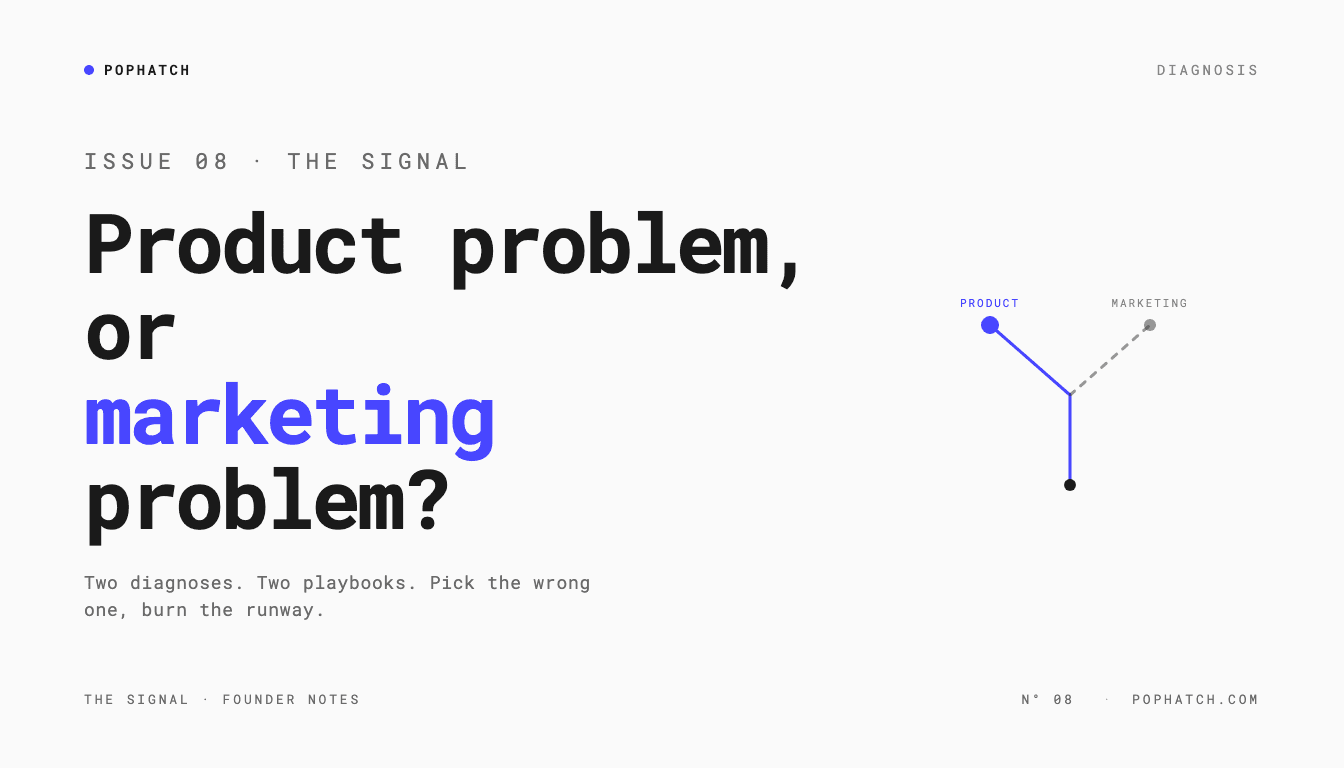
You're Changing Both at the Same Time. That's Why You Can't Tell.
"Is my SaaS bad? Or is it just my marketing?" You have typed something like this into ChatGPT or posted it on r/startups. You are not alone. It is one of the hardest questions you face after launch. And you never get a clear answer, because you are changing both things at the same time.
You rebuilt the landing page, added a feature, changed pricing, tried a new subreddit. Nothing improved. You cannot tell which variable caused the problem. When you change multiple variables at once, diagnosis is impossible. But there are distinct patterns that separate product problems from marketing problems. You can run three quick tests this week to figure out which one you are dealing with.
TL;DR: Product problems and marketing problems leave different fingerprints in your data. If users sign up but don't come back, that's a product problem. If nobody visits or everyone bounces immediately, that's a marketing problem. Run three tests in order: change the headline (isolates messaging), post in a different community (isolates audience), then talk to your most active users (isolates product). Fix marketing first. It's faster to test and cheaper to change.
What Are the Differences Between Product Problems and Marketing Problems?
Product problems show up as poor retention. Marketing problems show up as poor awareness or high bounce rates. They leave different fingerprints in your data.
Product problem indicators: Your users sign up but do not come back. Your retention is low. You get contradictory feature requests, which means different users think your product does different things. Your activation numbers are the bottleneck. People create accounts but never complete the core action.
Marketing problem indicators: Nobody visits, or visitors bounce immediately. If your bounce rate is above 70%, your first impression does not match what brought the visitor there. People who fit your ICP have never heard of you. When they land on your page, they leave before scrolling. You do not have a product problem. You have a positioning problem.
Mixed indicators: You see some engagement but no conversions. Users show up. Some sign up. Nobody pays or sticks. When you see mixed results, you need to isolate variables before you can diagnose anything.
If the marketing fingerprint is 'people arrive and leave,' the specific diagnosis is your landing page not converting. Run those tests first before deeper triage.
How Do You Test Whether It's a Product Problem or a Marketing Problem?
Run three tests in order, each changing one thing and measuring one metric. You can complete all three in under a week.
The 3 quick tests below are growth experiments in their simplest form. One change. One metric. One window.
Test 1: The Headline Test (isolates messaging)
Change only your landing page headline. Keep everything else identical. If you have been leading with a feature description ("AI-powered testing platform"), switch to a pain-point statement ("Stop guessing why nobody is signing up"). Run it for 48 hours with at least 100 visitors.
What to measure: Bounce rate. Positive result: bounce rate drops 10+ percentage points. Your problem was messaging. Your product is likely fine. Negative result: bounce rate stays the same. Move to Test 2.
Test 2: The Channel Test (isolates audience)
Post a problem-description message in a completely different community from where you have been active. If you have been on r/SaaS, try r/SideProject or a niche Slack group. Describe the problem your product solves without mentioning the product.
What to measure: Number of genuine replies from people who describe having the problem. Positive result: 5+ engaged responses. Your problem was audience, not product. You were talking to the wrong people. You may need to rethink your niche. Negative result: no engagement across multiple communities. Move to Test 3.
Test 3: The Retention Test (isolates product)
Reach out directly to your 5 most active users, people who came back at least twice. Ask them: What problem were you solving when you found us? What almost made you leave? How would you describe what we do to a friend?
What to measure: How they describe your product versus how you describe it. Positive result: they describe a different product than you think you built. That's a positioning fix, not a product fix. Negative result: they struggle to articulate value. Your problem is the product itself. Stop marketing and focus on retention.
What Should You Fix First?
Fix marketing first. It is faster to test and cheaper to change. You can rewrite a headline in 10 minutes and get data in 48 hours. Product changes take longer.
If marketing is the problem: Stop building features. Your product is not the bottleneck. Your headline needs fixing. Try new channels. Your landing page needs to be rewritten in your users' language. For a deeper dive on conversion diagnosis, read Traffic But No Signups.
If product is the problem: Stop marketing. Every visitor you send to a product that does not retain is a wasted first impression. Your focus now is why existing users leave. Reduce time-to-value. You do not need more traffic. You need the traffic you have to stick.
If both: Start with marketing. It is faster to test and cheaper to change. Fix positioning first, then check if retention improves.
If you still cannot tell: You need the full PMF testing loop. That is a 4-week structured process that tests one variable at a time and reviews the patterns across all of them.
PopHatch runs this diagnosis for you. It looks at your data across every test you've run and identifies whether the bottleneck is product, marketing, audience, or pricing. Then it proposes the next test to confirm.