Oana Ruxandra, CEO of PopHatch. Former Chief Digital Officer at Warner Music Group.
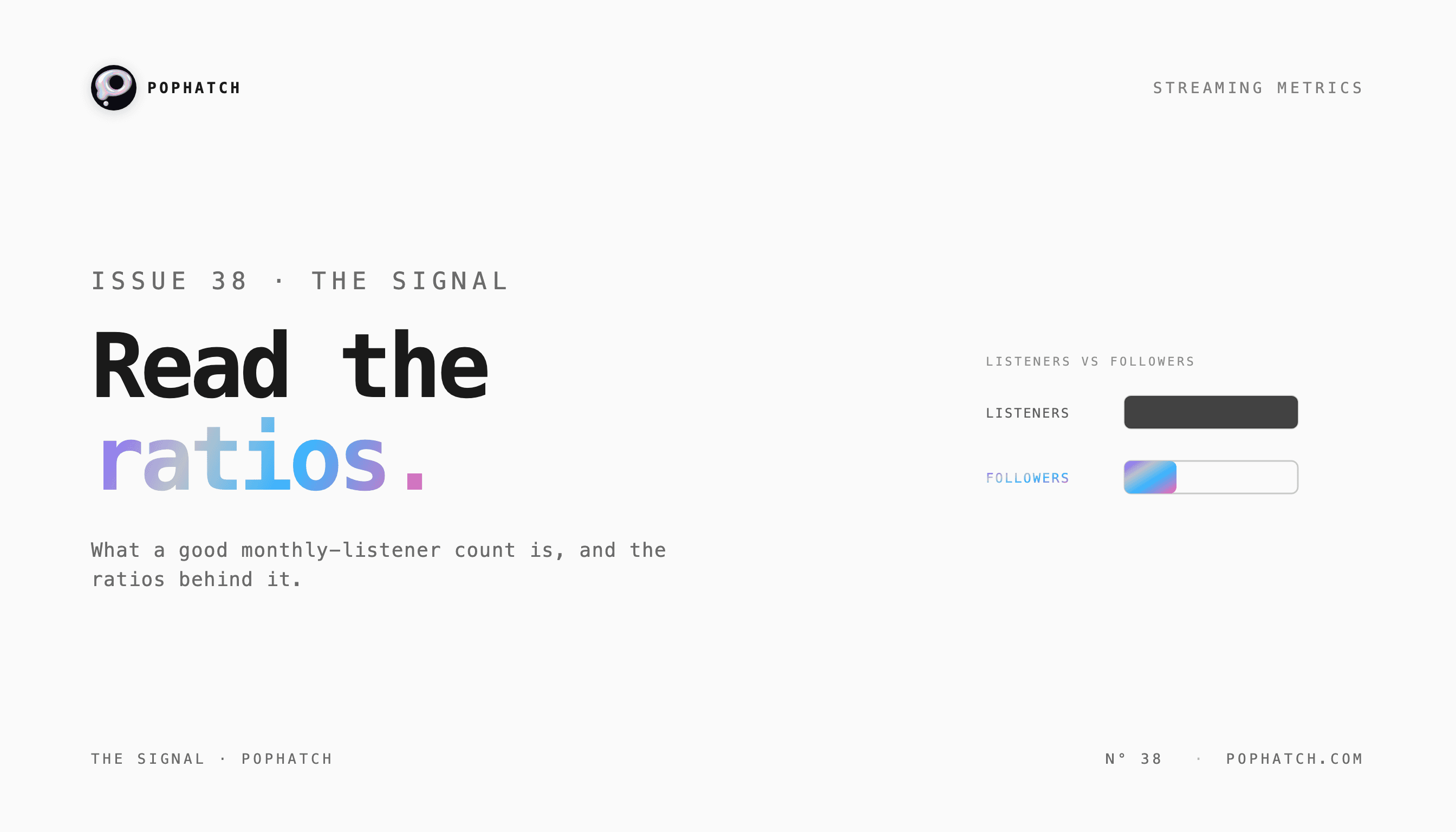
Monthly listeners is the number every artist refreshes and almost none of them can read. It goes up, it goes down, and on its own it tells you remarkably little, because the same count can mean a thriving small audience or a fragile large one. What it means depends on the numbers sitting next to it.
A good number of Spotify monthly listeners depends entirely on your stage and how the audience behaves, so there is no universal target. As a rough frame, a few hundred to a few thousand is normal early, the low tens of thousands marks clear momentum, and six figures is a substantial independent audience. The number alone is a vanity metric. What tells you whether an audience is healthy is the ratios around it: monthly listeners to followers, which shows how many listeners chose to commit, and listeners to saves and streams, which shows how deeply they engage. A smaller, high-ratio audience beats a larger, passive one. Read the ratios rather than the headline.
I sat in rooms at Warner where a big monthly-listener number got taken apart in about thirty seconds, because everyone knew the count was the start of the question rather than the answer. This guide gives you honest benchmark ranges, then the ratios that tell you where you stand and what to do next. The ranges are a general frame rather than a scientific standard, so treat them as orientation rather than a scoreboard.
What Are Spotify Monthly Listeners?
Monthly listeners is the count of unique accounts that played your music at least once in the past 28 days, and understanding that definition is the first step to not over-reading it. It is a rolling number, it resets its window constantly, and it counts anyone who pressed play even once, whether they are a devoted fan or a listener who got served your song in an algorithmic playlist and never chose you.
That definition has two consequences worth holding onto. The first is that monthly listeners is a reach number rather than a loyalty number, so a high count can include a large share of people who will never listen again. The second is that it moves with algorithmic placement, so a playlist add can spike it and a playlist drop can sink it, which makes week-to-week swings normal and often meaningless. Spotify's own definition of monthly listeners describes a unique-listener count over a rolling window, and that is exactly what it is.
This is why the number needs context to mean anything. Monthly listeners tells you how many people your music reached recently. It does not tell you how many of them care, how many will come back, or how many would ever pay you a cent, which is the gap between what those plays pay and what a true audience is worth. For that, you read the ratios around the number rather than the number itself.
What Is a Good Number of Monthly Listeners?
A good number depends on your stage, your catalog size, and your genre, so the honest answer is a range rather than a target. The ranges below are a general frame for orientation, drawn from what is typical rather than from a published standard, so use them to locate yourself rather than to grade yourself.
Stage | Rough monthly listeners | What it usually means |
Just released | A few hundred to low thousands | Early days; the work is finding your first room |
Building | Low tens of thousands | Clear momentum; an audience is forming |
Established independent | Tens of thousands to six figures | A substantial independent audience |
Professional scale | Six figures and up | A career-sized audience, often with a team |
These ranges are a general orientation rather than a scientific benchmark; what is good varies widely by genre, catalog size, and how the audience was built. A niche artist with a small, devoted audience can have a healthier business than a larger, passive count suggests.
The ranges come with a caveat that matters more than the ranges themselves. A count built by a devoted, engaged audience is worth far more than the same count built by algorithmic reach that will evaporate when the playlist moves on. Twenty thousand monthly listeners who save your songs, follow you, and come to shows is a stronger position than a hundred thousand who heard you once in a playlist and forgot. The stage frame is useful for locating yourself. It is useless for judging the health of what you have built, which is what the ratios are for.
Why Monthly Listeners vs Followers Matters More
The ratio of monthly listeners to followers tells you how many of the people reaching your music chose to commit, and it is a sharper read than either number alone. A follower made a deliberate decision to keep hearing from you. A monthly listener may have just pressed play once. The relationship between the two numbers shows how well your reach is converting into a true audience.

A diagram of the three ratios that read a monthly-listener count. First, listeners to followers: how many who heard you chose to follow, shown converting a wide bar to a narrower committed one. Second, listeners to saves: how deeply the audience engages. Third, monthly listeners to streams per listener: whether people play you once or on repeat. A caption reads: the ratios, not the count, tell you where you stand.
The three ratios to read, and what each tells you:
Monthly listeners to followers. A high share of followers means your reach is converting to commitment. A large listener count with few followers means you are being heard but not chosen, which points to a conversion problem, the same gap behind why views don't convert.
Listeners to saves. Saves are a deliberate act that survives the session. A healthy save rate means the people reaching your music are keeping it, which is the clearest sign of a true audience forming.
Monthly listeners to streams per listener. A high streams-per-listener ratio means a smaller group is playing you on repeat, which is depth. A low ratio means many people play you once and leave.
Followers also drive your follower-driven reach on Release Radar, so growing them does double duty. The point across all three ratios is the same: a smaller audience with strong ratios is a business, and a larger audience with weak ones is a billboard. The count tells you how many people glanced. The ratios tell you how many stayed.
How Do You Grow Monthly Listeners the Right Way?
You grow monthly listeners sustainably by converting reach into committed, engaged listeners, rather than chasing a spike that leaves when the playlist does. The number worth growing is the one backed by followers and saves, because that audience keeps coming back and pays off across everything else you build.
The levers that grow the durable version of the number:
Release consistently. Regular releases give the algorithm and your followers repeated reasons to return, which compounds the count over time rather than spiking it once.
Convert listeners to followers. Point new listeners to follow you, because a follower is a committed listener who keeps the number from collapsing between releases.
Earn saves. A song people save is a song the algorithm keeps serving and the listener keeps returning to, so write and sequence for the save rather than only the first play.
Find your true audience. Reach that matches your music converts; reach that does not evaporates. Targeting the right listeners is what turns a spike into a base.
Build toward depth. The goal is your superfans, the engaged core that makes a modest count a genuine career, rather than the biggest number.
A shape for how this goes. An artist obsessing over a flat monthly-listener count checks the ratios for the first time and finds the opposite of a problem: a small listener count, but a high follower ratio and strong saves. The audience is tiny and devoted, which is a far better position than she feared. The work is to serve the engaged base she already has and let it grow on its own terms, rather than to inflate the count.
Reading the ratios behind the number, and knowing whether the work is more reach or more depth, is exactly the kind of read the artist business partner prepares. PopHatch watches how your reach converts to commitment and helps you read your audience so a monthly-listener count becomes a decision rather than an anxiety. It prepares the read. You make the music and the moves, because the audience is yours to earn.
___
The count tells you how many glanced. The ratios tell you how many stayed, and which is the question that matters. PopHatch is the artist business partner that reads the ratios behind the number. Join the waitlist at pophatch.com.
Frequently Asked Questions

Written by
Oana Ruxandra
Founder & CEO, PopHatch
Oana Ruxandra is the founder and CEO of PopHatch, the artist business partner. She spent fifteen years inside the music industry, ending as Chief Digital Officer at Warner Music Group, where she grew digital revenue by $2B and negotiated first-of-their-kind deals with Apple, Spotify, YouTube, Amazon, Meta, and TikTok. She writes about the business of music from the inside, for the artists building careers on their own terms.