Oana Ruxandra, CEO of PopHatch. Former Chief Digital Officer at Warner Music Group.
Ask most artists what artist development means and they picture a label grooming a young act into a star. That picture is a decade out of date, and believing it keeps artists waiting for a phone call that stopped coming for almost everyone.
Artist development is the deliberate, ongoing work of turning a person who makes music into an artist with a lasting career: finding the sound through A&R, building the audience through marketing, reading the data to guide decisions, and running the business around it. Major labels once did all four for the artists they signed, patiently, across several records. They now reserve that work for a thin top tier and expect everyone else to arrive already developed. The functions still exist and are learnable, which means an independent artist can run the same development playbook for themselves.
Development was the promise the industry made to a few and quietly stopped making to everyone else. I watched that happen from the inside: the work stayed a set of learnable functions while the access to it narrowed. That gap is the reason I am building PopHatch.
Here is what artist development covers, what labels stopped doing, and how you build it for yourself.
What Does Artist Development Mean?
Artist development means investing in an artist over time so a talented person becomes a sustainable career, rather than a single release that rises and disappears. It is the difference between making a good song and building an act that can make good songs for years and earn a living from them.
The word covers a set of functions rather than a vibe. Development is the sound getting sharper, the audience getting larger and better understood, the positioning getting clearer, and the business getting sturdier, all on purpose and over more than one release. A label used to sequence that work across albums, absorbing early losses because it owned the long-term upside, a structure I broke down in how record labels make money.
The reason the term matters now is that the work did not disappear when the label deals dried up. An artist still needs their sound developed, their audience built, their data read, and their business run. The only question that changed is who does it, and increasingly the answer is the artist.
It helps to hear the word the way the industry uses it. Inside a label, artist development described both a department and a timeline: the people whose job was to grow an act, and the years over which they did it. Stripped of the jargon, it means the unglamorous, repeated work between talent and a career, the part that does not happen by accident and does not happen overnight. Naming it as a set of functions, rather than a mood or a stroke of luck, is the first step to running it yourself.
What Are the Four Functions of Artist Development?
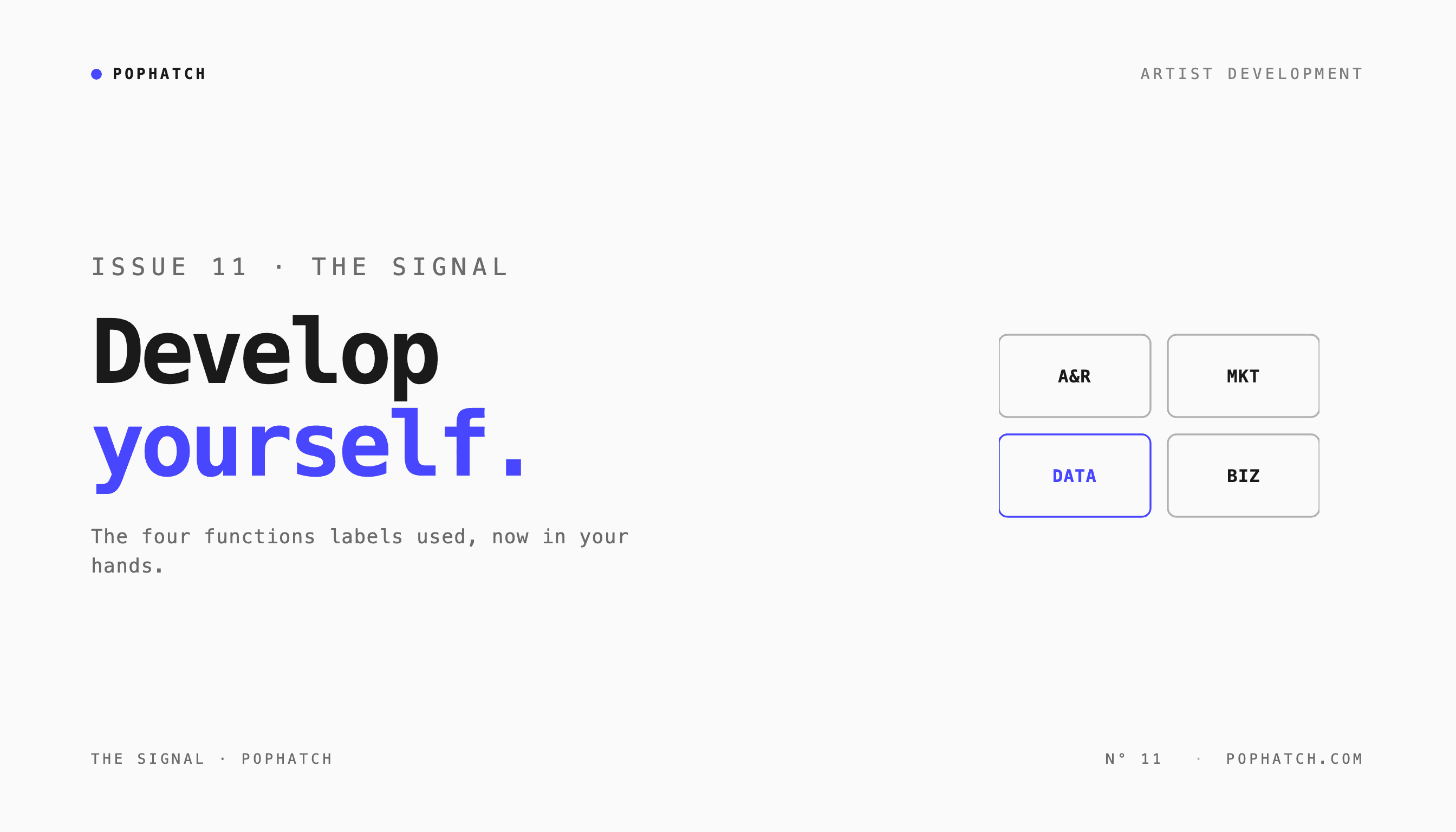
Artist development breaks into four functions: A&R, marketing, data, and business management. A label ran all four with staff and budget. An independent artist runs the same four with tools and decisions, which is the whole of what makes the modern path possible.

Diagram of the four functions of artist development arranged around a central artist: A&R and sound, marketing and audience, data and decisions, and business and rights.
Here is what each function is and how it moves from a label's building to your own hands.
Development function | What a label did | How you do it now |
A&R and sound | Signed talent, paired writers and producers, picked singles | Choose your songs and collaborators by reading your own audience and taste |
Marketing and audience | Ran radio, press, and campaigns to build a following | Grow and read your audience across streaming and social yourself |
Data and decisions | Read charts and research to guide the next move | Read your own dashboards to decide the release, the city, the spend |
Business and rights | Managed royalties, licensing, contracts, and money | Register your rights, choose your revenue streams, keep your masters |
Read the middle column as what you are replacing and the right column as how. None of it requires a building. A&R is taste applied to your own catalog. Marketing is audience-building you can now do from a phone. Data is reading dashboards you already have. Business is the rights and money work that decides what you keep. The functions are the same. The access is what opened up.
Each function rewards a closer look, because knowing what it involves is how you decide which to build first.
A&R and sound is taste applied with discipline. A label's A&R team heard a hundred demos to pick the one single, paired an artist with the right producer, and pushed for another draft when a song was merely finished. Your version is the same judgment turned on your own catalog: choosing which song leads, which collaborator sharpens you, and which idea is worth finishing. You have an advantage a label A&R never had, which is your own audience data telling you what already connects.
Marketing and audience is the work of finding and growing the people who care. A label ran radio, press, and paid campaigns to build a following from the outside in. You build yours from where you already stand, on the platforms where your listeners are, reading who they are and what turns a casual play into a follow. The tools that once needed a department now sit on your phone.
Data and decisions is the function that ties the others together. A label had research teams reading charts and panels to guide the next move. You have dashboards that show more about your own audience than those teams ever saw about theirs: where your listeners live, which songs they save, and how they found you. The data is the easy part. Deciding what to do with it is the work.
Business and rights is the function that decides what you keep. A label managed royalties, licensing, contracts, and catalog, and it held most of the value because it did that work. When you register your rights, join a performing rights organization, and keep your masters, you hold the value the label would have held. This is the least glamorous function and the most expensive one to neglect.
How Did Artist Development Work in the Label Era?
Artist development in the label era ran on patience and ownership. A label signed an act, absorbed the early losses, and built the career across several albums, because it owned the masters and the long royalty position that paid off if the artist broke.
The cycle was deliberate. A first album might lose money while the act found its sound and its audience. A second, stronger record widened the following. A third broke the artist, and the catalog the label now owned paid for decades. The label could afford to wait through two quiet records because the upside on the third, and on the catalog behind it, justified the patience. That was the trade at the heart of how the majors operated, and it is the same trade I unpack in how record labels make money.
Development staff made it work. A&R shaped the records, marketing built the audience, research read the market, and business affairs managed the rights and money, all coordinated toward a career rather than a single. The artist focused on the music while the label ran the functions around it.
That model produced much of the catalog the majors still sell, and it worked because the incentives lined up: the label spent on development because it captured the long-term value. When streaming broke that math, the spending followed the incentive, and development narrowed to the acts most likely to pay it back fastest. The functions did not stop mattering. The party willing to fund them changed.
What Did Labels Stop Doing, and Who Gets Development Now?
Labels stopped developing almost everyone. Full artist development now goes to a thin top tier of signed, priority acts, and the overwhelming majority of artists outside it are told to come back once they have grown, which is a request to develop themselves first and bring the results.
The math changed the behavior. Streaming made the early stages cheap to skip and the data fast to read, so labels learned they could wait, watch which independent artists were already climbing, and sign the ones who had done the development themselves. Funding three patient albums stopped making sense when an artist could arrive pre-validated with the audience already built.

Diagram showing artist development narrowing: a full four-function development pipeline now reaches only a thin top tier of signed priority acts, while the overwhelming majority of other artists are left to develop themselves.
The result is a gap, and the artists it hits hardest are the ones who most need help: the musician between a first release and a lasting career. The development function still exists inside the majors, pointed at the acts that least need it. Everyone else assembles a patchwork of a manager who may or may not have business depth, a distributor that moves files and reads no strategy, and scattered advice from forums and videos.
That patchwork is the problem, and the numbers show artists solving it anyway. Independent artists and labels together held 46.7 percent of global recorded music on an ownership basis in 2023, according to MiDiA Research, and in 2025 more than 13,800 artists each earned at least 100,000 dollars from Spotify alone, according to Spotify's Loud and Clear report. Careers are being developed outside the building.
Market figures change each reporting cycle. These were verified in mid-2026; check the current MiDiA and Spotify reports before citing them elsewhere.
What Artist Development Is Not?
Artist development is not the same as management, and it is not what a distributor does, which is why relying on either alone leaves a gap. Knowing the difference keeps you from assuming a role is covered when it is empty.
A manager coordinates and represents you, and a good one is valuable, though management is not the same as development. A manager may or may not have the business depth to run your rights, the data skill to read your audience, or the taste to A&R your catalog, and many managers of early-career artists are stretched across too many clients to develop any one of them deeply. Development is a set of functions; management is a relationship that may or may not deliver them.
A distributor moves your files to platforms and passes on your money, and little else. It reads no strategy, shapes no sound, and builds no audience. Treating a distributor as development is a common mistake, because the dashboard looks like help while the decisions stay entirely yours.
Development is also more than a single campaign or a lucky break. A viral clip is attention, and development is the work that turns attention into a career. The building is deliberate and repeated across releases, which is what separates an artist with a moment from an artist with a catalog.
How Do You Develop Yourself as an Artist?
You develop yourself by running the four functions in order and on a schedule, treating your career as one business rather than a series of unconnected releases. The label's discipline is the part to borrow, applied to your own catalog with your masters in your name.
Work the functions deliberately.
A&R your own catalog. Before a release, ask the label's questions: is the song finished or just done, where is the hook, which of these demos earns your attention first. Answer them by listening to your audience and your taste.
Build and read your audience. Grow your following across platforms, and read who is listening, where they are, and which songs convert a casual listener into a fan.
Turn data into decisions. Use your dashboards to choose the next single, the next city to play, and where to spend, rather than guessing.
Run the business. Register your rights, join a performing rights organization, put every co-write on a signed split sheet, choose your revenue streams, and keep ownership of your masters so the value compounds to you.
Sequence these over time rather than all at once. Development is patient by nature, which is why a label spread it across albums, and you can spread it across releases in the order that fits where you are. Building your income across streams, covered in build your revenue across streams, is the business function paying off over time.
If you are starting cold, begin with the function that is weakest, which for most artists is data. Claim your dashboards first, because every other decision improves once you can read your own audience. Let what you learn sharpen your A&R, use that clarity to grow your audience deliberately, and lock down the business as the income starts to matter. A musician who runs these four functions on purpose for a year has done what a label's development department would have done, and kept the ownership.
This is the work PopHatch is built to hold. The four functions a label used to run with a team, put in one place for the artist running their own career, is what the artist business partner does with you: it reads your audience, surfaces the next decision, and prepares the move, so you develop on purpose instead of by guesswork. It is also the throughline of what it means to be a professional musician now. You can study the full picture of modern artist development and decide which function to build first.
___
Development is a set of functions a label used to give the few. Running them for yourself, on purpose and in order, is the work, and PopHatch is the artist business partner that reads your audience and prepares each next move. Join the waitlist at pophatch.com.
Frequently Asked Questions

Written by
Oana Ruxandra
Founder & CEO, PopHatch
Oana Ruxandra is the founder and CEO of PopHatch, the artist business partner. She spent fifteen years inside the music industry, ending as Chief Digital Officer at Warner Music Group, where she grew digital revenue by $2B and negotiated first-of-their-kind deals with Apple, Spotify, YouTube, Amazon, Meta, and TikTok. She writes about the business of music from the inside, for the artists building careers on their own terms.