Your Stripe Dashboard Is Empty. Here's What to Do.
You built the thing. It works. You showed it to a few friends and they said it was cool. Now you need strangers to pay for it, and you have no idea where to find them.
This is the hardest transition in a solo founder's life. Building and selling require completely different muscles. You went from writing code in Cursor or Lovable to staring at an empty Stripe dashboard, wondering if anyone besides your mom will ever see your product. The good news: your first 10 customers aren't hiding. They're in a handful of specific places, talking about the exact problem you solve. You don't need a marketing strategy. You need to show up where they already are.
Here's how. Every tactic below is something you can start today with zero budget.
TL;DR: Your first 10 SaaS customers come from direct, personal effort, not funnels or ad campaigns. Go where your users are already complaining (Reddit, Slack groups, Discord), send 10 personal messages to people who match your ICP, write one post about the problem you solve, and ask your network for specific introductions. Track which tactic produces signups so you can double down on what works.
Why Are Your First 10 Customers Different From Every Customer After?
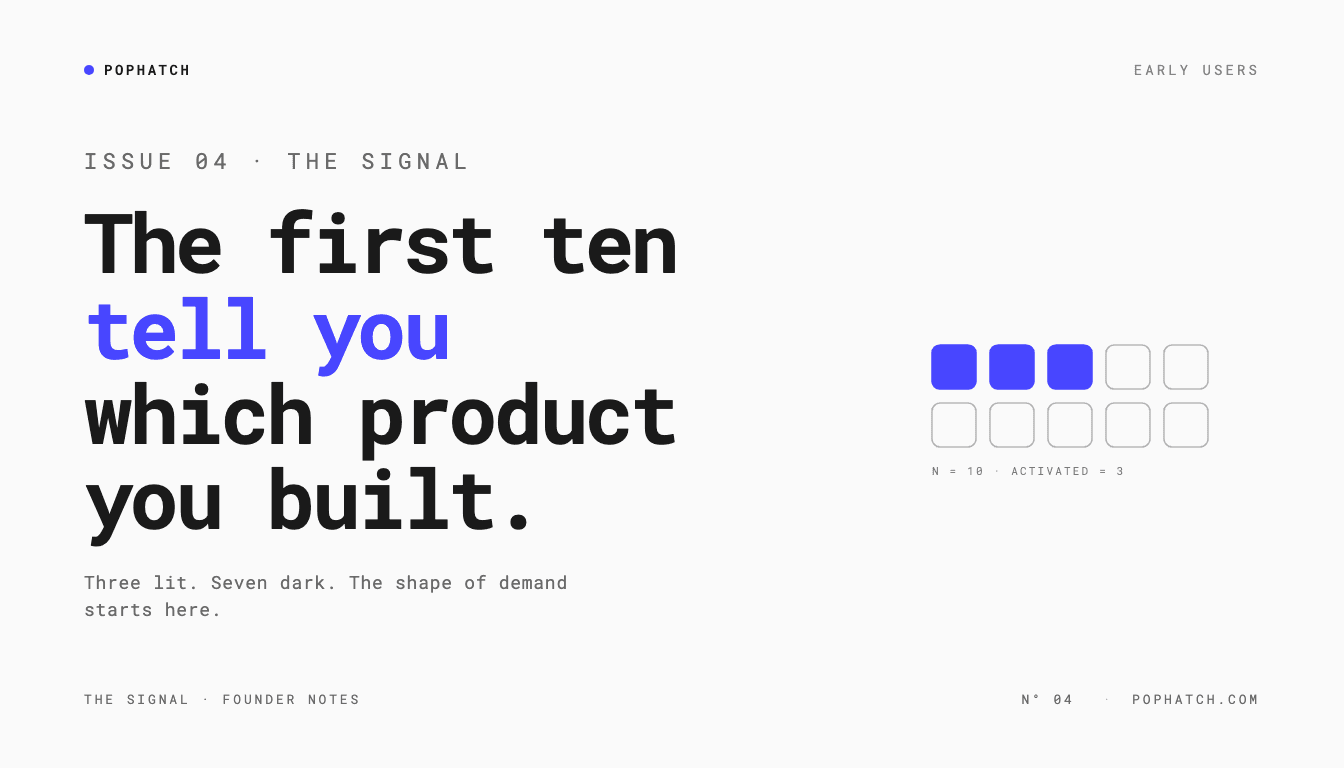
Your first 10 customers come from direct, personal effort, not from funnels, ad campaigns, or viral loops. You're not scaling anything yet. You're proving that people will exchange money for what you built. That proof changes everything that comes after it.
The dynamics of 0 to 10 are the opposite of 10 to 100. At 10 to 100, you're optimizing. At 0 to 10, you're searching. You need conversations, not conversions. Feedback, not data. One specific person saying "yes, I'll pay for this" is worth more than 10,000 landing page visitors who bounce.
Most founders skip this stage. They jump straight to Product Hunt launches and Twitter threads and paid ads. Then they wonder why nothing works. It doesn't work because those are amplification channels. You can't amplify what doesn't exist yet. First, you need to find 10 people who care. If you're stuck after launch, this is where to start.
Your first 10 customers come from one specific audience. If you're still describing them as 'small business owners' or 'modern teams,' you need examples of niche markets to see what specific looks like.
Where Should I Go to Find My First Customers?
Go where your target users are already posting about their problem. Reddit, Indie Hackers, niche Slack groups, Discord servers. They're not searching for your product. They're venting about the pain your product solves.
Here's the exact move. Go to r/SaaS, r/startups, r/SideProject, or r/Entrepreneur. Search for the problem your product addresses. Read 20 posts. Find 5 where the person is describing frustration, not just asking a hypothetical question. Now write a genuinely helpful reply. Don't mention your product. Explain what you'd do in their situation based on what you've learned building yours. Be specific. Name the tools, the steps, the numbers.
Do this every day for a week. After 3 to 5 comments where you've helped people, you'll notice something. People start clicking your profile. They see what you're building. Some of them DM you. That's your first lead.
Your Reddit profile bio should mention what you're working on and include your landing page link. Let them come to you. Pushing a link in a comment gets you banned. Being genuinely helpful gets you customers.
How Should I Do Direct Outreach Without Being Spammy?
Send 10 personal, specific messages to people who match your ideal customer profile. Direct outreach gets a bad reputation because most people do it terribly. They blast a generic message to 500 strangers. That's spam. Sending 10 personal messages to people who match your ICP isn't spam. It's a conversation starter.
Find 10 people on LinkedIn, Twitter/X, or in founder communities who match the exact profile of who your product is for. Look at their recent posts. Read what they're struggling with. Then send a message that references something specific they said and explains how you've been thinking about the same problem.
You're not pitching. You're opening a door. "I saw your post about struggling with X. I'm building something that might help. Would you be open to a 15-minute call so I can show you?" That's it. If 10 messages get you 2 calls and 1 customer, you're on pace.
The key is specificity. "Hey, I'm building a SaaS" is noise. "I saw you posted last week about your bounce rate being 80% on your pricing page, and I think I know why" is a conversation.
How Do I Write a Post That Attracts My First Users?
Write one post about the problem your product solves, not about the product itself. You've been heads-down building for weeks or months. You know things about the problem your product solves that most people don't. Write about it.
The format that works: "I talked to 50 people who were struggling with [problem]. Here's what I learned." Or: "I spent 6 months building a tool to solve [problem]. Here are the 3 things I got wrong at first." Lead with the insight, not the product. Let the product be the obvious next step for anyone who reads it and thinks, "that's me."
Post it on Tuesday or Wednesday morning. Those are the highest-engagement days on LinkedIn and most communities. If you're posting on Twitter/X, make it a thread. First tweet is the hook, last tweet is what you built. No link in the body of a LinkedIn post. Put it in the first comment or your bio instead.
One strong post can produce 5 to 10 inbound conversations. That's half your target right there.
How Do I Ask My Network for Introductions That Convert?
Ask for specific introductions, not vague ones. You already know people who know people who might need your product. The problem is you haven't asked them the right way.
Don't say: "Hey, can you share my product with anyone who might be interested?" That's too vague. Nobody acts on vague requests.
Say: "I'm looking for solo founders who launched a SaaS product in the last 3 months and are struggling to get their first paying users. Do you know anyone like that?" Now the person you're asking can think of a specific face instead of a general category. Specificity makes introductions happen.
Send this message to 20 people in your network. Friends, former colleagues, people you met at meetups. You need 2 to 3 warm introductions to get your next customer. Warm intros convert at 5 to 10x the rate of cold outreach because trust is already built.
Should I Launch on Product Hunt or in a Niche Community First?
Launch in a niche community first. Product Hunt, Hacker News, and big launch events are tempting. But they're noisy, competitive, and the audience is mostly other builders, not buyers. Your first 10 customers are more likely to come from a 500-person Slack group of people who share your exact niche than from a 5-million-visitor platform where you get 15 seconds of attention.
Find 2 to 3 niche communities. A Slack group for indie SaaS founders. A Discord server for your industry. A Facebook group where your target users hang out. Introduce yourself. Share your story. Offer early access or a discount for community members who want to try it.
This works because small communities have trust baked in. People see each other's names every day. A recommendation from a regular member carries more weight than a banner ad. Your goal is to become a regular member first, then introduce your product. Not the other way around.
How Do I Know Which Tactic Brought Me Those Customers?
Track which actions lead to which results so you can double down on what works. Here's where most founders stumble. You try 3 or 4 of these tactics in the same week. A customer signs up. You have no idea which tactic produced them.
You need a simple way to track. Ask every new signup how they found you (a single question in your onboarding flow). Use different landing page URLs for different channels. Keep a spreadsheet where you log what you did each day and what happened in the 48 hours after.
This is the difference between activity and learning. You're not just trying tactics. You're running small tests and paying attention to what happens.
Your first 10 customers will probably come from 1 or 2 of these channels, not all of them. The goal isn't to be everywhere. It's to find the one place where your message resonates and go deep. If you're getting traffic but no signups, the problem has shifted from distribution to conversion.
Once you've got 10 customers, the next read is on behavioral PMF patterns. Five patterns to watch for, three conversations that tell you everything.
Once you've found your first 10, the game changes. You'll have feedback from people who paid. If you want a week-by-week plan for what to do next, read Your First 30 Days After Launch.
PopHatch tracks your tests and tells you which ones moved the numbers, so you can double down on what's working instead of repeating what isn't. Start your diagnosis