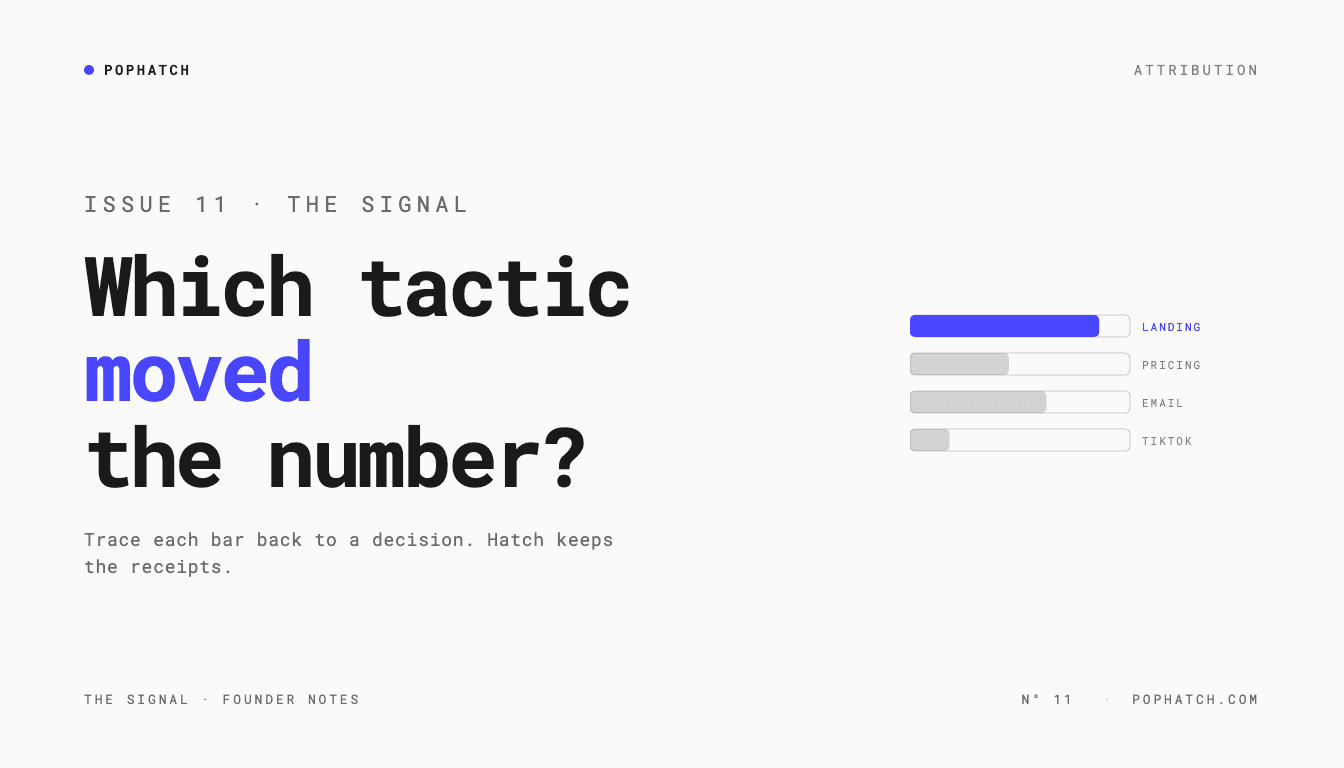
You Got Signups. You Have No Idea Why.
You changed your landing page copy on Monday. Posted in r/SaaS on Tuesday. Sent 15 cold emails on Wednesday. Tweaked your pricing on Thursday. By Friday, you had 4 new signups.
Good news: something worked. Bad news: you have no idea what.
So you do what most founders do. You double down on whatever felt the most productive. Usually that's the thing you enjoyed doing, not the thing that converted. You liked writing the Reddit post, so you assume Reddit is working. The cold emails felt painful, so you assume they flopped. None of this is based on data. It's based on vibes.
This is the most common trap in early-stage marketing. You're running five experiments at the same time and calling it "testing." It's not testing. It's chaos. And it's costing you the one thing you can't get back: time.
TL;DR: If you're running multiple marketing tactics in the same week and can't tell which one is producing signups, you have an attribution problem. The fix: test one channel at a time for one week, track results with UTM parameters and a "how did you hear about us" question, and make a keep-or-kill decision before moving to the next tactic.
How Do I Know Which Marketing Channel Is Working?
When you change multiple variables at the same time, attribution becomes impossible. This isn't a data problem. It's an experimental design problem.
Think about it. You changed four things in the same week. Then signups happened. Was it the new landing page copy that convinced them? Was it the Reddit post that brought them? Was it the lower price that closed them? Was it the cold email that caught their attention? You cannot know. The data doesn't exist to answer that question because you didn't create the conditions to measure it.
That guessing has a cost. You'll pour weeks into a channel that isn't converting because it "felt right." You'll abandon a tactic that was working because you couldn't see its contribution. You'll stay stuck, not because you're lazy, but because you're optimizing blind.
If you feel stuck after launch, this is often why.
Should I Test One Channel at a Time or Multiple Channels?
Test one channel at a time. Wait long enough to see the result. Make a keep-or-kill decision. Move to the next thing. Here's the principle that changes everything.
This sounds painfully slow. It isn't. It's faster than what you're doing now. Running five things in parallel and learning nothing from any of them wastes far more time than running one thing, learning from it, and moving on.
Here's what "one variable" means in practice.
A channel test. You want to know if Reddit works for you. So for one week, Reddit is your only distribution activity. You don't send cold emails. You don't post on LinkedIn. You don't change your landing page. You write 3 posts in your target subreddit over 5 days. You track how many people visit your site from those posts and how many of them sign up. At the end of the week, you have a number. That number tells you whether Reddit is worth continuing.
For shipping product changes alongside channel tests, the same discipline applies in a different form. A controlled feature rollout exposes the change to a percentage of users so you don't lose users you can't afford to lose.
A messaging test. You want to know if your headline is the problem. So you change the headline and nothing else. Same traffic sources. Same pricing. Same everything. You run the new headline for one week and compare signups to the previous week. Did the number change? That's your answer.
A pricing test. You think your price is too high. So you lower it for one week. Same landing page. Same channels. Same message. Did conversions go up? If yes, price was a factor. If no, price wasn't the blocker.
The principle of one variable at a time is what separates testing from chaos. The article on stopping the change-everything-at-once trap covers the underlying framework.
Each of these tests takes about a week. In a month, you can run four clean tests and know more about your business than most founders learn in a quarter of chaotic parallel activity.
How Do I Track Marketing Results Without Enterprise Analytics?
You need four things to track marketing results at small scale, and they're all free. No Mixpanel. No $500/month attribution platform. Not even a perfectly configured Google Analytics.
UTM parameters. Every link you share gets a UTM tag. When you post on Reddit, the link is yoursite.com/?utm_source=reddit&utm_medium=post&utm_campaign=test1. When you send a cold email, it's yoursite.com/?utm_source=email&utm_medium=cold&utm_campaign=test1. Your analytics tool (any of them) will show you which UTM source generated the visit.
A simple tracking spreadsheet. Open a Google Sheet. Four columns: what you changed, the date you changed it, what metric you're watching, and what happened. That's it. Update it every time you run a test. After a month, this sheet will tell you more than any dashboard.
A "how did you hear about us" question. Add it to your signup flow. One field. Dropdown or free text. It sounds too simple to be useful. It's the single most reliable attribution method at small scale. When you have 8 signups and 6 of them say "Reddit," you know where to focus.
Dedicated landing pages. If you're testing two channels at the same time (which is fine, as long as each channel gets its own landing page), create yoursite.com/reddit and yoursite.com/email. Different URLs, same product. Now you can see exactly which channel is sending people.
None of this is complicated. It just requires doing it before you start the test, not after. The 10 minutes you spend tagging links and setting up a spreadsheet will save you weeks of guessing later.
If people are arriving but not converting, that's a different problem. Read Traffic But No Signups or How to Tell If the Problem Is Your Product or Your Marketing.
How Do I Make a Keep-or-Kill Decision on a Marketing Tactic?
Keep it if it produced signups and the effort was sustainable. Kill it if you ran a clean test for a full week and got zero response. Test further if you got engagement but no signups.
Keep it if: the tactic produced signups (even one or two) and the effort was sustainable. You can do it again next week without burning out. That's a pattern worth pursuing.
Kill it if: you ran a clean test for a full week and got zero response. Not low response. Zero. No clicks, no visits, no engagement at all. That's a clear indicator that this channel or this message isn't connecting with your audience.
Test it further if: you got some engagement (clicks, replies, DMs) but no signups. That's a positioning gap, not a channel failure. The people are there and they're interested, but something between "interested" and "signed up" broke down. Was the landing page confusing? Was the CTA unclear? Was there too much friction in the signup flow?
The mistake most founders make is killing tactics too early or keeping them too long. A tactic that produced 2 signups in week one is worth running for week two. A tactic that produced 0 engagement for two consecutive weeks is dead. Let it go.
Why "Feeling Like It's Working" Is Costing You
Most solo founders make marketing decisions based on feelings, not data. And feelings are expensive.
You "feel like" Twitter is working because you got some likes on a thread. But likes aren't signups. You "feel like" cold email is a waste of time because it's uncomfortable. But three of your first 10 users came from cold emails and you didn't know because you weren't tracking.
Your feelings about a marketing channel are shaped by whether you enjoy doing it, not whether it converts. Reddit feels good if you're a natural commenter. Cold outreach feels terrible if you're introverted. LinkedIn feels productive because the algorithm gives you vanity metrics. None of those feelings correlate with results.
This is why tracking matters even at tiny scale. It protects you from your own biases. When you have a spreadsheet that says "Reddit: 4 signups. Cold email: 6 signups. LinkedIn: 0 signups," you stop investing in the thing that feels good and start investing in the thing that works.
What Do I Do If I'm Doing Everything and Nothing Is Working?
Stop everything for 48 hours. Pick the one channel that has shown the most promise. Run it for a full week. Track it. Then move to the next channel.
If you're reading this and realizing you've been running five things at once, here's how to untangle it.
First, stop everything for 48 hours. Seriously. No new posts, no new emails, no landing page changes. Let your current tests finish producing whatever data they're going to produce.
Second, pick the one channel that has shown the most promise. "Most promise" means the most signups, not the most engagement. If nothing has produced signups, pick the channel where you had the most genuine conversations with potential users.
Third, run that one channel for a full week. Track it using the methods above. At the end of the week, make your keep-or-kill decision.
Fourth, move to the next channel. Run it for a week. Compare the results to the first channel.
In a month, you'll have tested four channels cleanly. You'll know which ones produce signups and which ones produce noise. You'll have a strategy instead of a hope-based one.
PopHatch proposes the next test based on your data, tracks the result, and tells you what it means. Start your diagnosis
What's the Difference Between Activity and Learning?
Activity is posting, emailing, tweaking, and going to bed feeling productive. Learning is doing those things, tracking the results, and knowing which one converted. Here's the dividing line between founders who find growth and founders who stay stuck. It's not effort. Everyone's working hard.
Activity keeps you busy. Learning makes you less wrong every week.
Every experiment you run should end with one of three conclusions: this worked (keep doing it), this didn't work (stop), or the results are unclear (redesign the test). If you can't reach one of those conclusions, the experiment was badly designed. Fix the design, not the effort.