You Launched. Now What?
You launched. The adrenaline spike lasted maybe a day. Now it's Tuesday morning and you're sitting at your laptop wondering what you're supposed to be doing. Your dashboard shows some traffic. Maybe a signup or two. But you don't have a plan for what comes next, and every hour feels like you're either doing the wrong thing or doing nothing at all.
That feeling isn't failure. It's the absence of structure. Most founders launch without a post-launch plan because all their energy went into the build. The product is done. The landing page is up. And now the work that nobody teaches you how to do starts.
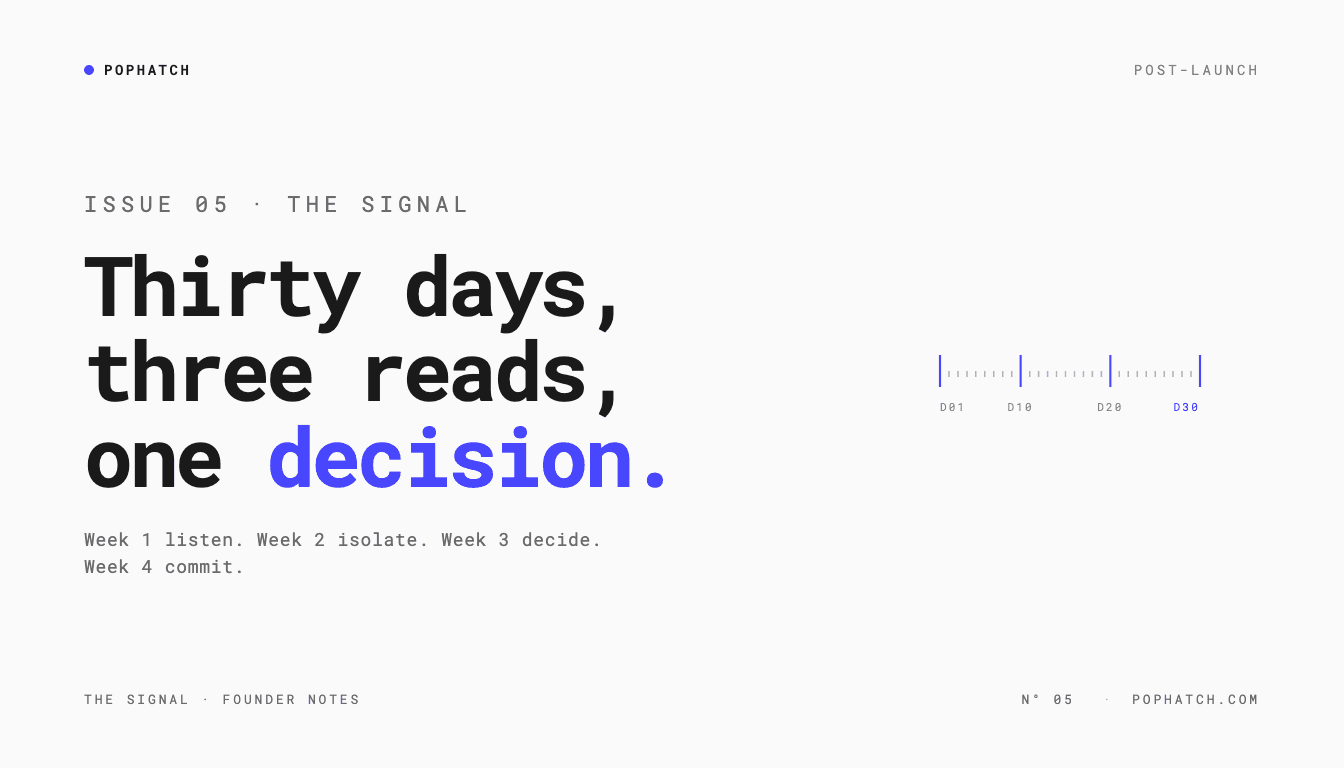
This is your plan. Four weeks. One job per week. Every action has a purpose. If something isn't producing data by the end of its window, you stop and move to the next thing. That's not giving up. That's being systematic about finding what works.
TL;DR: Your first 30 days after launch should follow a structured plan. Week 1: get the product in front of people and observe. Week 2: interpret why they did or didn't respond, then make one change. Week 3: double down on the channel that's working and cut what isn't. Week 4: audit your numbers, kill dead channels, and build your Month 2 plan based on evidence.
Week 1: How Do You Find Out If Anyone Cares? (Days 1 to 7)
Your only job in Week 1 is to get your product in front of people and observe what happens. You're not optimizing anything. You're not building new features. You're gathering raw data about whether the problem you're solving resonates with the audience you chose.
Set Up Your Listening Posts
Before you do anything else, make sure you can see what's happening. Install Google Analytics 4 if you haven't already. Set up a simple event for your most important action (signup, trial start, purchase). You don't need a complex analytics stack. You need to answer one question: when someone lands on your page, do they do the thing you want them to do?
Also set up a way to ask people how they found you. A single question in your signup flow. A short Typeform after onboarding. This data becomes essential in Week 2 when you're figuring out which channels work.
Start 3 to 5 Conversations Per Day
Go to the communities where your target users hang out. r/SaaS, r/startups, r/SideProject, r/Entrepreneur, niche Slack groups, Discord servers for your industry. Find posts from people describing the problem your product solves. Write helpful replies. Be specific. Be useful. Don't pitch.
Your goal isn't signups this week. It's conversations. You want 15 to 25 interactions with potential users by Friday. Some will visit your site. Some will sign up. Most won't. That's fine. You're building presence and gathering language, the exact words people use to describe the problem you solve.
Send Your First 10 Direct Messages
Identify 10 people on LinkedIn, Twitter/X, or in founder communities who match your ICP. Send each one a personal, specific message. Reference something they posted recently. Explain what you're working on. Ask if they'd be open to a quick call. Not a pitch. A conversation.
Week 1 Checkpoint
By Day 7, you should know: Did anyone sign up? Did anyone engage with your community posts? Did anyone reply to your direct messages? What exact words did they use when they described their problem? Write down the answers. You'll need them next week.
Week 2: How Do You Figure Out Why (or Why Not)? (Days 8 to 14)
Week 1 gave you raw data. Week 2 is about interpreting it. Your job now is to figure out why people did or didn't respond, and make one adjustment based on what you learned.
Read Your Week 1 Data
Look at your analytics. How many people visited your site? Where did they come from? What percentage signed up or took the action you wanted? If your conversion rate is below 3%, the problem is likely your landing page, not your traffic source. If it's above 3% but signups are low, the problem is traffic volume, not your message. Traffic But No Signups: Diagnosing the Problem
Look at your outreach responses. Which messages got replies? What did those messages have in common? Which communities generated the most profile clicks or site visits?
Talk to Anyone Who Signed Up
If you have signups, email every single one. Not an automated drip. A personal email from you. "Hey, I saw you signed up for [product]. I'm the founder. I'd love to hear what made you try it and whether it's solving the problem you expected it to." Schedule calls with anyone who replies. These conversations are worth more than any amount of analytics data right now.
If nobody signed up, that's data too. Go back to the communities where you posted and re-read the responses. Did people engage with your advice but not visit your site? Your community presence is working but your profile or link isn't compelling enough. Did people visit but not sign up? Your landing page isn't converting. Did nobody engage at all? You're in the wrong community, or you're solving a problem this audience doesn't care about. How to Tell If the Problem Is Your Product or Your Marketing
Make One Change Based on What You Learned
Not five changes. One. If your landing page isn't converting, rewrite the headline using the exact language people used in community posts. If your outreach isn't getting replies, try a different opening line that references a more specific problem. If you're getting engagement in one community but not another, drop the dead one and double your effort in the live one.
One change per week means you can tell what made the difference. Change five things at once and you learn nothing.
Week 2 Checkpoint
By Day 14, you should know: Is the problem resonating with the audience you chose? Which channel produced the best response? What's the one thing you changed and did it improve results? Document everything. Week 3 builds on this.
Week 3: How Do You Double Down on What's Working? (Days 15 to 21)
You've been at this for two weeks. You have some data. Maybe one channel is clearly outperforming the others. Maybe a specific message or angle is getting more response. Week 3 is about doing more of what works and cutting what doesn't.
Increase Your Effort in the Winning Channel
If Reddit is producing signups, post more often. If direct outreach is converting, send 20 messages this week instead of 10. If a specific LinkedIn post drove traffic, write two more with the same angle.
The temptation is to add new channels. Resist it. You don't have enough data yet to spread yourself thin. Your first 10 customers will probably come from one or two places, not five. Go deeper, not wider.
Ask for Referrals From Early Users
If you have any active users, now is the time to ask them for help. "Do you know anyone else dealing with [specific problem]? I'd love to help them too." Give them a specific description of who you're looking for. Don't say "anyone who might benefit." Say "solo founders who launched a SaaS product in the last 3 months and are struggling to convert free users to paid."
Warm referrals convert at 5 to 10 times the rate of cold outreach. One happy early user can produce your next 3 customers if you make it easy for them to connect you.
Start Documenting What You're Learning
Write a short post about what you've discovered so far. What worked, what didn't, what surprised you. Publish it on LinkedIn, in a community, or on your own blog. Building in public does two things: it attracts other founders who relate to your story, and it forces you to think clearly about your progress.
Week 3 Checkpoint
By Day 21, you should know: Which channel is your strongest? How many active users or paying customers do you have? Are early users using the product, or did they sign up and disappear? What's the one insight from Week 3 that changes your approach for Week 4?
Don't ship Week 3's improvement to your entire user base on Tuesday morning. Use the A/B rollout guide to expose it to 25 percent first and watch what happens.
Week 4: How Do You Decide What's Next? (Days 22 to 30)
The experimental phase isn't over, but you now have enough data to make decisions. Week 4 is about assessing what the first three weeks taught you and building a plan for the next 30 days based on evidence instead of guesses.
Audit Your Numbers
Pull together the data from all four weeks. Total signups. Conversion rate from visitor to signup. Which channels produced which results. How many of your signups became active users. How many converted to paid. Write it all down in one place. How to Know Which Marketing Tactic Worked
If you have paying customers, look at what they have in common. Did they come from the same channel? Do they share a demographic or company size? Did they describe the problem the same way? Patterns in your first 10 customers tell you where your next 50 will come from.
Kill What Isn't Working
If a channel produced zero results after three weeks of consistent effort, stop investing time in it. This isn't a judgment call. It's math. You have limited time and every hour spent on a dead channel is an hour not spent on a live one.
This is hard for founders because it feels like quitting. It's not. It's reallocating. The best founders don't do more things. They do fewer things better. What to Do When Your SaaS Has No Users
Build Your Month 2 Plan
Take what worked in Month 1 and turn it into a repeatable process. If Reddit outreach produced your best customers, build a daily routine: 30 minutes every morning, 3 to 5 helpful comments, track which posts generated profile visits. If direct outreach worked, build a target list of 50 new people for the next month.
Your Month 2 plan should have one primary channel, one secondary channel, and a weekly check-in where you look at the numbers and decide whether to adjust.
By Week 4 you should be able to say which marketing tactic worked. If you can't, the channel testing framework will tell you why and how to fix attribution.
Week 4 Checkpoint
By Day 30, you should know: Do people want what you built? Which channel is your primary acquisition path? What's your conversion rate from first touch to paying customer? What will you do differently in Month 2?
Day 31: What Comes Next?
If you followed this plan, you're not guessing anymore. You have data. You know which channels work. You know which messages resonate. That's a foundation most solo founders never build because they skip the structured first month and jump straight to tactics.
The challenge now is keeping this process going. Every week should still have one job. Every test should still be tracked. Every decision should still be based on what the data shows, not what you hope it shows.
PopHatch runs this process continuously. It proposes specific tests based on your data, tracks results across everything you try, and tells you what the numbers mean so you can focus on execution instead of interpretation.