Oana Ruxandra, CEO of PopHatch. Former Chief Digital Officer at Warner Music Group.

A fan subscription is the most oversold move in the independent playbook. Every guide tells you to start one, few tell you when, and an empty Patreon page does more quiet damage to momentum than no page at all. The timing is the whole decision.
Start a Patreon when you already have a group of proven superfans who buy what you make and want more access than releases give them, not before. The readiness test is behavioral: you have a direct channel of a few hundred engaged people, you've sold at least one thing successfully, and fans are already asking for more. When you launch, offer access and connection rather than discounts, price two or three simple tiers, and expect a small fraction of your list to convert. Patreon charges 10 percent of what you earn plus payment processing; Ko-fi and Fourthwall cost less for smaller or occasional support. A subscription rewards demand that already exists. It rarely creates demand from nothing.
The instinct to launch a subscription during a slow stretch, hoping recurring income will steady the ship, is the exact wrong time. A subscription is a promise to keep delivering to people who pay monthly, and making that promise while depleted or before the audience exists sets up a page that stalls in month two. This piece covers the readiness test, what to offer, how to price, and how Patreon compares to the alternatives, so you start one when it will work.
When Should a Musician Start a Patreon?
Start when the demand is already visible, measured by behavior rather than hope. The clearest signal is that fans have started asking for more of you than your releases provide, more access, more frequency, a way to support you directly. When people are trying to give you money and you have nowhere to put them, you are ready. Until then, a subscription is a solution waiting for a problem.
Three conditions tend to be true when a Patreon works, and they build on each other. You have a direct channel, an email list or community, of at least a few hundred engaged people you can reach without an algorithm's permission. You have sold something successfully at least once, a merch drop, a physical release, a pay-what-you-want download, so you know a slice of your audience will pay. And you can commit to a delivery rhythm you can sustain for a year, because a subscription is recurring by nature and a page that goes quiet loses members fast.

A readiness gate for launching a fan subscription. Three conditions must be met before the "launch" path opens: a direct channel of a few hundred engaged fans, at least one successful paid offer, and a sustainable delivery rhythm. Missing any one routes to "build that first."
The honest version of this advice is that most artists asking the question are not there yet, and that is fine. Being pre-subscription is a stage with its own work: growing the direct channel and running the first paid offers that prove demand. Launching too early teaches your most engaged fans that your subscription is quiet, which is a hard first impression to undo.
Do I Have Enough Fans for a Subscription?
You have enough when a countable group already chooses you across surfaces, and the number is smaller than most artists fear. Kevin Kelly's 1,000 True Fans essay set the frame years ago: a creator needs only a few hundred to a thousand people willing to spend meaningfully to make a living, and a subscription is one way those fans spend. You do not need a hundred thousand monthly listeners. You need a few hundred people who would miss you if you disappeared.
The useful count is not monthly listeners. It's your superfans: the people who stream on repeat, follow across platforms, buy merch, and show up. A rough planning ratio, borne out across direct-to-fan pages, is that a low single-digit percentage of an engaged email list will convert to a paid subscription, and a smaller fraction of casual followers will. Two hundred true superfans might yield a starter tier of ten to thirty paying members, which is a solid beginning and a modest income rather than a salary.
Conversion rates vary widely by genre, audience warmth, and offer quality; treat any percentage as a planning estimate to test rather than a promise.
That math is the point of honest gating. If your engaged direct list is 40 people, a subscription will convert a handful and feel like a ghost town, which discourages you more than launching later would. If it is several hundred warm names, you have the base a subscription needs. The threshold is a direct, engaged audience, and building that audience is the work that comes before the page.
What Should You Offer Patreon Subscribers?
Offer access, connection, and things only you can give, rather than discounts on what fans could buy anyway. The mistake that kills music Patreons is treating them like a store with a coupon. People do not subscribe monthly to save two dollars on a shirt. They subscribe to get closer to an artist they already love, so the offer has to trade in closeness.
The categories that consistently work:
Early listens before release, demos and voice memos, works in progress, the version of you fans never see on the polished feed.
A community space, monthly live streams, Q&As, direct replies, the sense of a room rather than a broadcast.
Exclusive tracks, name-in-the-credits, physical mail like postcards or handwritten notes, limited items that only members get.
Behind-the-scenes on how songs get made, which many fans find as compelling as the finished song, and which costs you little because it is your ordinary workday.
The unifying principle: subscribers are paying for a relationship, and the best rewards deepen one. A monthly voice note about what you're working on outperforms a discount code, because it gives the feeling no store can. Keep the promises small enough to keep forever. A tier that requires a new exclusive song every week will bury you by month three, and burying yourself is how pages die.
How Should You Price Your Tiers?
Price two or three simple tiers, anchored around a middle option most people pick, and resist the urge to build a complicated ladder. Choice overload lowers conversion, and every tier you add is another promise you have to keep every month. Most successful music subscriptions run on three tiers or fewer.
A structure that works for most artists starting out:
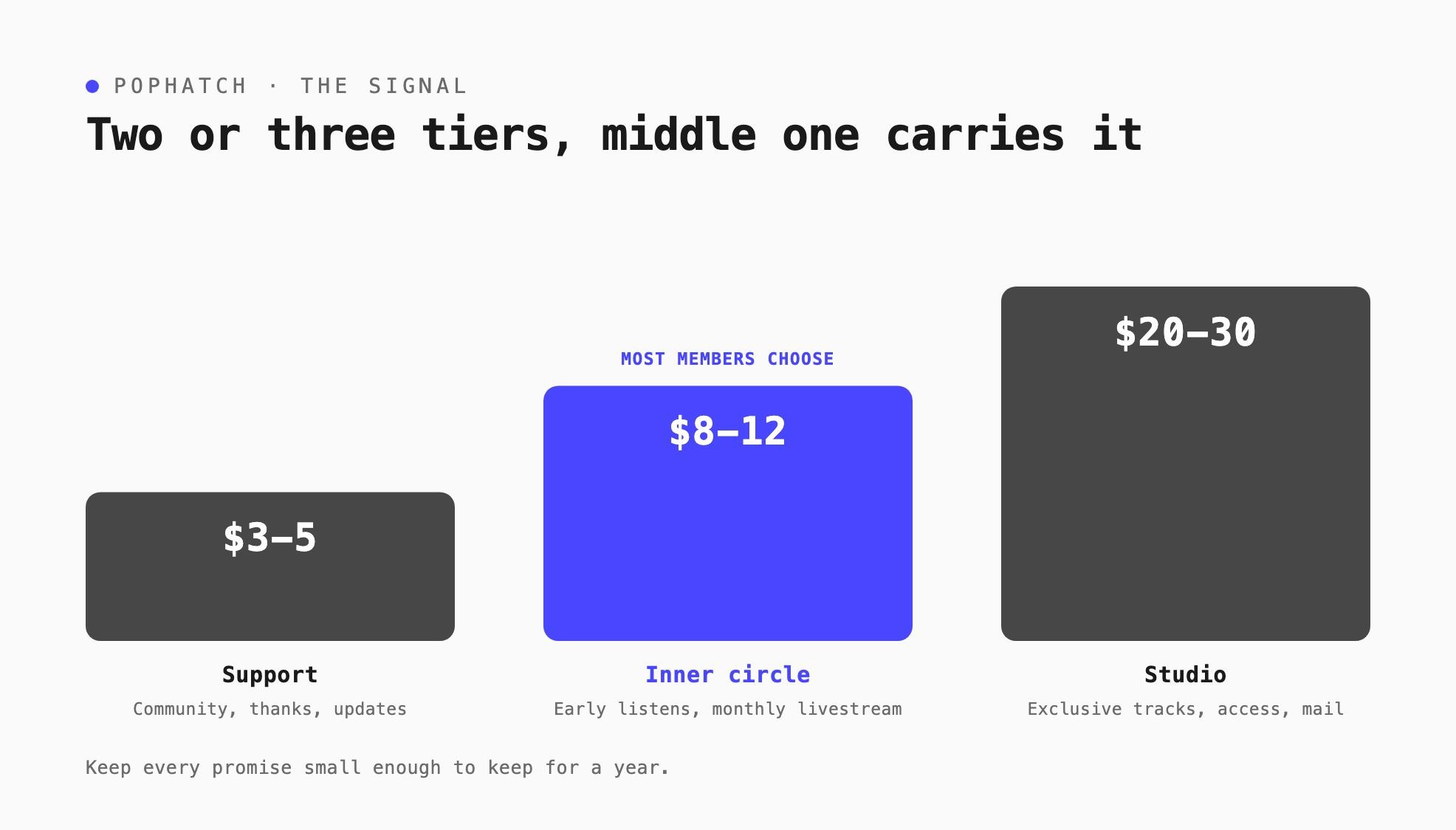
A three-rung membership tier ladder. The bottom rung is a low-price support tier with community access and thanks. The middle rung, marked as the one most members choose, adds early listens and monthly livestreams. The top rung adds exclusive tracks and personal access. A note beside it reads: keep every promise small enough to keep for a year.
Tier | Monthly price range | What's inside | Who it's for |
Support | $3 to $5 | Community access, monthly update, early feed posts, thanks | Fans who want to chip in and belong |
Inner circle (most popular) | $8 to $12 | Everything above, plus early listens, demos, monthly livestream | Superfans who want closeness and access |
Studio | $20 to $30 | Everything above, plus exclusive tracks, name in credits, occasional mail | The deepest fans who want ownership and contact |
Design the middle tier to be the obvious best value, because it will carry most of your revenue. Name the tiers in your world rather than "Bronze, Silver, Gold," since the naming is part of the experience. And set prices you would happily deliver against for a year, because raising prices later is easier than walking back promises you cannot sustain.
Patreon vs Ko-fi vs Fourthwall: Which Platform?
Choose Patreon for a structured membership you'll run monthly, Ko-fi for lightweight tips and occasional support, and Fourthwall when merch sits at the center of your offer. The fee differences are wide, and they matter more the smaller you are, because a percentage of a small number still stings.
Here is how the three compare on cost and fit as of August 2026.
Platform | Platform fee | Monthly cost | Best for |
Patreon | 10% of income, plus payment processing | Free to start | Structured monthly memberships with tiers and community |
Ko-fi | 0% on tips, 5% on shop and memberships (free plan); Ko-fi Gold removes it | $0, or $12/mo for Gold (0% fees) | Tips, occasional support, low-overhead starts |
Fourthwall | 0% on products, 5% on memberships and digital | Free, no monthly fee | Artists whose offer centers on merch and physical goods |
Platform fees and plan prices change; these figures come from [Patreon's pricing](https://www.patreon.com/pricing), [Ko-fi's pricing](https://ko-fi.com/pricing), and Fourthwall's pricing pages as of August 2026. Confirm current rates before you commit, and remember payment-processing fees apply on top of every platform's cut.
The pattern in the table: Patreon charges the most and gives the most structure for a full membership, community, tiers, analytics, podcast tools. Ko-fi is the cheapest way to let fans tip or support you without a monthly commitment, and its Gold plan drops fees to zero for a flat fee once your volume justifies it. Fourthwall shines when your subscription is primarily a merch relationship, because it takes nothing on products and builds a storefront around them. Pick the one that matches the offer you intend to deliver rather than the one with the biggest name.
How to Launch Yours in the Next 30 Days
If you pass the readiness test, you can launch a subscription that starts warm rather than empty by treating the first month as a deliberate sequence. The difference between a Patreon that lands and one that stalls is almost always the launch, not the platform.
Confirm readiness. Check the three conditions: a direct channel of a few hundred engaged fans, one successful paid offer behind you, and a delivery rhythm you can sustain. If any is missing, build that first and revisit in a quarter.
Design two or three tiers. Use the structure above, make the middle tier the obvious value, and write down exactly what you owe each tier per month. If the list scares you, cut it.
Seed it privately. Before any public launch, invite your ten to twenty closest superfans in first. A page that already has members when the public sees it converts far better than a page at zero.
Announce to the direct channel first. Email and message your warm list before you post publicly, because those people convert highest and their early joins create the proof everyone else needs to see.
Deliver visibly for 90 days. Keep every promise on schedule for the first three months, because the early experience sets retention. Then read the numbers and adjust tiers or cadence from what happened.
A shape for how this goes. An artist with a 900-person email list and two sold-out merch drops launches three tiers, seeds the top tier with 12 superfans she messages personally, then emails the full list. She converts 34 members in the first month, most on the $10 middle tier, for a few hundred dollars of recurring income. It is not a salary. It is a floor that grows as she keeps delivering, and it sits on top of the wider revenue stack rather than replacing it.
Knowing whether you've crossed the readiness threshold, and which superfans to invite first, is exactly the read the artist business partner prepares. PopHatch watches how deep your audience runs, flags when the demand for a subscription is there, and helps you plan your monetization in the right order, so you launch the page when it will fill rather than echo. You run it. It helps you time it.
___
A subscription rewards fans who already chose you; it rarely conjures them. PopHatch is the artist business partner that tells you when your superfan base can carry a Patreon and prepares the tier plan, so you launch it at the moment it fills. Start your free trial at pophatch.com.
Frequently Asked Questions

Written by
Oana Ruxandra
Founder & CEO, PopHatch
Oana Ruxandra is the founder and CEO of PopHatch, the artist business partner. She spent fifteen years inside the music industry, ending as Chief Digital Officer at Warner Music Group, where she grew digital revenue by $2B and negotiated first-of-their-kind deals with Apple, Spotify, YouTube, Amazon, Meta, and TikTok. She writes about the business of music from the inside, for the artists building careers on their own terms.