Oana Ruxandra, CEO of PopHatch. Former Chief Digital Officer at Warner Music Group.

The single most expensive belief in independent music is that streaming is the income and everything else is a hobby on the side. The math runs the other way. Streaming is the foundation that pays least per unit, and the money lives in the streams built on top of it.
Musicians make money from a stack of revenue streams rather than just one: streaming royalties, direct music sales, merch, live shows, fan subscriptions, sync licensing, publishing royalties, and brand partnerships. No single stream supports most independent artists on its own. The right combination depends on your stage, your audience depth, and your catalog: streaming scales with reach, direct sales and merch and subscriptions scale with how deeply your fans are attached, sync and royalties scale with your catalog over time, and live scales with where your listeners cluster. The skill is sequencing these in the right order as you grow, so each stream funds the next. This guide maps every stream and shows how to build them in sequence.
Fifteen years watching how music earns taught me one durable pattern: the artists who make a living are rarely the ones with the biggest stream counts. They are the ones who turned a modest, engaged audience into five or six small income lines that add up. This is the framework for doing that. It will not tell you which streams are yours, because that depends on your music and your fans. It will teach you how to decide.
Why Can't You Make a Living From Streaming Alone?
Streaming pays too little per play for most artists to live on it, because it is designed as a discovery and access layer rather than a wage. Platforms pay from a shared pool divided by total streams, so how streaming pays depends on your share of all listening, not a fixed rate per play. In practice, a million streams tends to return somewhere in the low thousands of dollars across platforms, split further with anyone who owns a piece of the recording.
Per-stream economics vary by platform, listener plan, and territory; the "low thousands per million streams" figure is a widely cited rule of thumb as of 2026, not a fixed rate. Confirm current numbers against your own distributor statements.
That does not make streaming worthless. It makes it the wrong thing to squeeze. Streaming does two jobs well: it puts your music everywhere a new listener might find it, and it generates the data that tells you who those listeners are and where they cluster. Treat it as the top of the funnel and the intelligence layer, and the low payout stops being a disappointment and starts being a fair price for global distribution and a map of your audience.
The living comes from converting that reach into depth. A listener who streams you for free is worth cents. The same listener who buys a shirt, joins a subscription, and comes to a show is worth a hundred times more, and the difference is your superfans. Every other stream in this guide is a way to serve the people streaming already found.
What Are All the Revenue Streams a Musician Can Earn From?
Musicians in 2026 can earn from at least eight distinct streams, and each has a different payout, a different requirement, and a different stage where it starts to matter. Seeing them together is the first step, because most artists are leaving three or four completely untouched.
Revenue stream | What it pays | What it needs | Where it fits |
Streaming royalties | Low per stream, scales with reach | Distribution, consistent releases | Foundation and data layer, from day one |
Direct music sales | High margin per sale (vinyl, downloads) | A direct channel, superfans who buy | Early, as soon as you have buyers |
Merch | High margin, repeatable | A visual identity, an audience who wears you | Early to mid, grows with fandom |
Live and touring | Variable, can be significant | Local audience density, a show worth seeing | Where your listeners geographically cluster |
Fan subscriptions | Recurring, predictable | Proven superfans, sustainable cadence | Mid, after demand is visible |
Sync licensing | Lump sums, occasionally large | A quality catalog, the right metadata | Ongoing, scales with catalog size |
Publishing and royalties | Small but automatic, compounds | Registration with the right collectors | From first release, forever |
Brand partnerships | Fees, in-kind, exposure | A defined brand and engaged niche | Mid to later, once you stand for something |
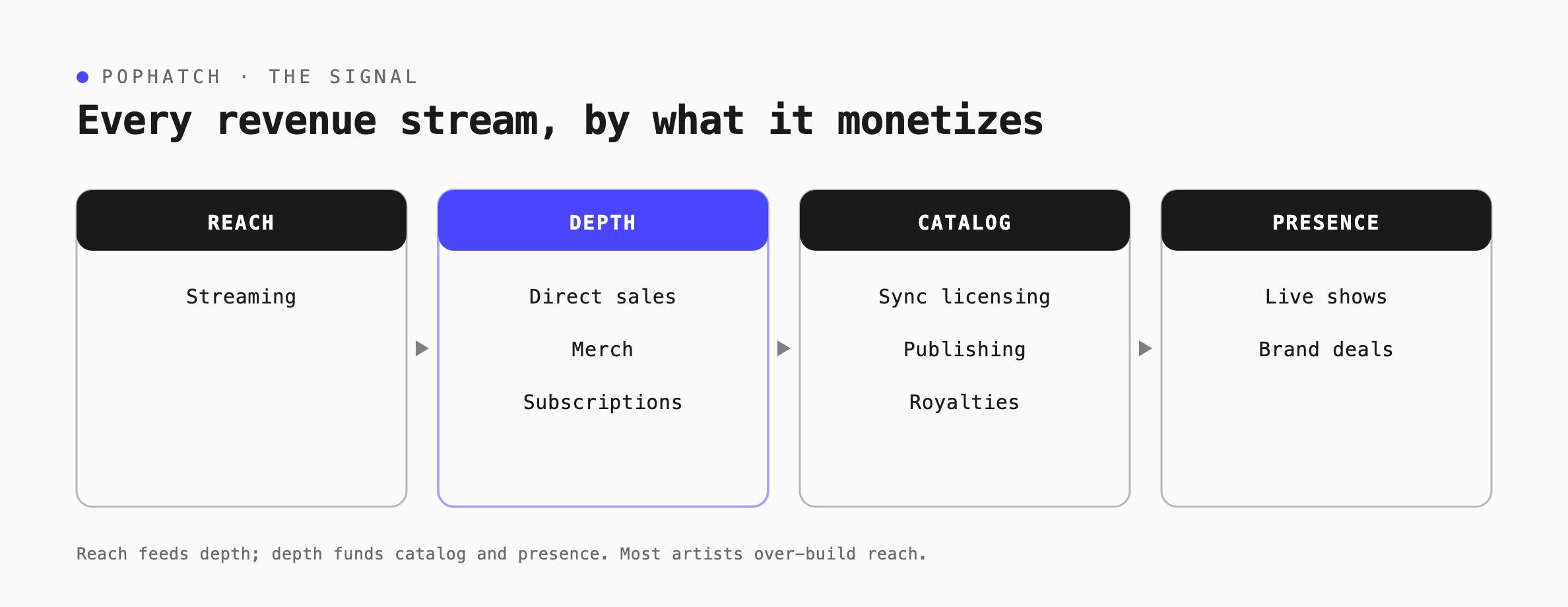
A revenue map grouping the eight streams by what each one monetizes. "Reach" holds streaming; "Depth" holds direct sales, merch, and subscriptions; "Catalog" holds sync, publishing, and royalties; "Presence" holds live shows and brand partnerships. A note reads: reach feeds depth, depth funds catalog and presence.
Read the map by what each stream monetizes. Streaming monetizes reach. Direct sales, merch, and subscriptions monetize depth, the strength of your relationship with individual fans. Sync and publishing monetize your catalog, the body of work you own, and they compound as it grows. Live and brand deals monetize presence, your pull in a place or a niche. Most artists over-index on reach because it is the visible number, and under-build the depth and catalog streams where the money accumulates.
What Royalties Are You Missing on Streaming?
The royalties most independent artists miss are mechanical, performance, and digital performance royalties, each collected by a separate organization, and each sitting unclaimed until you register for it. Streaming generates more than the payout on your distributor dashboard: every song creates two copyrights, the composition and the recording, and each throws off separate royalties. Miss the registration and the money simply sits unclaimed.
The pieces, briefly, since the royalties your music earns deserve their own full guide:
Recording royalties. Paid by streaming and download services to whoever owns the master, which for an independent artist is usually you, delivered through your distributor.
Mechanical royalties. Paid for the reproduction of your composition when it is streamed or downloaded. In the United States, The MLCcollects these for streaming and pays self-administered songwriters directly, and membership is free.
Performance royalties. Paid when your composition is performed publicly, including on streaming, radio, and in venues. A performing rights organization collects these for you.
Digital performance royalties. Paid for your recording on non-interactive services like internet and satellite radio, collected by SoundExchange, which is also free to register with.
The reason this belongs in a money guide rather than only a legal one: these royalties are automatic once you register, and invisible until you do. An artist who releases through a distributor but never joins the MLC or SoundExchange is leaving meaningful, already-earned money in accounts with their name waiting on it. The setup is a few hours, once, and then it pays for the life of the catalog.
How Do You Sell Music and Merch Directly?
You sell directly through a channel you own: Bandcamp for music and downloads, and print-on-demand, Shopify, or a creator platform like Fourthwall for merch. Direct sales and merch are where a small audience turns into meaningful income, because the margins are high and the money comes to you. A fan who streams you generates cents. The same fan buying a 30-dollar vinyl or a 35-dollar hoodie generates meaningful dollars, most of which you keep, which is why selling your music directly matters far more than its share of headlines suggests.
Direct music sales work best where fans want to own rather than only access. Vinyl has become the format superfans buy as an object and a statement, and limited runs reward the attention of your deepest listeners. Bandcamp remains the artist-friendly home for this, taking 15 percent on digital sales, dropping to 10 percent after 5,000 dollars in sales, and 10 percent on physical goods, plus payment processing, with monthly Bandcamp Fridays that waive its share entirely.
Platform fees change; Bandcamp's rates here are from its published fee documentation as of August 2026. Confirm current terms before pricing.
Merch scales further because it is repeatable and expresses identity. Print-on-demand services let you offer shirts and goods with no upfront inventory, taking a cut of each sale, while a full storefront on a platform like Shopify or a creator-focused one like Fourthwall gives more control and better margins at higher volume. The tradeoff between them, covered in the merch platform comparison, comes down to how central selling is to what you do. The through-line is simple: merch turns fandom into income you can see, and it works at audience sizes far smaller than streaming payouts would suggest.
When Do Live Shows, Subscriptions, and Brand Deals Start Paying?
Live shows, fan subscriptions, and brand partnerships are the streams that reward depth and presence, and each one starts paying at a different, knowable moment. Timing them wrong is the common error, so the trigger for each matters as much as the stream itself.
Live and touring monetize geographic density. A city with fifty engaged listeners is a show waiting to happen, and your streaming data shows you where those clusters are. Live income spans the door, guarantees, and the merch table, which often out-earns the ticket for a small act. The trigger is data: play where your listeners already concentrate rather than where you hope to be discovered.
Fan subscriptions monetize proven demand. A fan subscription on Patreon, Ko-fi, or a similar platform turns your most committed fans into recurring income, and the honest trigger is that you already have superfans asking for more access. Launched before that demand exists, a subscription stalls. Launched after, it becomes a predictable floor under everything else.
Brand partnerships monetize a defined identity. Once you stand for something specific and hold an engaged niche, brand partnerships with companies whose audience overlaps yours can pay fees or provide gear, travel, and exposure. The trigger here is clarity: brands buy a clear audience and a clear aesthetic, so this stream opens once your positioning is sharp rather than while it is still forming.
Why Is Sync Licensing Worth Building From Your Catalog?
Sync licensing, placing your music in film, television, ads, and games, is the stream most independent artists ignore and one of the few that can pay a lump sum large enough to change a year. A single placement in a show or campaign can pay from a few hundred dollars to five figures, and it compounds because your catalog keeps existing and keeps being licensable long after release.
Sync rewards catalog and readiness more than fame. Music supervisors need tracks that fit a scene, and an instrumental or a clean emotional cut from an unknown artist can win a placement over a famous song that costs more and clears slower. What it requires is preparation: recordings you fully own or can clear, clean metadata, instrumental versions available, and split documentation in order so a deal can close on a supervisor's timeline. Sync licensing is its own discipline, and the artists who earn from it are usually the ones who made their catalog easy to say yes to.
The reason it belongs in every serious money plan: sync income is uncorrelated with your stream count. It does not care how you are trending. It cares whether your song fits the scene and whether the paperwork is clean, which means an artist with a modest audience and a well-prepared catalog can earn from it as readily as a large one. That independence from the popularity cycle makes it a stabilizer in a stack of otherwise reach-dependent streams.
How Do You Sequence These as You Grow?
Build the streams in an order where each one funds and enables the next, rather than trying to stand all eight up at once. Sequencing is the actual skill, because effort is your scarcest resource and the wrong order wastes it. The order follows the same logic as the map: establish the foundation, convert to depth, then let the catalog and presence streams compound.

A sequencing diagram showing four phases of building revenue as an artist grows. Phase one, Foundation: distribution, releases, and royalty registration. Phase two, Depth: direct sales, merch, and a direct channel. Phase three, Recurring and Presence: subscriptions and live shows. Phase four, Catalog and Scale: sync licensing and brand partnerships. Arrows show each phase funding the next.
A workable sequence for most independent artists:
Foundation. Get distributed, release consistently, and register everything so royalties collect automatically. Join the MLC and SoundExchange and a performing rights organization. This is a few hours of setup that pays for the life of the catalog.
Depth. Build a direct channel you own, an email list or community, and open direct sales and merch. This is where a small audience starts producing meaningful money, and it depends on fandom rather than scale.
Recurring and presence. Once superfans are visible and buying, add a subscription and play where your data shows listeners cluster. Both monetize the depth you built in phase two.
Catalog and scale. As your body of work grows, pursue sync placements and brand partnerships. These reward the catalog and identity the first three phases produced.
The sequence is not rigid, and streams overlap. The point is direction: reach before depth is backwards, a subscription before superfans is early, and a brand deal before positioning is premature. Artists who feel stuck are often working hard on a later-phase stream while an earlier one sits unbuilt, which is why the order matters more than the effort.
Do This Now: Your First Revenue Audit
You can map your own stack in an afternoon and find money you are already owed or one obvious stream to open next. Run this once, then quarterly as you grow.
List what you earn today. Write every current income line and its rough monthly amount. Most artists find one or two streams and a lot of blanks.
Check your royalty collection. Confirm you are registered with a distributor, the MLC, a performing rights organization, and SoundExchange. Any you are missing is money currently unclaimed, so fix it this week.
Locate your depth. Count your direct channel and your superfans. If you have buyers and no store, direct sales are your next stream. If you have superfans asking for more and no subscription, that is next.
Read your geography. Open your streaming dashboard and note your top cities. A dense cluster with no show is a live opportunity your data is handing you.
Pick one stream to open this quarter. One, rather than five. Choose the phase-appropriate stream with the clearest path, build it, and measure it before adding another.
A shape for how this goes. A producer with 20,000 monthly listeners runs the audit and finds a single income line: streaming, a few hundred dollars a month. The audit surfaces three fixes. He was never registered with the MLC, so months of mechanical royalties sit unclaimed. He has 400 email subscribers and no store, so merch is an obvious open. And a third of his listeners cluster in one city with no show on the calendar. None of that required more listeners. It required building the streams the audience he already had could support.
Deciding which stream to open next, in the right order, from your actual audience and catalog, is exactly what the artist business partner is built to prepare. PopHatch reads where your money already is and where it is being left, and helps you plan your monetization in a sequence that fits your stage. It maps the stack and prepares the next move. You build it.
Frequently Asked Questions

Written by
Oana Ruxandra
Founder & CEO, PopHatch
Oana Ruxandra is the founder and CEO of PopHatch, the artist business partner. She spent fifteen years inside the music industry, ending as Chief Digital Officer at Warner Music Group, where she grew digital revenue by $2B and negotiated first-of-their-kind deals with Apple, Spotify, YouTube, Amazon, Meta, and TikTok. She writes about the business of music from the inside, for the artists building careers on their own terms.