Oana Ruxandra, CEO of PopHatch. Former Chief Digital Officer at Warner Music Group.

Music royalties confuse almost everyone, and the confusion is expensive, because money you do not understand is money you do not collect. The system looks like a tangle of acronyms. Underneath, it follows one clean logic, and once you see it the whole thing organizes itself.
Music royalties come from two copyrights in every song, the composition and the sound recording, and they are earned in four main ways: mechanical royalties for reproducing the composition, performance royalties for performing it publicly, synchronization royalties for pairing it with visual media, and print royalties for reproducing the written music. Different organizations collect each: performing rights organizations collect performance royalties, The MLC collects streaming mechanicals, SoundExchange collects digital performance royalties on your recording, and sync deals are usually made directly. The composition side is the publishing money; the recording side is the master money. Most independent artists collect only a fraction of these because no one enrolls them automatically. Understanding the map is how you stop leaving money behind.
I have watched sophisticated teams lose track of these flows, so if it feels overwhelming, that is the system's fault and not yours. This guide lays out the four types, the two copyrights they spring from, and exactly who collects each, in plain language. Rights and royalties sit under every dollar your music earns, which is why this is the piece worth reading twice. It is general information rather than legal or financial advice; the collectors' own sites and the U.S. Copyright Office govern your specific case.
The Foundation: Two Copyrights in Every Song
Every royalty starts from one fact: a song is two separate copyrights, and every payment traces back to one of them. The first is the musical work, the composition, which is the song as written: melody, chords, and lyrics. The second is the sound recording, the master, which is one specific recorded performance of that composition. The two copyrights in every song are owned, licensed, and paid independently.
This split is the source of the "publishing versus master" language you hear constantly. Publishing royalties are the income from the composition copyright, owed to songwriters and their publishers. Master royalties are the income from the sound recording copyright, owed to the recording's owner, which for an independent artist is usually the artist. A single stream of your song can generate both at once: a publishing royalty for the composition and a master royalty for the recording, flowing to different accounts.
For the self-releasing artist who writes and records their own material, the practical upshot is that you wear both hats. You are the songwriter collecting publishing money and the master owner collecting recording money, and you have to set up collection for each separately because the systems assume those are two different people. Hold onto this foundation, because every royalty type below is just one of these two copyrights earning in a particular situation.
The Four Types of Music Royalties
The composition and recording earn royalties in four main situations, and naming them is what makes the system legible. The four types are mechanical, performance, synchronization, and print. Each is triggered by a different use of your music, and each is collected through a different channel.
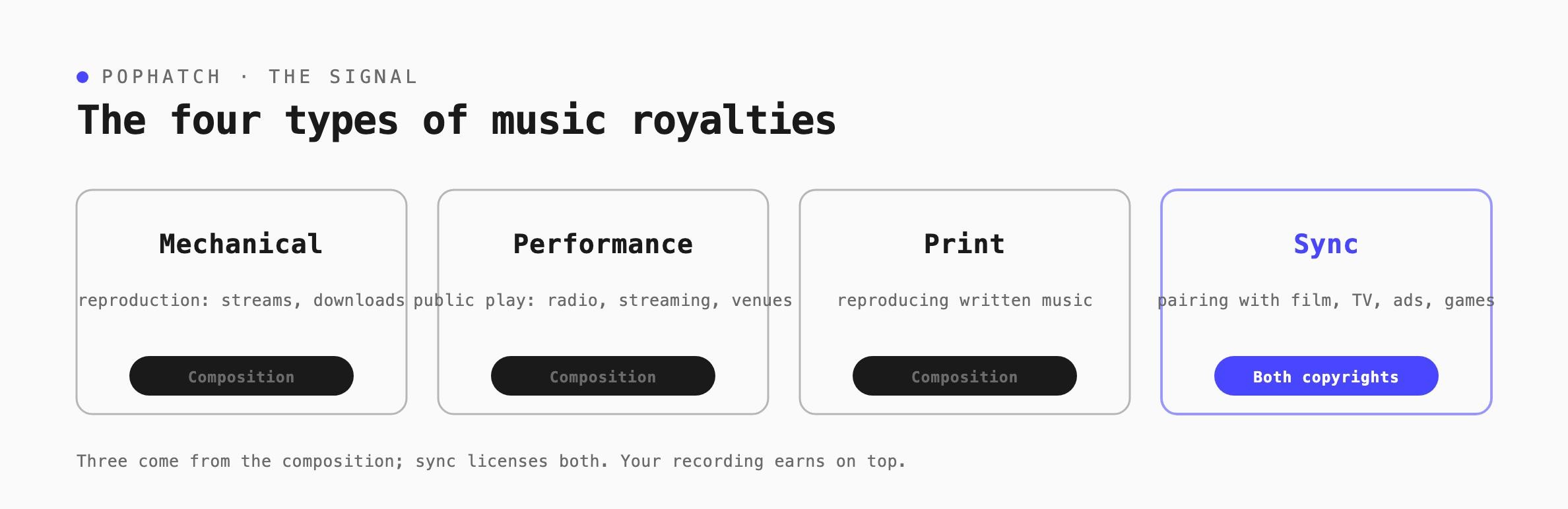
A four-panel diagram of the royalty types, grouped under the two copyrights. Under "Composition": Mechanical (triggered by reproduction, streams and downloads and physical), Performance (triggered by public performance, radio and streaming and live), and Print (triggered by reproducing written music, sheet music). Spanning both copyrights: Synchronization (triggered by pairing music with visual media, film and TV and ads and games). A caption reads: every royalty is one of two copyrights earning in a specific way.
Here is what triggers each and roughly what it is worth.
Mechanical royalties. Triggered by reproducing the composition: every stream, download, and physical copy. Small per unit, large across a catalog. Collected in the US streaming and download context by The MLC.
Performance royalties. Triggered by performing the composition publicly: radio play, streaming, a venue, a store, TV. Collected by performing rights organizations for songwriters and publishers.
Synchronization (sync) royalties. Triggered by pairing music with visual media: film, television, ads, games, trailers. Paid as negotiated fees, often the largest single payments. Usually arranged directly or through a sync agent.
Print royalties. Triggered by reproducing the written music: sheet music, tablature, songbooks. Small for most artists, meaningful in some genres. Collected through print publishers.
Three of the four, mechanical, performance, and print, are composition royalties. Sync is the exception, because a sync placement usually licenses both the composition and the recording, so an artist who owns both gets paid twice for one placement. That double ownership is a quiet advantage independent artists hold and often do not realize they have.
Mechanical vs Performance Royalties: The Most Confused Pair
Mechanical and performance royalties both come from the composition, and telling them apart is the single most useful distinction in music royalties. The difference is the action being paid for. A mechanical royalty pays for reproducing the song, making a copy. A performance royalty pays for performing the song, playing it in public. Copy versus play.
Streaming is where this gets slippery, because a single stream triggers both at once. When your song streams, it is reproduced, generating a mechanical royalty, and it is publicly performed, generating a performance royalty, both on the composition, plus a master royalty on the recording. That is why one stream flows to several places, and why an artist collecting only through their distributor is capturing a slice of what the stream earned.
The collection split follows the two actions. A performing rights organization such as ASCAP, BMI, SESAC, or GMR collects the performance royalties for the composition. The MLC collects the mechanical royalties for US streaming and downloads and pays self-administered songwriters directly. They are different organizations collecting different royalties from the same stream, which is exactly why you register with both. Missing one leaves half your composition income behind, and mechanicals are the half most often skipped, which is why they deserve their own guide on how to collect your mechanical royalties.
What About Your Recording? The Master Side
Your sound recording earns its own royalties, separate from the composition's four types, and this is the master money that belongs to whoever owns the recording. For an independent artist who owns their masters, this is income flowing straight to you, and it comes in two main forms.
The first is recording royalties from streaming and downloads. When your song plays on Spotify, Apple Music, or a download store, the platform pays a royalty for the use of your master, and that money reaches you through your distributor. This is usually the one royalty independent artists do collect, because setting up a distributor is the obvious first step to being on streaming at all.
The second is the digital performance royalty, and it is the master-side counterpart to composition performance royalties. When your recording plays on non-interactive digital radio, satellite services, internet radio, and similar stations, it earns a digital performance royalty for the recording. In the United States, SoundExchange collects and distributes this, registration is free, and it pays the featured artist and the rights owner directly, on a standard split of 45 percent to the featured artist, 50 percent to the rights owner, and 5 percent to non-featured performers.
Splits and covered services are set by statute and policy and can change; the SoundExchange figures reflect its published model as of August 2026. Confirm current terms on the collectors' sites.
So the complete picture is the four composition royalties plus these two recording royalties. Some frameworks fold everything into "four types" and treat the master royalties as a separate category entirely, which is why counts differ across guides. The labels matter less than the logic: two copyrights, several triggers, several collectors, and your job is to be registered everywhere your music earns.
Who Collects Music Royalties? The Full Map
No single organization collects all your royalties, which is the fact that trips up most artists, so knowing who collects what is the difference between full and partial payment. Each collector handles one or two specific royalties, and you register with each one that applies to how your music is used.
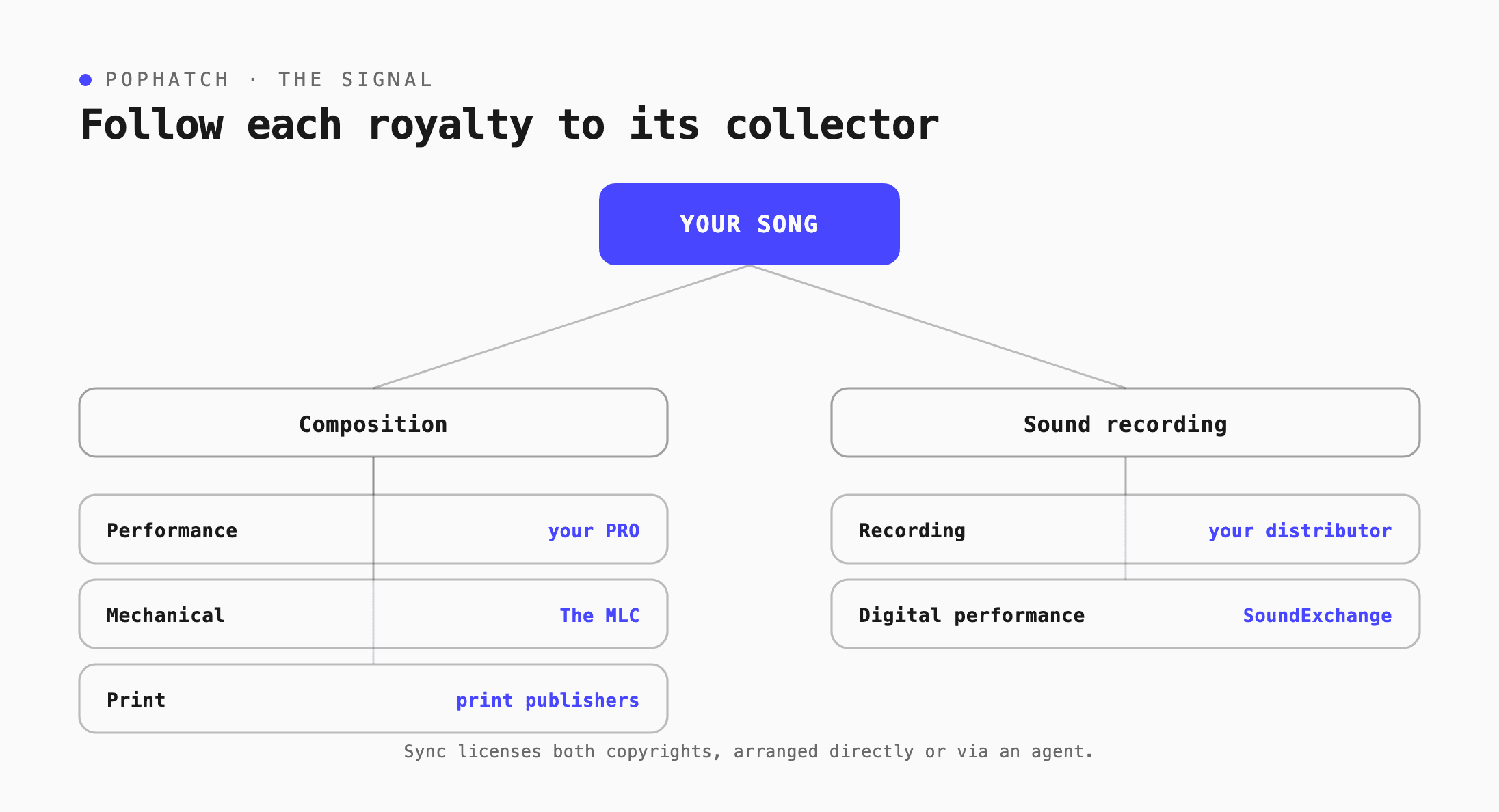
A source tree tracing royalties from a song to their collectors. The song splits into Composition and Sound recording. Composition branches to: performance royalties collected by a performing rights organization, mechanical royalties collected by The MLC, and print royalties via print publishers. Sound recording branches to: recording royalties paid through your distributor, and digital performance royalties collected by SoundExchange. Sync sits across both, arranged directly or via a sync agent.
This table maps every royalty to its source and collector.
Royalty type | Which copyright | Triggered by | Who collects it |
Performance | Composition | Public performance: radio, streaming, venues, TV | Performing rights organization (ASCAP, BMI, SESAC, GMR) |
Mechanical | Composition | Reproduction: streams, downloads, physical | The MLC (US streaming/downloads), publisher or admin |
Composition | Reproducing written music: sheet music, tab | Print publishers | |
Recording | Sound recording | Streaming and download plays of the master | Streaming services, paid via your distributor |
Digital performance | Sound recording | Non-interactive digital radio plays of the master | SoundExchange |
Sync | Both | Pairing music with visual media | Negotiated directly or via a sync agent |
Read the "who collects it" column as your setup checklist. A fully collecting independent artist is typically registered with a distributor, a performing rights organization, The MLC, and SoundExchange, and is set up to pursue sync when relevant. A publishing administrator can sit on top to collect composition royalties internationally, which the domestic organizations do not reach. The gap most artists discover is the same one every time: distributor and performing rights organization in place, The MLC and SoundExchange missing, which means the composition mechanicals and the digital performance royalties go uncollected.
Sync Licensing: The Royalty You Negotiate
Synchronization royalties work differently from the other types, because you negotiate them rather than collect them from a pool, and they can be the largest single payments a song earns. A sync royalty is the fee paid to use your music in visual media: a film scene, a TV episode, an ad, a game, a trailer, a social campaign.
The mechanics set sync apart. There is no organization automatically collecting sync money and mailing you a check. A placement happens when a music supervisor or brand licenses your song, and because most uses need both copyrights, they license the composition and the recording together. An artist who owns both negotiates one deal and collects both fees, which is a meaningful edge over a signed artist who controls only one side.
What makes a song licensable is preparation more than fame. Clean ownership, clear metadata, instrumental versions on hand, and documented splits let a supervisor say yes on a tight timeline, and sync licensing rewards the artists who made their catalog easy to clear. The reason sync belongs in every royalty overview is that it is uncorrelated with your streaming numbers. A modest artist with a well-prepared, fitting catalog can land a placement that pays more than a year of streams, which makes it one of the most valuable royalties to understand even before you are big.
How Do Royalties Reach You?
Royalties reach you only through the accounts you have registered, which is why understanding the flow matters as much as understanding the types. The money moves from the user of your music, a platform, a station, a venue, a production, to a collector, and then to you, but only if you are in that collector's system with your songs registered and your ownership stated.
The flow, simplified: a use happens, the platform or licensee reports it and pays the relevant collector, the collector matches the use to a registered work and its owners, and it pays those owners on its schedule, usually monthly or quarterly. Every step depends on registration and accurate data. An unregistered song cannot be matched, and unmatched royalties sit waiting, sometimes for years, until their owner claims them.
This is the mechanical reason independent artists under-collect, and it is fixable. The systems are not withholding your money out of malice. They are waiting for you to register so they know where to send it. Set up each collector once, register every new song at release, keep your splits accurate, and the flows that looked like a tangle run on their own in the background. The complexity is front-loaded into setup, and after that it mostly takes care of itself.
Do This Now: Map Your Own Royalties
You can turn this framework into a personal action list in one sitting, and doing so usually surfaces at least one royalty you are not collecting. Work through it in order.
Confirm your copyrights. For each song, note whether you own the composition, the recording, or both. Most self-recording artists own both. If you have registered your copyright, this is documented already.
Check performance royalties. Confirm you are affiliated with a performing rights organization and that every song is registered there.
Check mechanical royalties. Confirm you are a member of The MLC and have registered your compositions with accurate splits.
Check recording royalties. Confirm your distributor is paying master royalties, and register with SoundExchange for digital performance royalties on your recordings.
Note your sync readiness. List whether you have clean ownership, metadata, instrumentals, and split documentation, so you can act when a placement opportunity appears.
A shape for how this goes. A writer-producer maps her catalog and finds she owns both copyrights on everything, is affiliated with a performing rights organization, and has a distributor. The map exposes two gaps: no MLC membership, so her streaming mechanicals are uncollected, and no SoundExchange registration, so her digital-radio royalties are too. Two free signups later, both flows start, and back royalties surface from The MLC on songs that have been streaming for years. Nothing about her music changed. Her collection did.
Seeing which royalties your catalog generates, which collectors pay them, and which you have not set up is exactly the read the artist business partner prepares. PopHatch helps you understand your rights, maps each royalty your music earns to the organization that pays it, and orders the setup by what you are losing most. It prepares the map. You register the accounts, because they belong in your name.
___
Two copyrights, several triggers, several collectors, and your money only arrives where you're registered. PopHatch is the artist business partner that maps every royalty your catalog earns to the organization that pays it, and prepares the setup. Start your free trial at pophatch.com.
Frequently Asked Questions

Written by
Oana Ruxandra
Founder & CEO, PopHatch
Oana Ruxandra is the founder and CEO of PopHatch, the artist business partner. She spent fifteen years inside the music industry, ending as Chief Digital Officer at Warner Music Group, where she grew digital revenue by $2B and negotiated first-of-their-kind deals with Apple, Spotify, YouTube, Amazon, Meta, and TikTok. She writes about the business of music from the inside, for the artists building careers on their own terms.