Oana Ruxandra, CEO of PopHatch. Former Chief Digital Officer at Warner Music Group.

There is money sitting in an account with your name attached to it, and if you write and release your own songs without a publisher, you are probably not collecting it. This is one of the most common and most fixable gaps in an independent career, and closing it is free.
Mechanical royalties are payments for the reproduction of your composition, generated every time your song is streamed, downloaded, or pressed to a physical copy. Your distributor pays you for the recording, but it does not pay the mechanical royalties on the composition, which is why so many self-releasing songwriters miss them. In the United States, you collect streaming and download mechanicals by becoming a member of The MLC, which is free, registering your songs, and letting it match your plays and pay you monthly. You should also register with SoundExchange for a separate digital performance royalty, and with a performing rights organization for performance royalties. Together these are money you have already earned and simply have not claimed. The claim is a few hours of setup, once.
The reason this gap is so widespread is structural. The systems that collect these royalties were built for publishers, and no one automatically enrolls the independent songwriter who does everything themselves. If you have never joined a mechanical collective, the mechanicals on every stream since your first release have been accumulating without you. This guide covers what mechanical royalties are, why your distributor does not pay them, and exactly how to collect yours, plus the other royalties commonly missed alongside them. This is general information, not legal or financial advice; the collectors' own sites govern your specific case.
What Are Mechanical Royalties?
Mechanical royalties are royalties paid for reproducing a musical composition, and they are owed to the songwriter and publisher every time a copy of the song is made. The name is a holdover from player-piano rolls, but the concept now covers the digital era completely: every stream and download reproduces the composition, and each one generates a small mechanical royalty for whoever wrote and owns that composition.
The key is that mechanical royalties attach to the composition, not the recording. Recall that every song is the four types of music royalties flowing from two copyrights: the composition, which is the underlying song, and the sound recording, which is the specific master. Mechanicals belong to the composition side. So when your track is streamed, two different royalties are created: a recording royalty for the master, and a mechanical royalty for the composition. They are collected by different parties and paid on different schedules.
For an independent artist who writes their own songs, this means you are owed mechanicals as the songwriter even on your own recordings. The stream that pays you a recording royalty through your distributor also owes you a mechanical royalty as the composer, and that second payment travels a completely separate path. Understanding that split is the whole reason the money goes uncollected: artists assume one stream means one payment from one place, and it does not.
Why Doesn't Your Distributor Pay Mechanical Royalties?
Your distributor pays you for the recording and not for the composition, because those are two different rights collected by two different systems. A distributor like DistroKid, TuneCore, or CD Baby delivers your master to streaming services and pays you the recording royalties the platforms remit for that master. That is the job it signed up for, and it does it well. The composition's mechanical royalties are simply outside that lane.
Streaming mechanicals in the United States flow through a separate channel created by the Music Modernization Act of 2018, which established a blanket license for digital services and a single organization to administer it. The streaming platforms pay those mechanicals into that system rather than through your distributor, and the system pays them out to registered songwriters and publishers. If you are not registered there, your share goes uncollected and, over time, may be held as unmatched money waiting for its owner to claim it.
Some distributors and publishing-admin services offer add-on publishing or mechanical collection for an extra fee or percentage. Read what your distributor covers; the default distribution product almost always excludes composition mechanicals, which is why checking is worth the five minutes.
This is not a flaw you did wrong. It is a division of labor that assumes a publisher is handling the composition side, which is true for signed artists and false for the self-releasing songwriter. The fix is to step into the publisher role yourself, which the modern system lets you do directly and for free.
How to Collect Your Mechanical Royalties Through The MLC?
You collect your U.S. streaming and download mechanicals by becoming a member of The MLC, the Mechanical Licensing Collective, registering your songs, and letting it pay you monthly. Membership is free, and the organization exists specifically to pay self-administered songwriters, composers, and publishers the mechanicals that digital services owe them. It has distributed billions in streaming royalties since it began operating.
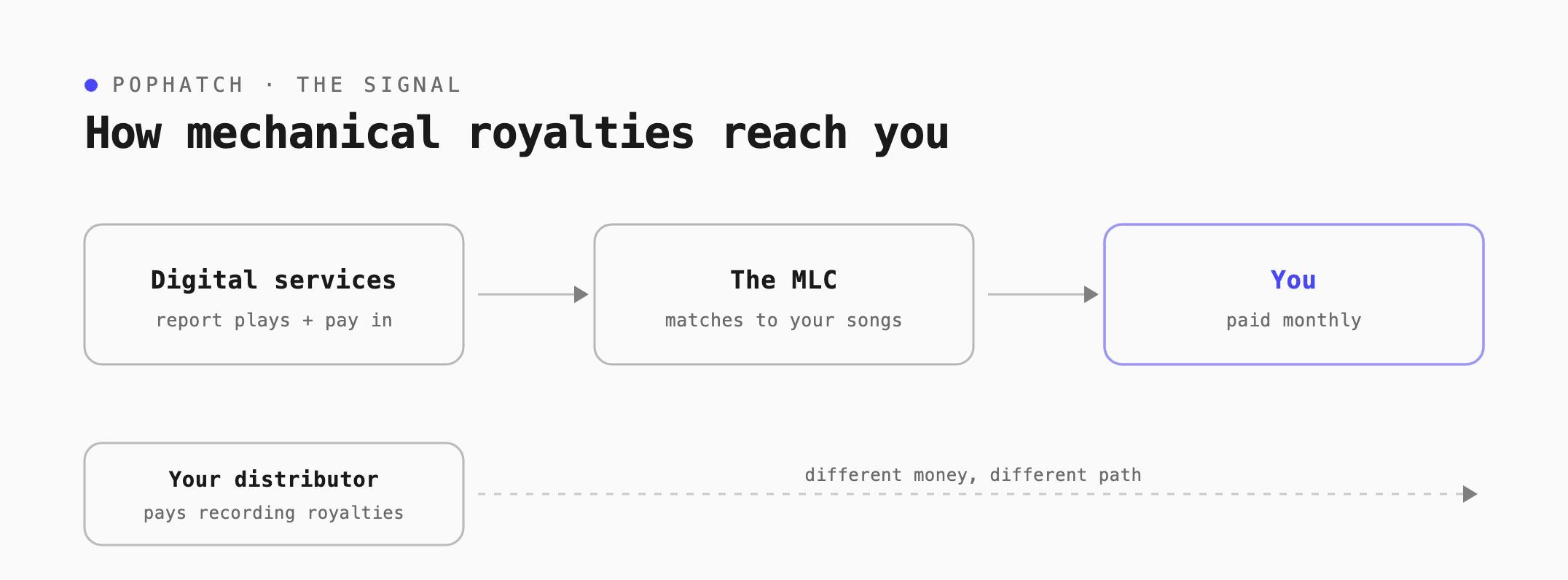
A flow showing how mechanical royalties reach an independent songwriter. Digital services send usage data and mechanical royalties to The MLC each month. The MLC matches the plays to songs registered by members. The MLC pays the matched royalties to the songwriter monthly. A parallel arrow shows the distributor separately paying recording royalties for the master, labeled "different money, different path."
The process is simple once you know the steps.
Become a member. Sign up on The MLC's site as a self-administered songwriter or, if you have set one up, your own publishing entity. There is no fee to join.
Register your songs. In the member portal, register each composition you have written, with the correct writer splits if you co-wrote. This is the step that lets the system match plays to you.
Enter your ownership shares. State what percentage of each composition you own. Accuracy here is what ensures you are paid correctly and that co-writers get their share.
Get matched and paid. The MLC receives usage data and royalties from digital services each month, matches the plays of registered songs to their owners, and pays members monthly.
Check for unclaimed royalties. If your music has been out for a while, look for historical unmatched royalties tied to your songs, which you may be able to claim once you register them.
The whole setup takes an afternoon and then runs on its own. Register a new song at release, and its mechanicals collect automatically from then on. The one habit worth keeping is registering every new composition promptly, because matching depends on the song being in the system.
Are You Collecting SoundExchange Royalties Too?
SoundExchange collects a different royalty you are probably also missing: the digital performance royalty for your sound recording when it plays on non-interactive digital radio. This is separate from mechanicals, separate from your distributor, and separate from The MLC, which is exactly why it slips through the cracks so often.
Here is the distinction. When your recording plays on services like SiriusXM satellite radio, internet radio, and similar non-interactive stations, it generates a digital performance royalty for the sound recording. SoundExchange is the organization that collects and distributes that royalty in the United States, registration is free, and it pays the featured artist and the rights owner directly. The standard split sends 45 percent to the featured artist, 50 percent to the rights owner, and 5 percent to a fund for non-featured performers.
Royalty splits and covered services are set by statute and SoundExchange policy and can change; the figures here reflect SoundExchange's published model as of August 2026. Verify current terms on their site.
For an independent artist who owns their masters, registering with SoundExchange means you collect both the artist and rights-owner shares yourself. The reason this belongs in a mechanical-royalties guide is that both are commonly-missed, free-to-claim royalties that live outside your distributor. Artists who set up The MLC and stop there still leave the SoundExchange money behind, so treat them as a pair.
Am I Collecting All My Royalties? The Full Checklist
You are collecting all your royalties only when you are registered with every organization that pays a different piece, and most independent artists are signed up with one or two of the four or five that apply. The way to know is to check each collector against your own registrations, because each one pays a distinct royalty that the others do not.

A checklist matrix of royalty collectors for an independent artist. Rows: Distributor pays recording royalties from streaming and downloads; Performing rights organization pays performance royalties on your composition; The MLC pays mechanical royalties on your composition from US streaming and downloads; SoundExchange pays digital performance royalties on your recording from digital radio; Publishing administrator collects mechanical and performance royalties internationally. Each row has a "free to join?" column and an empty "signed up?" checkbox.
Run yourself against this list.
Collector | What it pays you | Free to join? | Do you need it? |
Distributor | Recording royalties from streaming and downloads | Varies by plan | Yes, to be on streaming at all |
Performing rights organization | Performance royalties on your composition | Usually free for writers | Yes, if your music is performed publicly or streamed |
The MLC | Mechanical royalties on your composition (US streaming/downloads) | Yes | Yes, if you write your own songs |
SoundExchange | Digital performance royalties on your recording (digital radio) | Yes | Yes, if you own your recordings |
Publishing administrator | Mechanical and performance royalties collected internationally | Takes a percentage | Optional, useful for global collection |
The pattern most independent artists find when they run this list: they have a distributor, maybe your performing rights organization, and neither The MLC nor SoundExchange. That means the recording royalties and possibly the domestic performance royalties are collecting, while the composition mechanicals and the digital performance royalties are not. Two free signups usually close the biggest gaps. A publishing administrator is the optional upgrade for collecting mechanicals and performance royalties in other countries, worth considering once your music earns meaningfully abroad.
How Much Are Mechanical Royalties Worth?
Mechanical royalties are small per stream and add up across a catalog, and no honest guide will hand you a fixed per-stream number, because the rate depends on formulas and platform economics rather than a flat rate. The streaming mechanical rate in the United States is set through a regulatory process and calculated from a platform's revenue and other inputs, so the amount per stream shifts by service and over time.
What you can reasonably expect: mechanical royalties are a modest fraction of a cent per stream, meaningfully smaller than the recording royalty on the same stream. That sounds negligible until you multiply it across every stream of every song over the life of a catalog, and until you remember it is money you have already earned that costs nothing to collect. An artist with a few hundred thousand cumulative streams who has never registered with The MLC is typically leaving a meaningful, if not life-changing, sum unclaimed, and it compounds every month the catalog keeps playing.
Be wary of any "music royalty calculator" that promises a precise total from a stream count, because the true figure depends on registration, territory, platform mix, and rates that change. Treat such tools as rough estimates. The point is not to predict the exact dollar amount. The point is that the amount is greater than zero, it is yours, and collecting it is free, which makes the setup worth doing regardless of the total.
Do This Now: Claim Your Royalties This Week
You can close the biggest collection gaps in a single focused session, and the sooner you do it, the more of your back catalog's royalties you capture. Work through this in order.
Confirm your compositions are yours to register. For each song, note the writers and their splits. If you registered your copyright, you already have this documented.
Join The MLC. Sign up free as a self-administered songwriter, register every composition with accurate splits, and check for any historical unmatched royalties on your songs.
Register with SoundExchange. Sign up free as the recording artist and rights owner so your digital-radio performance royalties start collecting.
Confirm your performing rights organization. If you are not already affiliated with one, join to collect performance royalties on your compositions. If you are, make sure every song is registered there too.
Set a release habit. Add every new song to The MLC and your performing rights organization at release, so nothing new slips uncollected.
A shape for how this goes. A songwriter three years and two EPs into releasing through a distributor runs this list and realizes she has been collecting only recording royalties the whole time. She joins The MLC, registers all her compositions, and finds unmatched mechanicals waiting from songs that have been streaming since her first release. She registers with SoundExchange the same afternoon. The back royalties are a pleasant one-time catch-up, and from then on both streams collect automatically. The entire fix took one evening.
Knowing which collectors you are registered with, which you are missing, and what is quietly going uncollected is exactly the kind of read the artist business partner prepares. PopHatch helps you understand your rights, maps your royalties against the collectors that pay them, and lays out the signups in order of what you are losing most. It prepares the checklist. You complete the registrations, because the accounts have to be in your name.
___
The stream you already earned pays more than one royalty, and the composition side goes uncollected until you claim it. PopHatch is the artist business partner that maps your royalties against the collectors who pay them and prepares the signup checklist. Start your free trial at pophatch.com.
Frequently Asked Questions

Written by
Oana Ruxandra
Founder & CEO, PopHatch
Oana Ruxandra is the founder and CEO of PopHatch, the artist business partner. She spent fifteen years inside the music industry, ending as Chief Digital Officer at Warner Music Group, where she grew digital revenue by $2B and negotiated first-of-their-kind deals with Apple, Spotify, YouTube, Amazon, Meta, and TikTok. She writes about the business of music from the inside, for the artists building careers on their own terms.