Oana Ruxandra, CEO of PopHatch. Former Chief Digital Officer at Warner Music Group.

Here is the fact that surprises most artists: you already hold the copyright to every song you have written and recorded. It attached automatically. What you probably have not done is register it, and registration is the part that gives the copyright teeth.
In the United States, you own the copyright to a song the moment you fix it in tangible form, meaning the second you record or write it down. Registration with the U.S. Copyright Office is separate and optional, but it is what lets you sue for infringement and claim statutory damages, so it matters for any song with commercial value. You register online at the Copyright Office portal for $45 to $65 per work, or $85 for a group of up to 20 songs from one album. Every song contains two copyrights, the composition and the sound recording, and you can register both together when you own both. Filing takes minutes; the certificate takes several months and applies retroactively to your filing date. The automatic right exists. The registration is what you can defend.
This guide walks through exactly what to register, which application to use, what it costs, and how long it takes, in plain language. Rights sit at the base of everything your music earns, so getting this right early pays off across your whole catalog. This is general information rather than legal advice, and the Copyright Office site is the authority for your specific situation.
Do You Even Need to Copyright a Song?
Your copyright exists automatically, so the practical question is whether to register it, and for any song you release commercially the answer is usually yes. Under U.S. law, copyright protection attaches the moment an original work is fixed in a tangible medium, a recording, a notated score, a voice memo. You do not need to file anything, pay anything, or add a notice for the copyright itself to exist. That part is free and instant.
Registration is a separate legal step that unlocks the enforcement powers. For works of U.S. origin, you generally must register before you can file an infringement lawsuit. Registration also makes you eligible for statutory damages and attorney's fees, which are the remedies that make a lawsuit worth bringing, provided you register before the infringement happens or within three months of publication. Without registration, a copyright is a right you hold but struggle to enforce.
The practical rule most working artists follow: register the music you release and the music you expect to earn from or shop for placements, and do not lose sleep over unreleased demos and voice memos. The automatic right covers you the instant you create. Registration is the upgrade you buy for the songs that matter commercially, and this guide is about doing that upgrade cleanly.
The Two Copyrights in Every Song
Every song is two separate copyrights, and understanding the split is the key to registering correctly. The first is the musical work, the composition: the melody, the chords, and the lyrics, the song as it could be written on paper or performed by anyone. The second is the sound recording, the master: one specific recorded performance of that composition, the actual audio file.
These are distinct works with distinct owners. A songwriter can own the composition while a label owns the recording. A cover version is a new sound recording of someone else's composition. For an independent artist who writes and records their own material, this usually means you own both copyrights in your song, which is the simplest and most powerful position to be in.
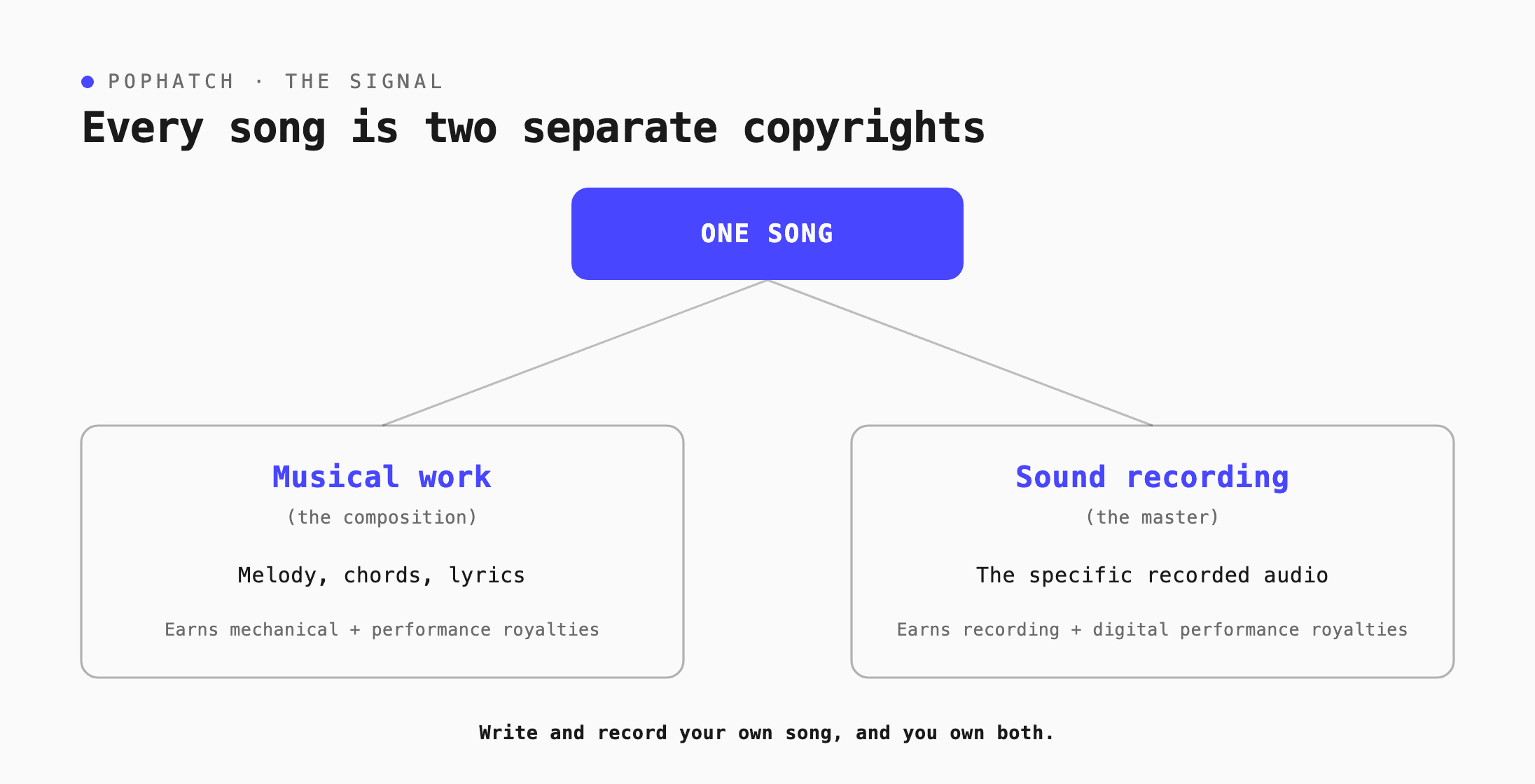
A diagram showing one song splitting into two copyrights. The left card, "Musical work (composition)," covers melody, chords, and lyrics, and generates mechanical and performance royalties. The right card, "Sound recording (master)," covers the specific recorded audio, and generates recording and digital performance royalties. A note below reads: when you write and record your own song, you own both.
Why this matters for registration and for money: the two copyrights generate different royalties your song earns, collected by different organizations, and they can be registered together or separately. When you own both, the Copyright Office lets you register the composition and the recording on a single application, which is efficient and inexpensive. When ownership is split, each owner registers their piece. Knowing which copyrights you hold is the first decision in the process, and for most self-recording artists the answer is: both, together.
How to Register a Song with the Copyright Office, Step by Step
You register a song online through the Copyright Office's electronic system, and the process takes about 15 to 30 minutes once your files are ready. Everything happens at the U.S. Copyright Office registration portal, the only official site, and no third-party service is required.
The steps, in order:
Create a free account in the Copyright Office's electronic registration system. This is your permanent account for every future filing.
Choose the right application. For most independent artists this is a standard application for a single work, or a group registration if you are registering a whole album or EP at once. The next section covers which to pick.
Complete the application. Enter the title, the author or authors, the claimant who owns the copyright, the year of creation, and whether and when the work was published. Accuracy here matters, because the registration reflects exactly what you enter.
Pay the filing fee. Fees are paid online by card or bank transfer at the time of filing.
Upload your deposit copy. This is the actual work: the audio file for the sound recording, and lyrics or a lead sheet for the composition if you are registering it separately. The Office keeps this as the record of what you registered.
Once you submit, the registration's effective date is the day the Office receives your complete application, fee, and deposit together. That date is what counts legally, even though the certificate itself arrives later. You do not need to wait for the certificate to have a registered copyright.
Which Application Do You Use? Single, Standard, or Group
The application you choose depends on how many works you are registering and who wrote them, and picking correctly saves both money and rejections. The Copyright Office offers a few paths, and the differences come down to eligibility rules rather than preference.
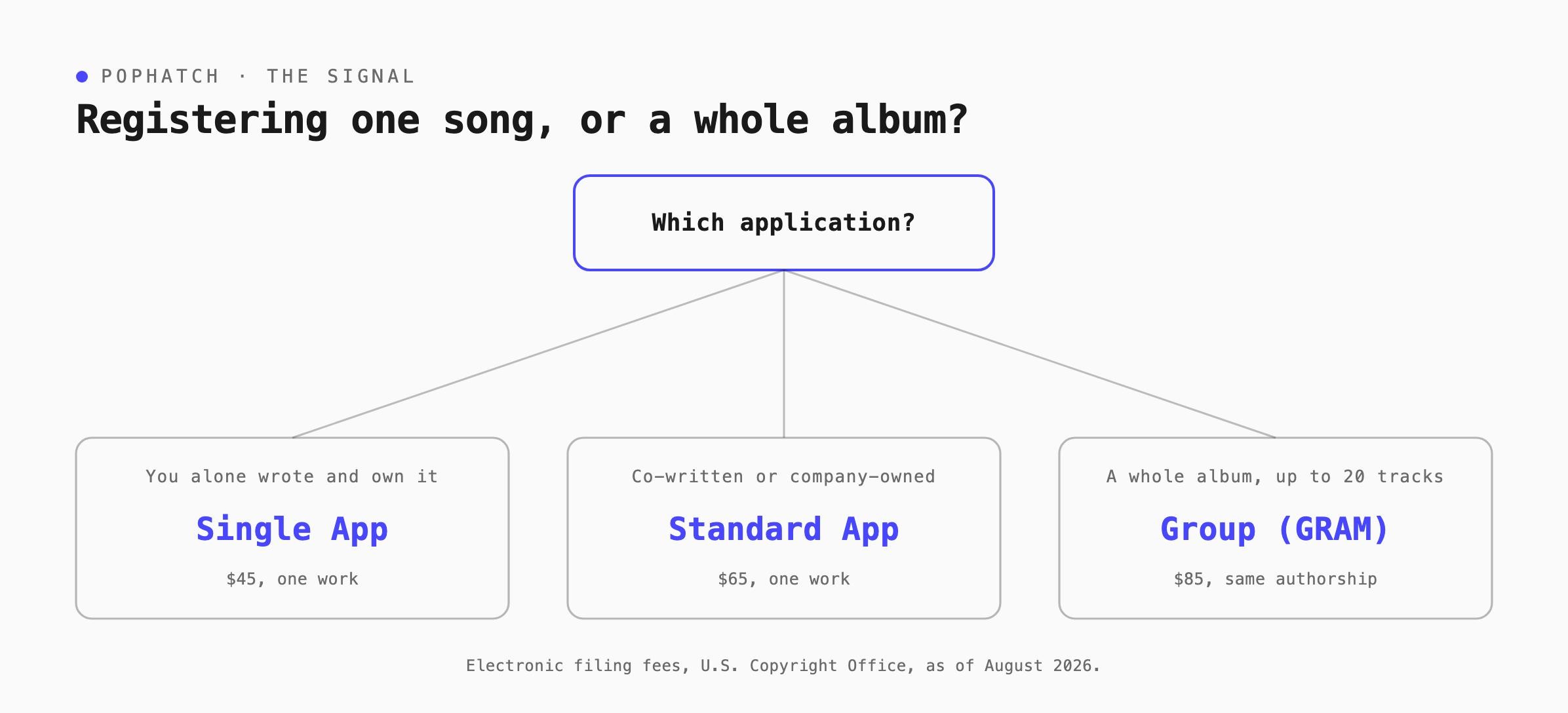
A decision tree for choosing a copyright application. First question: are you registering one song or a whole album? "One song" branches on a second question, "Did one person write and solely own it, and it isn't a work made for hire?" Yes leads to the Single Application; No leads to the Standard Application. "A whole album (up to 20 tracks, same authorship)" leads to Group Registration (GRAM).
Here is how the main options compare, with electronic filing fees as of August 2026.
Application | Fee | What it covers | Use it when |
Single Application | $45 | One work, by one author, who is the sole owner, not made for hire | You alone wrote and own a single song |
Standard Application | $65 | One work with multiple authors or owners, or a work made for hire | You co-wrote a song, or a band or company owns it |
Group Registration (GRAM) | $85 | Up to 20 musical works and/or sound recordings from one album, same authorship | You are registering a full EP or album at once |
Fees are set by the Copyright Office and change periodically. These figures come from [the Copyright Office fee schedule](https://www.copyright.gov/about/fees.html) as of August 2026; confirm the current amount before filing. Paper filing costs more than electronic.
The economics favor group registration for anyone releasing more than a couple of songs. Registering ten singles individually could cost hundreds of dollars, while group registration for an album covers up to 20 tracks from the same album, with the same authorship and claimant, for a single $85 fee. The catch is the eligibility rules: the works must share authorship and be from one album. When you are self-releasing an EP you wrote and recorded, group registration is almost always the right and cheapest path.
How Long Does Copyright Registration Take, and What Does It Cost?
Registration costs $45 to $85 to file and takes several months to process, though your legal protection starts on the day you file, not the day the certificate arrives. This gap confuses artists, so it is worth being precise: the effective date of registration is when the Office receives your complete submission, and everything the registration protects dates from that moment even if the paper certificate comes months later.
Processing times vary with the application type and the Office's workload, and electronic filings are generally faster than paper. As a planning estimate, many online registrations are processed within a few months, and some take longer, so file well ahead of any deadline like a release, a sync pitch, or a suspected infringement rather than in a rush after.
Copyright Office processing times change and are published on copyright.gov; treat any specific range as an estimate and check the current processing-times page for your application type.
On cost, the filing fee is the whole cost when you do it yourself, which every independent artist can. Third-party services and attorneys will file on your behalf for an added fee, which is worth it for complex ownership situations and unnecessary for a simple self-written, self-recorded release. The Copyright Office designed the electronic system for individual creators to use directly, and for the common case of an artist registering their own album, the do-it-yourself path is the standard one.
Copyright vs Trademark: What Each One Protects
Copyright and trademark protect different things, and musicians need to know the line because they routinely confuse the two. Copyright protects creative works: your songs, both the composition and the recording. Trademark protects brand identifiers that distinguish you in commerce: your artist or band name, your logo. You copyright the song. You trademark the name.
This distinction has practical consequences. You cannot copyright your band name, a song title, or a short phrase, because those are not the kind of creative work copyright covers. If you want to stop another act from using your name, that is a trademark question, handled through a different office and process entirely. Likewise, a trademark does nothing to protect the music itself. The two systems run in parallel and cover different assets.
For most artists starting out, copyright registration of the music is the priority, because the songs are the core assets that earn and that get infringed. Trademarking the name becomes worth considering once the name itself carries commercial value worth defending. Knowing which system applies to which asset keeps you from filing the wrong protection for the wrong thing, a common and costly mix-up.
Do This Now: Register Your Next Release
You can protect your catalog properly with one focused session, and the best time to do it is right before or right after you release. Run this as a checklist.
Confirm what you own. For each song, note whether you wrote it alone or with others, and whether you own the recording. This determines your application.
Gather your files. Final audio for each track, and the titles, writer names, and creation and publication dates. Have lyrics ready if registering compositions separately.
Choose your application. One self-written single: single application. A co-written song or band-owned work: standard application. A full EP or album you wrote and recorded: group registration.
File at copyright.gov. Create your account, complete the application, pay the fee, and upload your deposit. Save the confirmation; your protection dates from this submission.
Set up the money side. Registration protects the songs; it does not collect their income. Join a performing rights organization and the mechanical collective so you collect the royalties you're owed once the music is out.
A shape for how this goes. An artist finishing a five-track EP she wrote and recorded herself sits down the week before release. She uses one group registration, $85, to cover all five tracks and both copyrights, uploads the masters, and saves the confirmation. Total time, under half an hour. Total cost, less than registering two songs individually. Her whole EP is now registered as of that filing date, and she moves on to setting up royalty collection with the paperwork already handled.
Keeping track of what you have registered, what still needs it, and how the rights connect to the money is exactly the kind of read the artist business partner prepares. PopHatch helps you understand your rights, flags the registrations and collectors you are missing, and lays out the checklist in order. It prepares the plan. You file the paperwork, because these are your rights to hold.
___
Your copyright is automatic; the registration is what you can defend, and the royalties are a separate setup entirely. PopHatch is the artist business partner that tracks what you've protected and what you're still leaving on the table, and prepares the checklist. Start your free trial at pophatch.com.
Frequently Asked Questions

Written by
Oana Ruxandra
Founder & CEO, PopHatch
Oana Ruxandra is the founder and CEO of PopHatch, the artist business partner. She spent fifteen years inside the music industry, ending as Chief Digital Officer at Warner Music Group, where she grew digital revenue by $2B and negotiated first-of-their-kind deals with Apple, Spotify, YouTube, Amazon, Meta, and TikTok. She writes about the business of music from the inside, for the artists building careers on their own terms.