Oana Ruxandra, CEO of PopHatch. Former Chief Digital Officer at Warner Music Group.

Being on every streaming service is not the same as selling music, and confusing the two is why plenty of artists with respectable stream counts make almost nothing. Streaming rents your music to listeners for fractions of a cent. Selling means a fan pays you to own something, and the gap between those two numbers is enormous.
To sell music online, you offer something fans can own rather than only stream: digital downloads, physical formats like vinyl and cassette, and merch bundles, sold where you keep most of the money. Direct-to-fan platforms pay best. Bandcamp takes 15 percent on digital sales, dropping to 10 percent after $5,000, and 10 percent on physical, while your own store on Shopify or Fourthwall trades a platform cut for more control. Selling works at audience sizes far smaller than streaming payouts would suggest, because a few hundred superfans buying a $30 record generate more than hundreds of thousands of streams. The skill is matching what you sell to what your fans want to own. Where it pays is direct, to the fans who already chose you.
Streaming is worth keeping, because it is how new listeners find you and how you learn who they are. It works as the discovery layer rather than the store. This guide covers the difference between streaming and selling, the formats worth selling, where each one pays best, and how the main sales channels compare, so you build a store your audience will buy from. It is general information, not financial advice; platform terms come from the providers' own pages.
What's the Difference Between Streaming and Selling Music?
Streaming and selling are two different businesses, and knowing which one you are in changes every decision that follows. Streaming is access: a listener pays a platform a monthly fee or hears ads, and you receive a tiny share of a pool for each play. Selling is ownership: a fan pays you directly for a download, a record, or a bundle, and you keep most of the price.
The economics are not close. A stream returns a fraction of a cent, so a thousand streams might pay a few dollars. A single $25 vinyl sale to one fan can out-earn several thousand streams, and most of that $25 stays with you. This is the math that reorganizes an independent career: reach is abundant and cheap, ownership is scarce and valuable, and selling is how you monetize the scarce thing.

A scale weighing streaming against selling. On the light side, "1,000 streams" tips to roughly a few dollars, most of it split away. On the heavy side, "one $25 vinyl sale" drops far lower, with a note that most of the price stays with the artist. A caption reads: reach is cheap, ownership is valuable.
None of this means abandoning streaming. It means using each layer for its job. Streaming spreads your music everywhere a new listener might find it and tells you where your superfans cluster. Selling converts those superfans into income. Artists who treat streaming as the whole business feel perpetually underpaid, and artists who treat it as the top of a funnel that leads to a store feel very differently about the same stream counts.
What Can You Sell to Fans?
You can sell far more than downloads, and the formats that pay best are the ones fans want to own as objects and experiences. The catalog of what sells breaks into a few clear categories, each suited to a different kind of fan and a different price point.
Digital downloads. The song or album as a file. Low friction, low price, and the format for fans who want to own the music itself and support you beyond streaming.
Physical formats. Vinyl, cassette, and CD. The highest-margin music product and the one superfans treat as a collectible. Vinyl in particular has become a statement object that fans pay $25 to $40 for.
Music plus merch plus extras, sold together. Bundling raises the average order and gives fans a reason to buy the physical release alongside a shirt or a signed insert.
Beats and stems. For producers, selling beats and stems is a direct business of its own, with fans and other artists as customers.
Access and extras. Limited editions, signed copies, name-in-credits, and early or exclusive releases, which turn ownership into something scarce.
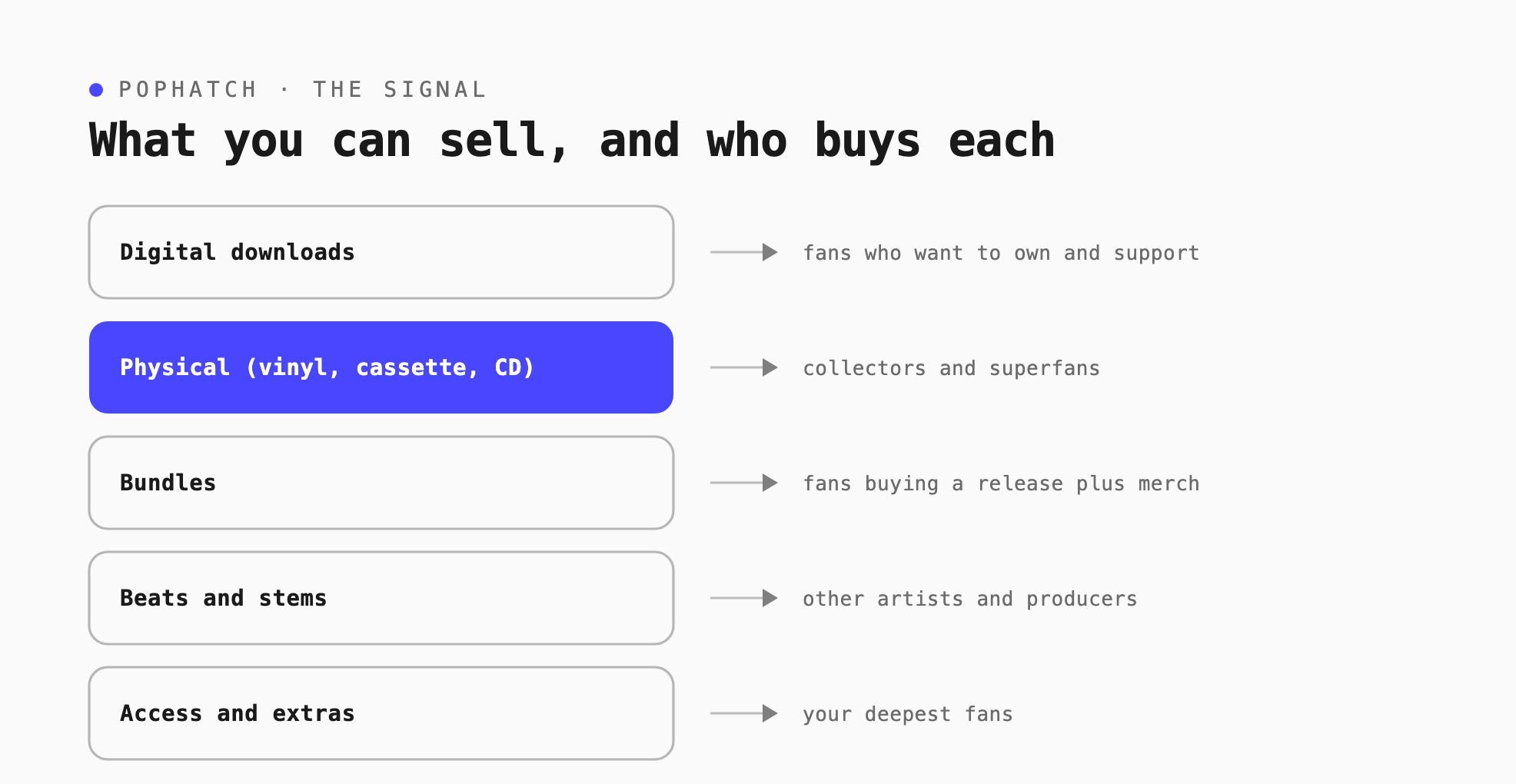
A map of what musicians can sell and who buys each format. Digital downloads suit fans who want to own the music and support you. Physical formats like vinyl, cassette, and CD suit collectors and superfans. Bundles suit fans buying a release plus merch together. Beats and stems suit other artists and producers. Access and extras like signed and limited editions suit your deepest fans.
The unifying idea is that people buy what they cannot get from a stream: an object, a limited run, a piece of the artist. A download competes with free access and sells modestly. A hand-numbered cassette or a signed vinyl competes with nothing, because owning it is the point. Matching the format to what your specific fans value is the difference between a store that sells and one that sits quiet.
Where Does Selling Music Pay the Most?
Selling pays most where you keep the largest share and own the fan relationship, which almost always means direct-to-fan rather than a marketplace. The channel you choose sets both your cut and how much you learn about your buyers, and both matter for a career.
Here is how the main channels compare as of August 2026.
Channel | What you sell | Their cut | Best for |
Bandcamp | Digital, physical, merch | 15% digital (10% after $5,000), 10% physical, plus processing | Direct sales with a built-in music-buying audience |
Your own store (Shopify) | Physical, merch, bundles | Monthly fee, plus card processing; low transaction fees | Serious merch and physical operations at volume |
Your own store (Fourthwall) | Merch, digital, memberships | No monthly fee; 0% on products, 5% on memberships and digital | Creators who want a free storefront centered on merch |
Download stores (via distributor) | Digital downloads | Set by distributor plan | Being available where some fans still buy downloads |
Beat marketplaces | Beats, stems, licenses | Varies by platform and plan | Producers selling to other artists |
Platform fees change; Bandcamp's rates come from Bandcamp's published fees, and Shopify and Fourthwall figures from their pricing pages, as of August 2026. Confirm current terms before choosing.
The pattern is that direct channels pay best and teach you most. Bandcamp is the standout for music specifically, because it pays out a high share, supports both digital and physical, and its monthly Bandcamp Fridays waive its cut entirely, sending nearly the whole sale to you. Your own store maximizes control and margin at higher volume, with the tradeoff of setup and, for Shopify, a monthly fee. Download stores reached through your distributor keep you available to the shrinking group who still buy downloads. Marketplaces are convenient but take more and hand you less of the customer relationship, which is the asset that compounds.
How to Sell Music on Bandcamp
Bandcamp is the most artist-friendly place to start selling music, because it combines high payouts, digital and physical support, and an audience that arrives ready to buy. Setting up a store takes an afternoon, and the platform is built around the direct artist-to-fan sale rather than an algorithmic feed.
The setup, in order:
Create an artist account and upload your music. Add high-quality audio, artwork, and credits for each release.
Set your prices. You can set fixed prices or allow fans to pay more than the minimum, which many do. Name-your-price with a floor is a proven approach for building goodwill and revenue at once.
Add physical items. List vinyl, cassettes, CDs, or merch, with inventory and shipping. Physical sales carry Bandcamp's lower 10 percent cut.
Connect payments. Link your payment account so sales pay out to you, minus Bandcamp's share and payment processing.
Sell on Bandcamp Fridays. On these recurring days, Bandcamp waives its revenue share, so time bigger releases and push your audience to buy then.
Bandcamp's fees are 15 percent on digital, dropping to 10 percent once you pass $5,000 in sales, and 10 percent on physical goods, plus payment processing, which leaves you with a large share of every sale. The reason it works so well for smaller artists is that its buyers are people who deliberately came to purchase music rather than passive listeners, so conversion is high relative to sending fans to a general storefront.
When Should You Build Your Own Store?
Build your own store when merch and physical products become central to your income and you want full control of margin, branding, and customer data, rather than at the very start. For most artists, Bandcamp covers early music sales well, and a dedicated store earns its keep once you are selling enough physical product for the extra control to pay off.
The two common choices split by cost model. Shopify charges a monthly fee and gives you a full commerce platform with low per-transaction costs at volume, which suits an artist running a serious merch operation with inventory, variants, and shipping. Fourthwall charges no monthly fee and takes nothing on products, making money on a margin built into fulfillment, and centers on merch and creator storefronts, which suits an artist who wants a free, low-overhead store. The full tradeoff is worth its own comparison, and Fourthwall and Shopify compared covers which fits which stage.
The deciding factor is where your money comes from. If music downloads and the occasional physical release are your sales, Bandcamp's cut is cheaper than a monthly store fee, so stay there. If merch is becoming a genuine revenue line with volume, a dedicated store's control and margin start to win. Many artists run both: Bandcamp for music, a dedicated store for merch, which is a perfectly reasonable setup rather than a compromise.
What About Selling Beats?
Producers sell beats through a different channel than artists selling songs, because the customer is another creator and the product is a license rather than a finished record. If you make beats, this is a direct business with its own platforms and its own pricing logic, and it can run alongside or instead of releasing your own tracks.
Beat sales usually work through specialized marketplaces built for the purpose, where you upload beats, set license tiers, and sell to artists who want to record over them. Pricing is tiered by license: a basic lease costs less and limits usage, while exclusive rights cost more and transfer the beat to one buyer. The platforms offer free and paid plans, with free tiers typically taking a larger cut and paid tiers lowering it, so the right plan depends on your sales volume.
Beat-marketplace plans and fees vary by platform and change over time; check the current terms on each platform before committing, and read what each license tier grants your buyers.
The principle that carries over from the rest of this guide: selling beats directly to the artists who use them pays far better than hoping beat-driven tracks earn through streaming. A single exclusive license can pay more than a track's lifetime of streams, and even non-exclusive leases add up across a catalog of beats. For producers, this is often the most direct path from skill to income, and it fits neatly into the full revenue stack alongside any releases of your own.
Do This Now: Open Your First Sales Channel
You can open a functioning store this week and give your existing fans somewhere to spend, which is often the fastest new income an artist can add. Work through it in order.
Pick your primary channel. If music is what you sell, start with Bandcamp. If merch is central, consider a dedicated store. Choose one to launch first rather than all at once.
Create one thing worth owning. A name-your-price download, a small vinyl or cassette run, or a single strong merch item. It does not need to be a full catalog, just one solid product.
Price it for ownership. Price the physical item where a superfan is glad to pay, often $25 to $40 for vinyl, and set a fair floor on digital. Fans routinely pay above the minimum when you let them.
Announce it to your direct channel first. Email and message your warmest fans before posting publicly, because your superfans convert highest and their early orders create momentum.
Time a push to Bandcamp Friday. If you are on Bandcamp, aim a bigger release or restock at a Bandcamp Friday so nearly the whole sale reaches you.
A shape for how this goes. A singer with 12,000 monthly listeners and a 600-person email list has never sold anything directly. She presses 100 cassettes, lists them on Bandcamp at $18 with a name-your-price digital album alongside, and emails her list two days before Bandcamp Friday. The cassettes sell out that weekend and the digital album earns more than a month of streams, because a few hundred people who already chose her were waiting for something to buy. The audience was always there. The store was the missing part.
Knowing which format your specific fans will buy, and when to open your own store, is exactly the read the artist business partner prepares. PopHatch watches how deep your audience runs and where it clusters, and helps you plan your monetization so you open the sales channel your fans are ready for. It prepares the plan. You run the store, because the fan relationship is yours to own.
___
Streaming spreads your music; selling is how it pays, and it works at audience sizes far smaller than the stream counts suggest. PopHatch is the artist business partner that reads what your fans will buy and prepares the channel to sell it. Start your free trial at pophatch.com.
Frequently Asked Questions

Written by
Oana Ruxandra
Founder & CEO, PopHatch
Oana Ruxandra is the founder and CEO of PopHatch, the artist business partner. She spent fifteen years inside the music industry, ending as Chief Digital Officer at Warner Music Group, where she grew digital revenue by $2B and negotiated first-of-their-kind deals with Apple, Spotify, YouTube, Amazon, Meta, and TikTok. She writes about the business of music from the inside, for the artists building careers on their own terms.