Oana Ruxandra, CEO of PopHatch. Former Chief Digital Officer at Warner Music Group.

Merch is where a modest audience turns into meaningful money, and the platform you sell it on quietly decides how much of that money reaches you and how much work you take on. Fourthwall and Shopify sit at opposite ends of that tradeoff, and choosing between them is a question about your stage.
Fourthwall is the better fit for most musicians starting or running merch, because it has no monthly fee, includes print-on-demand fulfillment, and takes 0 percent on products, making its money on a margin built into product cost. Shopify is the better fit once merch is a serious operation, because it gives full control, deeper features, and lower per-item costs at volume, in exchange for a monthly fee starting around $29 to $39 and needing a separate print-on-demand app. Fourthwall trades a slice of margin for simplicity and zero risk; Shopify trades a monthly cost and setup for scale and ownership. Match the store to where your merch is. Neither is universally better; they suit different stages.
I have seen artists lose meaningful margin by running a full commerce platform before they had the volume to justify it, and others cap their growth by staying on a simple tool too long. The right answer moves as you grow. This guide compares the two on cost, fulfillment, control, and fit, so you pick the one your merch is ready for. Platform terms come from each company's own pages and can change.
Fourthwall vs Shopify: The Short Answer
Choose Fourthwall if you want to start selling merch with no upfront cost and no fulfillment headaches, and choose Shopify if you are running a high-volume store and want maximum control. That is the decision in one sentence, and the rest of this guide is the reasoning behind it, because the two platforms are built on very different models.
Fourthwall is a creator-first platform that bundles the storefront, print-on-demand production, and fulfillment into one free-to-start product. You design merch, Fourthwall makes and ships it when an order comes in, and it earns by building a margin into the base cost of each product rather than charging you a monthly fee. For an artist, that means no inventory, no upfront money, and no risk, in exchange for a somewhat thinner margin per item.
Shopify is a full commerce platform built for any business rather than only creators. It gives you a powerful, customizable store and low per-transaction costs, but it charges a monthly subscription and leaves fulfillment to you, whether that is holding inventory or connecting a separate print-on-demand app. For an artist, that means more control, more features, and better margins at volume, in exchange for a monthly cost and more to set up and manage.
How the Costs Compare
The cost difference is structural: Fourthwall has no fixed cost and a built-in margin, while Shopify has a fixed monthly cost and a margin you control. Which is cheaper depends entirely on your sales volume, which is why stage matters more than the sticker prices.
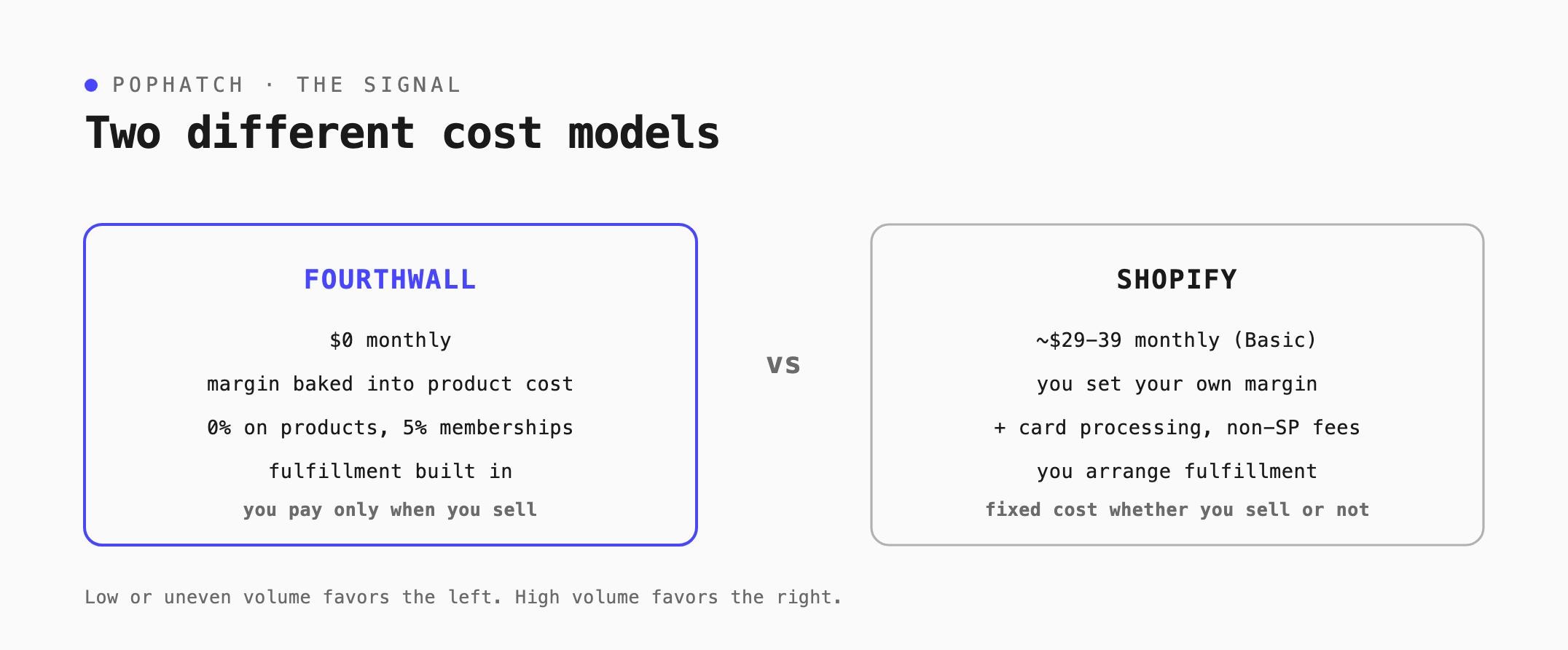
A two-column cost-model comparison. Left column, Fourthwall: $0 monthly, a margin baked into each product's base cost, 0% on products, 5% on memberships and digital. A note reads: you pay only when you sell. Right column, Shopify: a monthly fee from about $29 to $39, plus your chosen product margin, plus card processing and non-Shopify-Payments transaction fees. A note reads: fixed cost whether you sell or not. A caption reads: low volume favors the left, high volume favors the right.
Here is the detail as of August 2026.
| Fourthwall | Shopify |
Monthly fee | $0 | ~$29–$39 (Basic) up to $299 (Advanced) |
Cut on product sales | 0%; margin built into base cost | 0% platform fee; you set your margin |
Transaction fees | Included | Card processing, plus 2.0%/1.0%/0.6% if not using Shopify Payments |
Memberships / digital | 5% | Via apps, which set their own fees |
Fulfillment | Built in (print-on-demand) | You arrange it (inventory or a POD app) |
Prices and fees change; figures come from Fourthwall's pricing and Shopify's pricing as of August 2026, with Shopify's lower monthly rates reflecting annual billing. Confirm current terms and remember payment processing applies on both.
The way to read this: Fourthwall costs nothing until you sell and then takes its share through product margin, so a low or uneven sales month costs you zero. Shopify costs its monthly fee whether you sell ten items or a thousand, and rewards you with better per-item economics once volume is high enough that the subscription is a small fraction of revenue. There is a crossover point where Shopify's model wins, and below it Fourthwall's model wins, which is exactly why the recommendation tracks your stage rather than naming one champion.
Fulfillment: Who Makes and Ships Your Merch?
Fulfillment is the biggest practical difference between the two, because Fourthwall handles it for you and Shopify leaves it to you to arrange. For a busy artist, this often matters more than the fee math, since it determines how much operational work the store adds to your life.
Fourthwall includes print-on-demand fulfillment in the platform. You pick products from its catalog, upload your designs, and when a fan orders, Fourthwall produces and ships the item and handles customer service on fulfillment. You never touch inventory or a shipping label, which removes the single most common reason artist merch stalls: the logistics.
Shopify does not fulfill anything itself. You either hold inventory and ship orders, which means buying stock upfront and packing boxes, or you install a print-on-demand for musicians app like Printful or Printify that produces and ships on demand, taking its own cut on top of your Shopify subscription. That adds a layer to set up and a second margin to account for, though it also opens a far wider product range and supplier choice than a single built-in catalog.
The tradeoff is convenience against range and control. Fourthwall's built-in fulfillment is the fastest path from idea to a live store with no upfront spend. Shopify plus a fulfillment solution is more work and more cost to stand up, and it gives you more products, more suppliers, and the option to hold your own inventory for better margins and quality control once volume justifies it.
Control, Branding, and Scale
Shopify wins decisively on control and scale, while Fourthwall wins on speed and simplicity, and this is the tradeoff that eventually pushes growing artists to switch. The question is how much of a custom, owned commerce operation you need versus how quickly you want to be selling.
Shopify is a professional commerce platform, so it offers deep customization of your store's design, a large app ecosystem for everything from email to upsells, strong analytics, multi-channel selling, and the infrastructure to handle high order volumes and complex catalogs. If you envision merch as a serious business with its own brand, inventory, and growth, Shopify is built for that ceiling. The cost is complexity and the monthly fee, and the reality that you are configuring a store rather than filling in a creator template.
Fourthwall is built for creators specifically, so it trades some of that depth for a workflow an artist can run alone in an afternoon. It includes a clean storefront, print-on-demand, digital products, and a fan subscription-style membership option in one place, aimed at the artist who wants to sell merch and connect with fans without becoming an operations manager. The cost is a lower ceiling on customization and scale, which most artists do not hit for a long time, if ever.
The honest summary: Fourthwall's limits are the kind you grow into slowly, and Shopify's power is the kind you grow into only once merch is substantial. For the artist selling their first shirts and records, Fourthwall's simplicity is the advantage. For the artist running a five-figure-a-year merch line, Shopify's control starts to pay for itself.
Which Should You Choose? A Decision Guide
Choose based on your merch volume, your appetite for setup, and whether merch is a side income or a core business, and the answer will be clear once you place yourself. Most artists should start on Fourthwall and consider Shopify later, which is a progression rather than a mistake in either direction.

A decision tree for choosing a merch platform. First question: are you just starting merch or do you want zero upfront cost and no fulfillment work? Yes leads to Fourthwall. No, with a second question: is merch a high-volume, core business where you want full control and your own inventory? Yes leads to Shopify. A middle branch notes: many artists start on Fourthwall and migrate to Shopify as volume grows.
Use these guidelines.
Choose Fourthwall if you are starting merch, want no monthly cost, prefer built-in fulfillment, sell modest or uneven volume, or want merch and memberships in one simple place.
Choose Shopify if merch is a serious, high-volume line, you want full control of branding and data, you plan to hold inventory for better margins, or you are selling well beyond merch and need a full commerce platform.
Consider both over time if you expect to grow: start on Fourthwall to launch without risk, then migrate to Shopify when volume makes the monthly fee a small share of revenue and the extra control pays off.
The trap to avoid in both directions: do not pay for Shopify's power before you have merch volume to use it, and do not cap a growing merch business on a simpler tool out of inertia. The platform should match the stage, and the stage changes, so revisit the choice as your merch grows rather than treating the first decision as permanent.
Do This Now: Launch Your Merch This Week
You can have a working merch store live in an afternoon, and for most artists the fastest, lowest-risk path is the right first move. Run this.
Assess your stage honestly. Are you launching your first merch, or scaling an established line? First merch or modest volume points to Fourthwall; a serious operation points to Shopify.
Start with one strong product. A single well-designed item, a shirt, a hoodie, or a hat that fans would wear, beats a cluttered store. Design for your identity rather than a generic logo slap.
Set it up on your chosen platform. On Fourthwall, pick the product, upload the design, set your price, and publish, with no upfront cost. On Shopify, subscribe, connect a fulfillment app, and build the product page.
Price for margin and fandom. Account for the base cost or fulfillment fee, then price where a superfan is glad to pay. Merch is an identity purchase, so a well-designed $35 item outsells a cheap generic one.
Announce to your direct channel first. Email and message your warmest fans before posting publicly, because they convert highest and their early orders create the momentum everyone else responds to.
A shape for how this goes. A band with 15,000 monthly listeners and no merch wants to test demand without risking money on inventory. They open a Fourthwall store, upload one hoodie design, price it at $45, and email their list. Thirty hoodies sell the first week with zero upfront spend, because Fourthwall produced and shipped each one on demand. A year later, selling several hundred items a month across five products, they migrate to Shopify for the better margins and control that volume now justifies. Each platform was right for its stage.
Deciding which platform fits your stage, and when the crossover to a bigger one arrives, is exactly the read the artist business partner prepares. PopHatch watches your merch volume and audience depth and helps you plan your monetization so the store matches where you are. It prepares the decision. You build the store, because the brand and the fan relationship are yours to own.
___
Merch turns a modest audience into meaningful income, and the platform decides how much reaches you. PopHatch is the artist business partner that reads your volume and stage and prepares the call on which store fits. Start your free trial at pophatch.com.
Frequently Asked Questions

Written by
Oana Ruxandra
Founder & CEO, PopHatch
Oana Ruxandra is the founder and CEO of PopHatch, the artist business partner. She spent fifteen years inside the music industry, ending as Chief Digital Officer at Warner Music Group, where she grew digital revenue by $2B and negotiated first-of-their-kind deals with Apple, Spotify, YouTube, Amazon, Meta, and TikTok. She writes about the business of music from the inside, for the artists building careers on their own terms.