Oana Ruxandra, CEO of PopHatch. Former Chief Digital Officer at Warner Music Group.
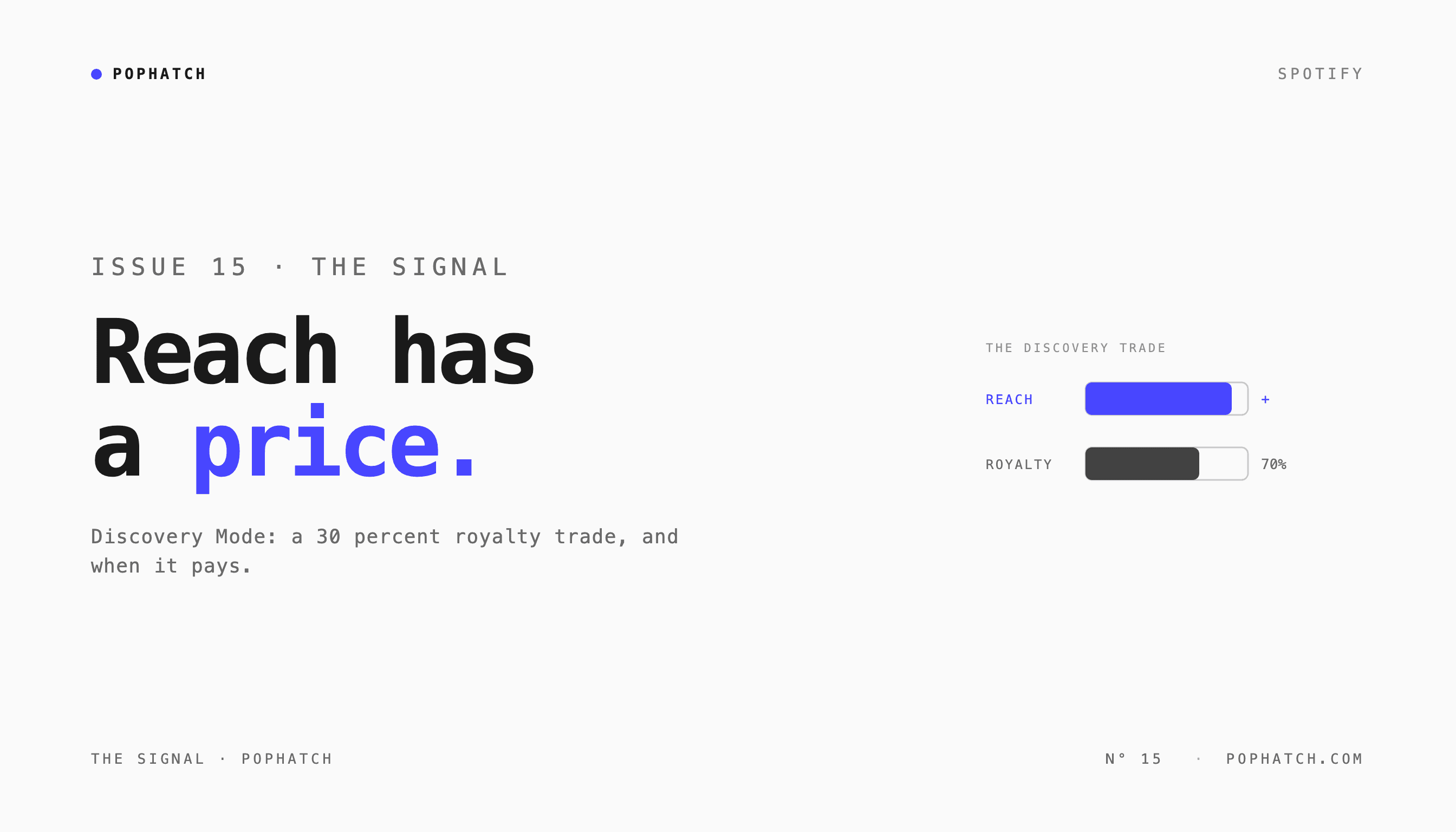
Discovery Mode is the promotion tool artists argue about most, and the argument usually skips the only question that matters. The tool has a price, the price is unusual, and whether it pays depends on math you can run in five minutes.
Spotify Discovery Mode is an opt-in promotion tool that makes a selected track more likely to be recommended in algorithmic contexts like Radio and Autoplay. It costs nothing upfront. Instead, Spotify applies a 30 percent commission to the recording royalties from streams of that track in Discovery Mode contexts, while every other stream keeps paying in full. A track qualifies once it has been on Spotify at least 30 days, drew at least 20 streams in those contexts in the last 28 days, and meets monetization criteria. Discovery Mode earns its keep when new-listener discovery is the goal and the boosted streams are streams you would never have gotten otherwise. It costs you when it mostly discounts listening that would have happened anyway. The tool is a trade, and the artist who names the trade wins it.
Every promotion a label buys has a price tag attached, and the discipline is always the same: name the price, name the return, and decide like an investor. Discovery Mode simply writes its price in royalties instead of dollars, which is why so many artists misread it as free.
Here is how it works, what the commission really costs, and a clean way to decide.
What Is Spotify Discovery Mode?
Spotify Discovery Mode is a feature inside Spotify for Artists that lets you flag a track as a priority for Spotify's recommendation algorithm. When the algorithm assembles listening in contexts like Radio, Autoplay, and algorithmic mixes, a flagged track becomes more likely to be chosen for listeners who have never heard you.
The design has one honest virtue: it points at strangers. Discovery Mode contexts are the lean-back surfaces where Spotify picks the music, which is where new listeners meet new artists. A boost there is a boost in front of people outside your existing audience, which is a different job from a playlist your fans already follow.
Participation is per-track and per-month. You turn it on for chosen songs, the algorithm weighs them more heavily in those contexts, and you can turn it off. Nothing about the deal touches your streams from searches, profiles, saves, or playlists, which continue exactly as before.
What Does Discovery Mode Cost?
Discovery Mode costs a 30 percent commission on the recording royalties from streams of the selected track in Discovery Mode contexts, and nothing anywhere else. Spotify's Discovery Mode terms state it plainly: no upfront budget, and a 30 percent commission applied to recording royalties generated from streams of selected songs in those contexts.
Put numbers on the shape. Since Spotify pays from a pool rather than a fixed rate, use the working estimate from how Spotify pays artists of roughly 3 to 5 dollars per thousand streams. A thousand Discovery Mode streams pay about 70 percent of that, call it 2.10 to 3.50 dollars. The 30 percent slice is the fee, collected only when the promotion produces listening. To see what your full stream count pays before the fee, run it through the free royalty calculator.
The subtlety that decides everything: the commission applies to streams of the selected track in those contexts whether or not the algorithm would have played it there anyway. Radio and Autoplay already serve your music to some listeners at full rate. Turn Discovery Mode on, and the boosted contexts pay 70 percent across the board for that track. The true cost is the discount on listening you already had, plus 30 percent of the new listening, which is why the math favors tracks with little existing Radio and Autoplay traffic and punishes tracks that already live there.
Discovery Mode's commission, contexts, and eligibility rules were verified on Spotify's pages in July 2026 and can change; confirm the current terms before enrolling a track.

Trade diagram for Spotify Discovery Mode: the algorithm serves your flagged track to more new listeners in Radio, Autoplay, and mixes, and in exchange those context streams pay 70 percent of the recording royalty, while all other streams keep paying in full.
Who Is Eligible for Discovery Mode?
A track becomes eligible once it has age, a pulse, and monetization standing. Spotify's stated criteria: the song has been on Spotify for at least 30 days, it was streamed at least 20 times in Discovery Mode contexts in the last 28 days, and it met the platform's monetization eligibility rules. Access also depends on your distributor or label participating in the program.
Read those criteria as a message about what the tool is for. A release younger than 30 days cannot enroll, so Discovery Mode is a catalog tool rather than a launch tool. Release week belongs to editorial playlist pitching, Release Radar, and your own push. Discovery Mode picks up later, when a song has settled and you want the algorithm to keep introducing it.
The 20-streams requirement tells you the algorithm needs something to work with. Discovery Mode amplifies existing recommendation activity rather than creating it from nothing, so a track with zero Radio presence has nothing to amplify. The tool rewards songs the algorithm already treats as viable.
When Is Discovery Mode Worth It?
Discovery Mode is worth it when new listeners are the goal, the track has room to grow in algorithmic contexts, and a 30 percent discount on those streams costs less than the discovery is worth to you. It is a poor deal when the track already earns heavily in those contexts or when this month's royalty income is the priority.
The cleanest way to see it is by scenario.
Scenario | What happens | Verdict |
Older track, small but steady Radio presence, goal is new fans | Boost mostly adds strangers; discounted streams are mostly incremental | Strong fit |
Deep catalog track that stalled | Algorithm re-introduces it; little existing context traffic to discount | Good test |
Track already carried by Radio and Autoplay | Commission discounts a large existing stream base for a modest boost | Poor fit |
Artist who needs every royalty dollar this month | 30 percent off a chunk of streams hits cash flow now | Skip for now |
Brand-new release | Ineligible until 30 days old | Use the release playbook instead |
The deeper logic: a new listener is worth more than one stream. A stranger who meets you in Radio and saves the track begins a relationship that pays at full rate for years, so paying 30 percent of a fraction of a cent to start it can be excellent business. That only holds when the listeners are new to you, which is exactly what the trade should be judged on.

Decision tree for Spotify Discovery Mode: if the track is under 30 days old, it is ineligible, so run the release playbook; if the track already earns heavily in Radio and Autoplay, skip, because the commission discounts streams you already had; if the track is older with room to grow and your goal is new listeners, run a one-month test and read the results.
What Results Should You Expect?
Expect a visible lift in context streams while enrolled, and judge the campaign on what rides along with the lift: new listeners, saves, and follows. Spotify has reported meaningful average gains in saves, playlist adds, and followers for participating artists, and independent reports commonly describe context-stream increases ranging from modest to several times baseline while a campaign runs.
Two patterns in the results tell you almost everything. The first is lift with engagement: streams up, and listeners, saves, and follows climbing with them. That pattern means the algorithm found people who want you, and the 30 percent commission bought relationships that keep paying at full rate. The second is lift without engagement: streams up, everything else flat. That pattern means the algorithm found placements rather than fans, and the commission is buying discounted plays with no compounding value.
Expect the effect to fade when you unenroll, because the boost is a weighting rather than a lasting change to your profile. What persists is whatever engagement the boosted period created: the saves keep resurfacing you in personal mixes, the follows keep feeding Release Radar, and the listeners who converted stay converted. Judge Discovery Mode by what remains after it is off, which is the cleanest measure of whether the reach was worth the price.
How Do You Run a Discovery Mode Test?
You run Discovery Mode the way you would run any paid campaign: one track, one month, numbers written down before and after, and a decision rule set in advance. The test costs little and settles the argument with your own data.
Pick one eligible track, ideally an older song with modest Radio and Autoplay activity and headroom to grow.
Record the baseline before enrolling: last 28 days of streams, listeners, saves, and followers, plus streams from Radio and Autoplay specifically, all visible in Spotify for Artists.
Enroll for one full month and change nothing else about how you promote that track, so the read stays clean.
Compare the same numbers after 28 days. The questions: how many additional context streams appeared, how many listeners were new, and did saves and follows rise with them.
Apply the decision rule you set at the start. A working rule: continue if new listeners and saves grew meaningfully beyond baseline, stop if the streams grew without engagement, because streams without saves are the discounted kind that never compound.
A scenario shows the shape. An artist enrolls a year-old track that draws 2,000 context streams a month. The test month shows 6,000, with listeners up 1,800 and saves up 240. The commission cost roughly a third of the royalties on those context streams, a few dollars, and bought 1,800 strangers, of whom 240 saved the track because they want more. That is a trade worth continuing. If the same test had shown 6,000 streams and 15 saves, the boost was empty calories, and off it goes.
Reading a test like that across platforms, baseline, lift, engagement quality, verdict, is the exact work PopHatch does with you. The artist business partner tracks the numbers, frames the trade, and prepares the call, so tools like this one get used on evidence rather than vibes. The habit starts with learning to read your audience, because every promotion decision is downstream of knowing who is already listening.
___
Discovery Mode is a trade: reach for royalties. Naming the price and reading the return is the work, and PopHatch is the artist business partner that runs that read with you, across every tool the platforms offer. Join the waitlist at pophatch.com.
Frequently Asked Questions

Written by
Oana Ruxandra
Founder & CEO, PopHatch
Oana Ruxandra is the founder and CEO of PopHatch, the artist business partner. She spent fifteen years inside the music industry, ending as Chief Digital Officer at Warner Music Group, where she grew digital revenue by $2B and negotiated first-of-their-kind deals with Apple, Spotify, YouTube, Amazon, Meta, and TikTok. She writes about the business of music from the inside, for the artists building careers on their own terms.