Oana Ruxandra, CEO of PopHatch. Former Chief Digital Officer at Warner Music Group.

The question rarely arrives on a bad day alone. It arrives after a run of them, when a release you believed in lands quiet, the numbers refuse to move, and the effort stops feeling like it points anywhere. That flat feeling is not imagined, and it deserves a better answer than a pep talk.
If you're asking whether to quit music, the honest first move is to stop treating it as one question. "Should I quit" usually hides three separate ones: am I burned out, is my approach misaligned, or am I done. Each has a different answer and a different fix. Burnout calls for rest, misalignment calls for a changed method, and a true ending is a valid choice you get to make on purpose. Before you decide any of it, run one small test, because a decision made inside a bad month is a decision made without evidence. Naming which of the three you're in is most of the work.
Your confusion here is not a character flaw. It is a design problem, and design problems have steps. This piece will not talk you into staying or out of it. It will give you a way to tell what is stuck, so the choice you make is yours and it fits the facts.
Why Does "Should I Quit Music" Feel So Loud Right Now?
The question gets loud when effort and evidence fall out of sync. You keep releasing, posting, and practicing, and the feedback loop that used to reward that effort has gone quiet. The brain reads silence as failure, and after enough silence it proposes the biggest available lever: stop everything.
Two things make the feeling louder than the facts warrant. The first is that music gives delayed, noisy feedback. A song can find its audience months after release, and a quiet launch says almost nothing about the work itself. The second is comparison. Every platform shows you peers at their peak moment, edited for the feed, and measuring your ordinary Tuesday against someone else's highlight reel produces a verdict that no honest scoreboard would.
None of that means the feeling is wrong to have. It means the feeling is a smoke alarm, useful for telling you something needs attention, unreliable for telling you what. The next sections separate the causes.
Is It Burnout, Misalignment, or a Genuine Ending?
Most "should I quit" moments are one of three states wearing the same clothes, and telling them apart is the entire game. Burnout is depletion: you still love the music and have nothing left to give it. Misalignment is a strategy problem: the work is good and the approach around it is aimed at the wrong room. A genuine ending is when the wanting itself has quietly left, and that is allowed.
Here is how each one tends to feel and what it asks for.
State | What it feels like | What's true underneath | The right response |
Burnout | Exhausted, resentful, dreading the work you used to crave | The desire is intact; the tank is empty | Rest first, decide later. Nothing structural, yet |
Misalignment | Working hard, going nowhere, confused rather than tired | The music may be landing in the wrong room | Change the method rather than the medium |
Genuine ending | Calm relief when you imagine stopping, not grief | The wanting has moved on | Choose to stop, cleanly and without shame |
Read your own reaction to the table, because the tell is emotional. Imagine setting the music down for good. Burnout imagines it and feels guilty and antsy, still pulled toward the work. A genuine ending imagines it and feels lighter, like a weight set down. Misalignment imagines it and feels furious, because the problem was never the wanting, it was the not-landing.
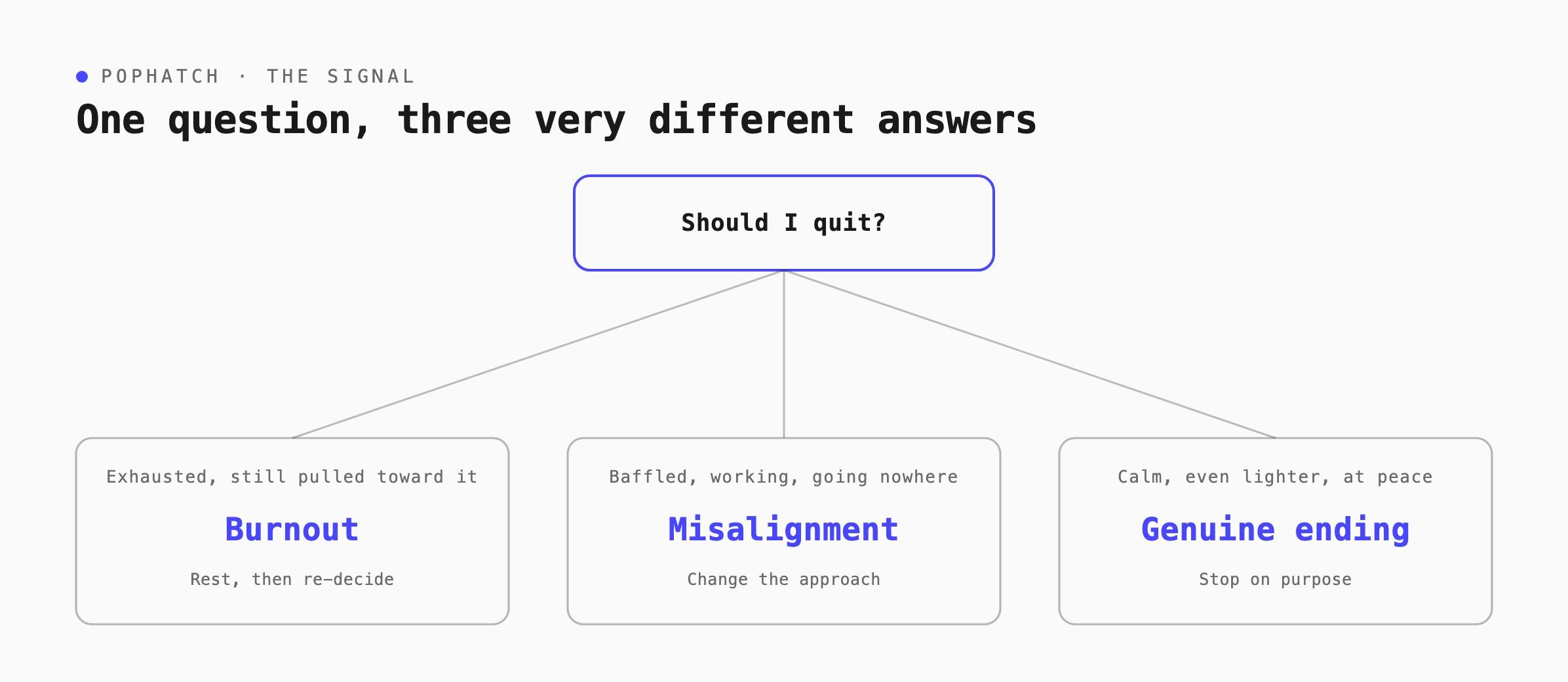
A fork diagram splitting the single question "Should I quit?" into three separate paths: Burnout leads to "rest, then re-decide," Misalignment leads to "change the approach," and Genuine ending leads to "stop on purpose." Each path shows its distinguishing feeling.
The reason this matters: each state has a wrong response that people reach for by default. Quitting during burnout throws away a career over a tired season. Resting during misalignment wastes months waiting for energy to fix a problem energy was never going to fix. Pushing harder during a genuine ending is how people spend years resenting a thing they were done with. Match the response to the state.
What If It's Burnout?
If the desire is intact and the tank is empty, the answer is recovery before any decision. Burnout distorts judgment in one specific direction: it makes everything feel permanent and personal. Decisions made from that place tend to be the ones people regret, which is why the first rule is simple. Do not quit anything important while depleted.
Recovery for musicians is rarely a beach vacation. It is subtraction. Cut the release you scheduled out of obligation. Mute the accounts that make you feel behind. Give yourself permission to make something with no plan to release it, because burnout often comes from turning every creative act into a marketing input. The play has to be play again for a while.
Reach outward too, because isolation makes depletion worse and the music world has built serious support for this. MusiCares and Backline both offer mental-health and wellness resources specifically for people who work in music, and using them is a professional move rather than a last resort. A tired artist who rests and reconnects usually finds, four to six weeks later, that the quit question has quietly answered itself.
What If Your Career Is Stuck?
If you're not tired so much as baffled, working steadily while nothing grows, you are probably looking at misalignment, and misalignment is fixable without quitting anything. The music can be good and the result still flat, because results depend on the music reaching the right listeners, in the right context, often enough to compound. Any link in that chain can break while the song stays fine.
Treat "not moving" as a diagnosis to run rather than a verdict to accept. The usual suspects are few. The audience might be wrong: the people hearing you are not the people built to love this, which is a targeting problem rather than a talent one. The positioning might be blurry: listeners can't tell in three seconds what you are or why you, which is how you show up rather than what you make. The consistency might be missing: attachment forms across repeated contact, and long gaps reset the clock every time. Or the definition of "moving" might be borrowed: chasing monthly listeners while ignoring the smaller group who already chose you, the fans who show up and spend.
Notice that every one of those has a next action attached, and none of them is "give up." Misalignment is the most common state behind the quit question and the most fixable, which is the good news hiding inside a frustrating month.
What If You Want to Stop?
Sometimes the honest answer is that you're ready to stop, and that is a legitimate outcome rather than a failure. People change. The version of you who needed to make records may have gotten what they came for, and choosing to close that chapter on purpose is a form of respect for the work rather than a betrayal of it.
A clean ending looks different from a burnout collapse. It's calm. You imagine the space after music and feel curiosity instead of dread. If that is where you are, a few moves make the ending kind to your future self. Release or archive the unfinished work so it exists somewhere. Keep your rights and registrations in order so any catalog income keeps finding you. Tell the people who supported you, because endings deserve the same honesty as launches. Music will still be there if you ever want it back, and plenty of people return on their own terms after years away.
The point of separating this from burnout is that only one of them should end a career, and it is the rare one. Make sure the ending you're considering is the calm kind before you act on it.
How Do You Decide Without Guessing? Run One Small Test?
Whatever state you're in, do not make the call inside the bad month. Make it after one small experiment, because a single piece of evidence beats a spiral every time. The goal is to turn a vague, heavy feeling into a specific question you can answer in two or three weeks.

A four-step reset loop: name the loudest feeling, isolate one variable to test, run a two-to-three-week experiment, then decide from the result. An arrow returns from "decide" to "name," showing the loop repeats.
Run it like this.
Name the state. Use the table above and your gut reaction to the "set it down" test. Write one sentence: burnout, misalignment, or ending. This alone dissolves half the fog.
If burnout: schedule two weeks of genuine subtraction before you touch the decision. No releases, no metrics, one thing made purely for you. Then re-read this list.
If misalignment: pick the single most likely broken link, audience, positioning, or consistency, and change only that for one release cycle. New audience targeting, or a sharper one-line description, or a four-week posting rhythm. One variable, so the result means something.
If ending: sit with it for two quiet weeks and notice whether the relief holds. Calm that lasts is your answer. Restlessness that returns means it was burnout wearing an ending's face.
Decide from the result rather than the mood. Whatever the test shows, that is your evidence. Then run the next small test, because a career is a sequence of these rather than a single verdict.
A shape for how this goes. A songwriter with 6,000 monthly listeners spends a winter certain she should quit. She names it: not tired, just baffled, so misalignment. She changes one variable, retargeting her ads from a broad indie audience to the specific sub-scene her lyrics speak to, and holds everything else steady for one release. Six weeks later the save rate has doubled off the same songs. The music was never the problem. The room was. The quit question does not survive contact with that evidence.
When Staying Is the Right Call, What Makes It Sustainable?
If the test points toward staying, the way to keep the quit question from returning every quarter is to stop running your career on vibes and start running it on a loop you can see. The despair usually comes from working without feedback, so build the feedback in. Small, deliberate tests. A clear picture of which fans already chose you. An honest read of what the work can pay so effort connects to a livable outcome rather than an open-ended hope.
That reframe is the whole shift: from a career that either magically takes off or doesn't, to a series of decisions you get to make with evidence in front of you. Decisions have off weeks. Identities have crises. It is easier to survive a slow month when it is a data point instead of a referendum on your worth.
This is the exact place the artist business partner is built to stand. PopHatch keeps the loop visible across months, reads which experiments moved something and which didn't, and prepares the next small test so the choice in front of you is always specific. It won't tell you whether to stay or go. It makes sure that when you decide, you're deciding from evidence rather than from the loudest feeling in a hard week.
___
A quiet month is a data point rather than a verdict. PopHatch is the artist business partner that keeps your feedback loop visible and prepares the next small test, so the decision to keep going or step back is always yours and always informed. Start your free trial at pophatch.com.
Frequently Asked Questions

Written by
Oana Ruxandra
Founder & CEO, PopHatch
Oana Ruxandra is the founder and CEO of PopHatch, the artist business partner. She spent fifteen years inside the music industry, ending as Chief Digital Officer at Warner Music Group, where she grew digital revenue by $2B and negotiated first-of-their-kind deals with Apple, Spotify, YouTube, Amazon, Meta, and TikTok. She writes about the business of music from the inside, for the artists building careers on their own terms.